As the party leaders head off around the country canvassing voters, behind the scenes in Westminster backroom staff are eagerly preparing themselves for the another of the British Parliamentary peculiarities, the infrequent and arcane ritual of the parliamentary "wash-up".
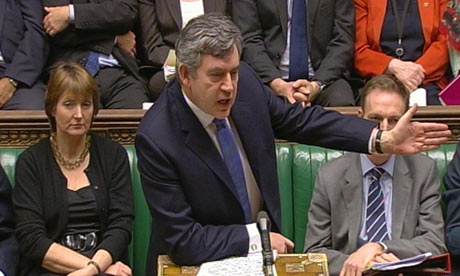
 The leader of the House of Commons, Harriet Harman, left, will shortly propose an emergency business motion to MPs designed to rush through as many of the outstanding bills into statute in the two days before Parliament is officially dissolved.
While legislation may now be "carried forward" from one parliamentary session to the next, it cannot be carried forward between parliaments. All bills not passed on the date when the House rises for the last time this year will be lost.
Since some of the legislation is non-controversial, and some financial legislation is essential to keep the country running, this is not an altogether brilliant outcome. Therefore, Parliament has evolved a mechanism for getting round this.
The wash-up, as it is known, is due this time around to take place on Wednesday (7th) and Thursday (8th), even if technically Parliament is still sitting until Monday (12th).
In today’s Guardian, political correspondent Martin Bell says it should instead be known as “stitch-up” since as it invokes the time-honoured tradition of the Party Whips going into a huddle and carrying out horse-trading over any legislation that has not yet made it all the way through both Houses of Parliament.
The ‘wash-up’, he says, “is a secretive process, the modern equivalent of the smoke-filled room. Those taking part are the parties' whips and business managers, plus officials from various government departments. Those excluded are the rank and file of MPs, together with independents and crossbenchers in the Lords. The wash-up is a stitch-up devised by and for the main political parties.”
 So how does the wash-up work? Well, according to the House of Commons Library, it is "not a procedural matter for the House" – which doesn’t help us a great deal to understand it.
The leader of the House of Commons, Harriet Harman, left, will shortly propose an emergency business motion to MPs designed to rush through as many of the outstanding bills into statute in the two days before Parliament is officially dissolved.While legislation may now be "carried forward" from one parliamentary session to the next, it cannot be carried forward between parliaments. All bills not passed on the date when the House rises for the last time this year will be lost.
Since some of the legislation is non-controversial, and some financial legislation is essential to keep the country running, this is not an altogether brilliant outcome. Therefore, Parliament has evolved a mechanism for getting round this.
The wash-up, as it is known, is due this time around to take place on Wednesday (7th) and Thursday (8th), even if technically Parliament is still sitting until Monday (12th).
In today’s Guardian, political correspondent Martin Bell says it should instead be known as “stitch-up” since as it invokes the time-honoured tradition of the Party Whips going into a huddle and carrying out horse-trading over any legislation that has not yet made it all the way through both Houses of Parliament.
The ‘wash-up’, he says, “is a secretive process, the modern equivalent of the smoke-filled room. Those taking part are the parties' whips and business managers, plus officials from various government departments. Those excluded are the rank and file of MPs, together with independents and crossbenchers in the Lords. The wash-up is a stitch-up devised by and for the main political parties.”
So how does the wash-up work? Well, according to the House of Commons Library, it is "not a procedural matter for the House" – which doesn’t help us a great deal to understand it.But what is clear is that the Opposition spokespeople essentially become veto players, going through what is left of all the existing legislation on a line-by-line basis, striking out anything that they dislike.
Each bill has to gain the approval of both sides of the House and so any compromises struck will speed up its entry into the statute book. Should one MP raise an objection and there is inadequate time to hold a debate on that objection, the chance is lost and the bill will fall.
At the current time, there are a number of bills all in a variety of stages along the path to become law. Many are in committee stages of the Lords, while others require the Commons to look at amendments proposed by the Lords. Some need only agreement on remaining sections, others for the entirety of the bill.
One notable bill of particular interest to be resolved is the Digital Economy Bill, which with its controversial measures aimed at stamping down on internet piracy and file-sharing, is a controversial topic on the internet forums. Many opposing the bill argue that it will remove the right to a fair trial, stamp out public WIFI, and effectively wreck Britain's ambitions to be a world web leader.
But parliamentary observers, like myself, are particularly interested in the progress of the Wright committee recommendations about parliamentary reforms, which would give MPs far greater power to set the parliamentary agenda and choose who sits on select committees. Many of these reforms have already been agreed, but others remain. What about the proposal to hold a referendum on the alternative vote system – a system that allows the voters to list the candidates in order of preference, and reflects their choices much more fairly than first past the post.
As Bell writes “It [wash-up] will be the enabler of some bills and the executioner of others. These are measures which will affect the lives and livelihoods of millions of people. Yet we will have no idea why one was nodded through and another was blocked; which party made which compromises and why; and whether the public interest was served or simply traded away.”
Each bill has to gain the approval of both sides of the House and so any compromises struck will speed up its entry into the statute book. Should one MP raise an objection and there is inadequate time to hold a debate on that objection, the chance is lost and the bill will fall.
At the current time, there are a number of bills all in a variety of stages along the path to become law. Many are in committee stages of the Lords, while others require the Commons to look at amendments proposed by the Lords. Some need only agreement on remaining sections, others for the entirety of the bill.
One notable bill of particular interest to be resolved is the Digital Economy Bill, which with its controversial measures aimed at stamping down on internet piracy and file-sharing, is a controversial topic on the internet forums. Many opposing the bill argue that it will remove the right to a fair trial, stamp out public WIFI, and effectively wreck Britain's ambitions to be a world web leader.
But parliamentary observers, like myself, are particularly interested in the progress of the Wright committee recommendations about parliamentary reforms, which would give MPs far greater power to set the parliamentary agenda and choose who sits on select committees. Many of these reforms have already been agreed, but others remain. What about the proposal to hold a referendum on the alternative vote system – a system that allows the voters to list the candidates in order of preference, and reflects their choices much more fairly than first past the post.
The greatest problem with this process is that it is far from democratic. Not even the elected representatives of the people get much of a say.
As Bell writes “It [wash-up] will be the enabler of some bills and the executioner of others. These are measures which will affect the lives and livelihoods of millions of people. Yet we will have no idea why one was nodded through and another was blocked; which party made which compromises and why; and whether the public interest was served or simply traded away.”

 I think the clever chaps at the
 The answer provides me with the perfect opportunity to begin to shed light on some of the fascinating parliamentary peculiarities of which the UK Parliament and I'm sure other Governments around the world have. And I'm sure that this is something you've never thought about before...
 This legal anomaly dates all the way back to a resolution made by the House of Commons on the 2nd March 1624 - a time in history where it was not uncommon for MPs to be elected to serve their country against their own will.


