Showing posts with label survivors. Show all posts

Tuesday, February 22, 2011

February 22, 2011 – It Pays to Shop Around

Here’s an eye-opening statistic: “Most Americans will spend more time comparison-shopping for flat screen TVs than searching for the best doctor possible.”

Kairol Rosenthal, an author who cites this statistic, is a cancer survivor who proudly tells of how she works the system:

“I approach the challenges of the system as if I’m on a personal vendetta. I crush the system like a superhero who has grown a hundred times my size. I sleep at night knowing I have done everything within my power to influence my outcomes. This is my definition of well-being.”

That’s beyond proactive.

Not everyone would put it so zealously, but she’s got a point about the importance of getting second opinions. We don’t survive cancer by just sitting back and waiting for medical professionals to do things for us. We’ve got to question, to research, to learn. We’ve got to insist that our doctors give us the time and information we need to make informed decisions. We’ve got to learn the art of negotiating with insurance companies. We’ve got to keep track of those test results and make sure they get forwarded to the proper specialists. We’ve got to become our own best advocate.

I’ve been fortunate, that way. I feel blessed to have the sorts of doctors who give me far more than the time of day, and aren’t put off by talk of second opinions. But that doesn’t mean I can slack off on my homework.

There is an alternative, of course. We could just sit home and watch that flat-screen TV.

Friday, January 14, 2011

Be Your Own Advocate

"Can you make me better, Doc?"

When we're first diagnosed, that's the question many of us may find rising to the front of our minds - whether or not we ever voice it. We look to our doctors to be healers, to cure our illness, to make us better.

Few of us travel very far down Cancer Road before coming to realize there's a lot more to it than that. There's so much to learn about the disease and its treatments.

I can remember the hours I spent reading Elizabeth Adler's Living With Lymphoma: A Patient's Guide (still the most informative book I've found about the biochemistry of this disease). Suddenly I found myself reading, with great interest, all about the chemical components of human lymphatic fluid - a topic I never dreamed I'd have the least interest in. Having cancer changes that in a hurry!

Today my friend and fellow lymphoma survivor Betsy de Parry published an article, "Candid Cancer: An active role in your care matters." Reflecting on her experience as a long-term survivor, Betsy asks:

"So why not just tell the doctor to fix it? The short answer is that medicine has come much too far and become much too specialized for us to simply be passive participants. In many cases, there are treatment choices, and we can only make sound decisions if we understand them. And aside from cancer's physical impact, there are emotional, practical and day-to-day challenges that we need to face and address....

In fact, if there is one thing I've learned from all the survivors I've talked with over the years - survivors of many types of cancer - it's that many of them are healthy because they became their own best advocates and learned everything they could about all treatment options. Many were told they'd be 'lucky' to be alive in a few years. Others simply refused to accept the next recommended treatment and searched for different options. They talked with other survivors and got second or third or fourth opinions."


So, don't be shy. March into your doctor's office with a notebook in your hand, and demand all the time you need to get your questions answered. Bring a friend or family member if that will help you remember what's said. Four ears are better than two.

Don't be overly considerate of your doctor's ego. It's no insult to say you want a second opinion. Good oncologists are used to this. Those who bristle at the suggestion are the ones you need to watch out for.

Don't be passive. Let your doctor know you want to be a full participant in treatment decisions. Ask for full explanations of why one treatment may be better than another, and ask for time to consider the various options, if that's appropriate. Go to the library or onto reputable websites (like www.cancer.gov) to get the full story (or as much of it as your non-medical mind may be able to comprehend). There are lots and lots of good resources out there that seek to explain cancer so ordinary folks like us can understand it.

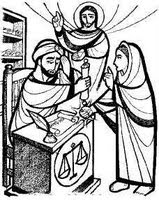
Jesus tells an odd little tale in Luke 18:1-8 that's often called the Parable of the Importunate Widow. That's an old-fashioned way of saying, "the Parable of the Pushy Broad." In the story, a poor widow is seeking justice from an unjust judge. He's a jaded bureaucrat who can't be bothered with shuffling case files from his inbox to his outbox any quicker than he absolutely has to. This widow, though, makes a pest of herself. She just keeps knocking on his door until he's obliged to rule on her case. Jesus ends by saying something to this effect: "If even a pushy broad like that can get some action out of a corrupt judge, won't our God of mercy pay even more attention to your prayers?" It's a word to the wise.

So, speak up for yourself. If you don't do it, who will?

Your doctor will respect you for it.

Thursday, December 23, 2010

December 23, 2010 - A Champion Gift-Giver

There's lots of talk, this time of year, about gifts and gift-giving, but here's a gift-giving story that will warm your heart. It comes from the sports pages, of all places.

Matt Hoffman is a defensive end for the Rowan University football team, here in New Jersey. Recently he was one of three runners-up for the Gagliardi Trophy, which is given to the most outstanding football player in Division III of the NCAA. It's that Division's equivalent of the Heisman Trophy.

Matt had put himself on the National Bone Marrow Registry's list of potential stem-cell donors some time back. Last November, his number came up. Matt's blood chemistry, it seemed, was a good match for a non-Hodgkin lymphoma patient, a stranger to him, who urgently needed to undergo the transplant procedure.

The only problem was, for Matt to say yes to the request to donate meant he would have to take some powerful medicines, whose side effects would prevent him from playing in the final football game of his Junior-Year season.

The voting for prestigious sports awards like the Gagliardi Trophy is heavily dependent upon statistics. For an outstanding player like Matt Hoffman to miss even a single game is a really big deal. It can mean the difference between being the trophy recipient and being the runner-up (as Matt turned out to be).

Matt didn't hesitate. He told his coach he couldn't play that day, because he had to go into the hospital to donate stem cells. For a stranger.

A few weeks ago - in the moments before the Gagliardi Trophy awards ceremony - Matt had the opportunity to meet the man who received his stem cells. The National Bone Marrow Registry puts a one-year moratorium on sharing the names of recipients, but after that year had elapsed - and with the consent of both parties - they brought the two men together. Matt had the opportunity to meet Warren Sallach, a 59-year-old road maintenance worker from Texas, who continues to be in full remission more than a year after receiving his stem cells.


It was an emotional occasion for both of them. Matt called it "one of the best moments of my life."

I'd be hard-pressed to think of a better gift-giving story than that. Matt Hoffman may be a runner-up for the Gagliardi Trophy, but he comes in first for an even more prestigious trophy, in my book.

Merry Christmas, one and all!

Tuesday, December 21, 2010

Why I Do It

Sometimes I wonder why I write this blog - why I started it in the first place; why I kept it up during some very difficult days, when I hardly felt up to it; why I keep doing it, more than 5 years after my diagnosis and more than 4 years into watch-and-wait so-called "treatment."

An answer has turned up in Britain's Guardian newspaper, as a psychologist speculates on why people write illness blogs. Here, a fellow cancer blogger, Sue Eckstein, quotes Dr. Tom Farsides:

"I'm just one of many hundreds of people who blog about their illness or trauma, and, according to Dr Tom Farsides of Sussex University, this is not surprising: 'Writing is an effective way of processing and coming to terms with challenging and potentially traumatic events,' he says. 'But blogging is more than the mere act of writing. It also fosters senses of both control and social connection, each of which is crucial for psychological wellbeing.'"

Oh, yeah. That's why.

Tuesday, December 7, 2010

December 7, 2010 – Remembering Elizabeth

Sad news, this evening, of the death of Elizabeth Edwards. Evidently, in the end it happened very quickly for her, which is a mercy.

The “late unpleasantness” of her husband’s irresponsible behavior has dominated the headlines in the past year or so, and many of us were very sorry to see that burden added to those Elizabeth was already carrying. It speaks to the strength of her character that, through faith and sheer determination, she somehow found the inner strength to be there for her family, to face the television cameras with her head held high and to continue to use her celebrity status to exercise compassion for others.

Her books, in which she candidly shared her life story, have been an inspiration.


Newsweek’s Jonathan Alter, himself a lymphoma survivor, shared a frank exchange he had with Elizabeth about her Christian faith, and the doubts she sometimes experienced, about both her cancer and the tragic, accidental death of her son, Wade:

“When I arrived, Elizabeth told me that cancer had essentially freed her to say whatever the hell she wanted. Then she proved it, by questioning the one thing all presidential candidates and their spouses must embrace - religious faith: ‘I’m not praying for God to save me from cancer. God will enlighten me when the time comes. And if I’ve done the right thing, I will be enlightened. And if I believe, I’ll be saved. And that’s all he promises me.’ But did she believe? Here she went further than any public figure this side of Christopher Hitchens.

‘I had to think about a God who would not save my son. Wade was – and I have lots of evidence; it's not just his mother saying it – a gentle and good boy. He reached out to people who were misfits and outcasts all the time. He could not stand for people to say nasty things about other people; he just didn’t want it. For a 16-year-old boy, he was really extraordinary in this regard. I wish I could take credit for it, but I can’t. You’d think that if God was going to protect somebody, he’d protect that boy. But not only did he not protect him, the wind blew him from the road. The hand of God blew him from the road. So I had to think, ‘What kind of God do I have that doesn’t intervene - in fact, may even participate - in the death of this good boy?”


That’s so like Elizabeth Edwards. She always told it like it is. Unlike so many people in public life who live elegantly fabricated lives, she was real.

Elizabeth will be well-remembered by those of us in the cancer community as a determined survivor, an encourager of others, an activist for change - and yes, a woman of faith. Let us offer prayers of thanksgiving for her life and witness.

Sunday, November 7, 2010

November 7, 2010 – Gratitude on the Radiation Table

Paul Bresnahan is an Episcopal priest who served with me on the writing team for the internet sermon resource, The Immediate Word, back when I was working as the team’s convener. Recently I came across a blog post of his, reflecting on his own cancer experience. Here's an excerpt:

“Prostate cancer struck me well over a year ago, and I have been living with Jesus as I always have and then journeyed through surgery and now radiation. God has given me the privilege of sharing my journey with others who gather with me in the waiting room at Massachusetts General Hospital in Boston. We share our joys and sorrows, our hopes and our fears, our aches and our pains.

We cheer one another along. Last week when I was called for a radiation treatment, I quipped: ‘My turn to shine.’ My companion for the day told me that the entire waiting room erupted in laughter as I left the room. ‘Who is that man?’ several asked. ‘He is my parish priest,’ was the proud answer. And thus the witness to Jesus' love and healing touch tickled those within the Cox Center for Cancer Treatment at one of the world's great hospitals.

Inside the treatment facility, as I lay on the table with a giant metal fork rotating around me and beaming its rays within my body, I saw the hand of God and sensed a healing touch within me. I saw no vision other than the hand of science and medicine ministering to me out of the gifts God so generously bestows upon the care giving community in my home city. The beaming rays of radiation give me the gift of healing and of life, and I am brim full of gratitude.”


It’s so true that the eye of faith can sometimes glimpse the hand of God in all kinds of things. Even a piece of radiation therapy equipment.

Friday, October 29, 2010

October 29, 2010 – On Meeting Oneself

Yesterday, my 54th birthday, I caught a National Public Radio interview on the car radio with singer/ songwriter Sheryl Crow. Amidst the usual light chat about music, songwriting and the like, the interviewer asked Sheryl about her experience as a breast cancer survivor. She had this to say:

“Once I was diagnosed, once I was handed that diagnosis, it was very apparent to me that my life was never going to look or feel the same to me again. And... my lesson... in my diagnosis and laying on the radiation table every single morning for seven weeks was, nobody can take care of me but me. And I wasn't doing that. I was putting everybody's needs before me and, so it was really, you know, I met myself on that radiation table every day and I had to reflect and had to remember who it was I came in as, and had to really sort of redefine my life.”

The line that jumped out at me at the time was: “I met myself on that radiation table every day.”

That sort of thing is part of the cancer experience, especially during treatment. The diagnosis crashes in, like a bolt out of the blue. The normal, everyday activities of life come to a screeching halt. Suddenly, it’s just you, your medical team and your treatment.

Mostly you, though. And a whole lot of time.

You have time to think. To reflect. To reconsider. You may not feel real great, and that may keep you from doing some of the activities most of us usually fall back on, to keep busy and avoid introspection – reading, media, computer. The thoughts flow wild and free. No scenario’s left unturned, when it comes to imagining the worst possible outcomes.

Somehow, out of that chaotic mix there arises a new synthesis. The new normal. We haven’t chosen it, but there it is. At the end of the day, it’s our normal, so we’ll take it. It beats the alternative.

I hear you, Sheryl. What you say is so true.

Saturday, October 9, 2010

October 10, 2010 - A Doctor Who Gets It

Betsy de Parry, a lymphoma survivor and blogger whom I frequently cite in these pages, has published a truly remarkable letter from an oncologist and specialist in rare adrenal cancers, Dr. Gary Hammer. It’s an open letter he wrote to cancer survivors everywhere, in response to an open letter to doctors Betsy had written a few days before.

Dr. Hammer notes in his letter that virtually all his patients die under his care. That’s because the prognosis for adrenal cancers is generally poor. The best he can promise his patients is to buy them a little time, and to enlist them as allies as he and his colleagues chip away at the frustrating search for a cure.

It takes a very special doctor to persevere in medical practice under such circumstances. At the very least, a “thick skin” would seem to be an emotional necessity – surely, not easy to maintain alongside a pleasing bedside manner. (I have a feeling, though, after reading his letter, that Dr. Hammer is one of those rare individuals who can integrate both.) The type of medicine he practices also affords him a rather remarkable vantage-point from which to view the experience of patients living through their last days.

Both letters are worth reading in their entirety, but I’d like to share with you, here, a selection from Dr. Hammer’s. It shows he’s truly been listening to his patients, in the deepest sense:


“Perhaps the most frightening words a person might hear in his or her lifetime are ‘You have cancer.’ This truth revealed fractures our reality. It challenges our relationship to our inner world, forcing us to re-evaluate who we are.

However, embedded within this experience lived is a gift. The little-known secret is that the gift is not just for the afflicted but also for their entire circle of relationships, including spouse, children, friend and caregiver alike. The only requirements to receive this unique communion: vulnerability and presence.

As a physician engaged in the care of people with a particular rare cancer – where those under my care almost always die – I am thankful for the sharing of truths that have been unveiled to me by these men and women in this, their most vulnerable and internal sanctuary.

In this place of finding themselves dying, brave people have let me into their space where three truths seem to be unveiled again and again as defining gifts of sacredness. These truths can be embraced as three reflections of the word ‘presence:’ conscious engagement, the experience of present time (the razor-sharp now) and the gift of emotional authenticity.

Through these patients, I have come to an understanding that if we are fortunate to actually have time while we are ill, and we are brave enough, what happens as our vanity, our beauty and ultimately our physical identity is stripped away is that we are granted a chance to become our own sacredness — as it becomes all that is left.

Sadly, when people die suddenly, they rarely have the luxury of such time, such a place. But equally as tragic is that most folks never risk to venture to this vulnerable place while living when they do have time. Having our own death close by in life — be it through illness or conscious reflection — sharpens our internal lens by stripping away all that is not present, all that is not presence.”


Based on my experience, I’d say that having a deadly cancer is something like getting off the local train that is the normal pace of life and boarding another. The new conveyance is a bullet train that bears us on rapidly, roaring through many of the normal stages of adult development without stopping, to a windswept, elevated platform overlooking a barren plain – the place where we may contemplate our own death. It’s the terminus, the end of that particular line, a station most people will never glimpse until they are far advanced in years, if at all (those who die suddenly may never see it). We who have wrestled with the cancer angel are familiar with that stark vista, and also know how bewildering this headlong, high-speed journey can be.

Even more bewildering is the return trip. It happens in the flash of an eye. If we’re fortunate enough to see our disease go into remission – or to enter into the extended watch-and-wait “treatment” that’s really a non-treatment – we may suddenly find ourselves seated again on the lurching local milk-run. Around us are our fellow-passengers, snoozing away to the soft, rocking motion of the train. We look around the cabin and at first see only others who are sleeping.

But wait, over there, across the aisle: was that a movement? It was. Another person awake. She and I make fleeting eye contact. Yes. It’s someone else who was on the express, someone who knows.

And what’s that, several rows ahead? Someone else is stirring. A passenger yawns and stretches before he turns around, idly scanning the passenger compartment. He gives me a brief nod of recognition before laying his head back down on the shoulder of his sleeping wife, trying (perhaps in vain) to join her in slumber. Another fellow-traveler. When he closes his eyes, does the stark vision of that empty, elevated platform, surrounded by barren, moonlit prairie, rise up in his imagination?

It’s a wonderful thing to encounter a physician who’s taken the time to know his patients in such an existential way, to try to vicariously experience something of what we’ve been through.

Blessings to you, Dr. Hammer. May your tribe increase. And “thank you” to Betsy for initiating this fruitful exchange.

October 9, 2010 - Comic Relief from The Onion

OK, this one's a bit out of the ordinary for my blog, but I can't resist posting a link to this "news" story from The Onion, the internet satirical newspaper. It's called "Teen With Cancer Vows It Won't Keep Her From Being Mean, Moody Little S**t."

(Sorry for the profanity, both in the headline and in the article, but you'll see how it makes literary sense in this case.)

The article gave me a good chuckle, but it also points out how we who have cancer are who we are. The disease strikes randomly, without regard to personal virtue (or lack thereof).

It's also a sly send-up of all the adulatory talk that goes on about people with cancer. When you get the disease, you find that people are a little more inclined than usual to say complimentary things about you.

Was anyone ever lauded for approaching their so-called "battle" with cancer like a total weenie? I'm sure many have taken precisely that approach. But they never say anything about that when they're hanging the medal around your neck at the Relay For Life.

Don't get me wrong. Cancer can be transformative. I believe it has been in my case, and mostly for the better (although - true confessions time - four and a half years later, I could stand to ditch the procrastinating, devil-may-care approach to personal financial management that I fell into during my chemo-treatment days).

For all the times we survivors may joke about "playing the cancer card," the diagnosis doesn't give us a free pass for treating others with disrespect.

I suppose the experience of dealing with cancer does lead some of us to rethink, maybe even reform, our lives. Others, maybe less so.

Are we somehow obliged to approach our disease like the opportunity for transformation it just may turn out to be? I don't think so. It's an individual thing.

We all do well to try to avoid judging others in that regard. Those who want to take the weenie approach have every right to do so. And they probably still deserve a medal around their neck.

Deep down, I'm enough of a Calvinist to believe that we're all sinners, and that chemo and radiation have little effect on that particular malady.

That cure lies elsewhere.

Tuesday, October 5, 2010

October 5, 2010 - This Is the Day

This excerpt from a Presbyterian News Service release tells the story of the death several days ago of singer/songwriter David M. Bailey:

"David M. Bailey, a singer/songwriter who moved audiences as much with his story of personal courage in the face of terminal cancer as with his music, succumbed to Glioblastoma on Oct. 2 in hospice care near his home in Charlottesville, Va. He was 44.

The son of Presbyterian missionaries, Kenneth E. and Ethel Bailey, Bailey was raised in Beirut, Lebanon. He spent some of his youth in Germany — where he learned to play the guitar and began writing songs — before returning to the United States....

In July 1996, he was diagnosed with Glioblastoma, a particularly virulent form of brain cancer. He then quit his corporate job and turned to songwriting and performing full-time.

'They told me I had six months. They were wrong,' Bailey said. 'Despite what you might hear, hope is a very real thing, and with every passing day, there are more and more reasons to hope.'

For 14 years he defied that diagnosis, writing and performing virtually non-stop, covering 45 states and 21 countries. His concerts were deeply personal, brutally honest accounts — rendered in a musical style that has been compared to James Taylor and Cat Stevens — of his struggles with his illness and his determination to make the most of whatever time God gave him.

His signature tune was 'One More Day.' The chorus goes:

'One more day when you can hold your children
One more day you can hold your wife
One more day when you can watch the grass grow
One more day when you can live your life.'"


It calls to mind the familiar scripture verse: "This is the day that the Lord has made; let us rejoice and be glad in it." (Psalm 118:24)

It's a lesson David taught us: how to live in the now, praising God for all good gifts. His music - and that lesson - will live on, through his recordings.

Prayers and good wishes go out to his family.

Monday, September 6, 2010

September 6, 2010 - His Music Lives On

In some earlier posts, I've written about a musician, David M. Bailey, who's been an inspiration to me. David's a brain cancer survivor who, after undergoing treatment the first time, reinvented his life as a singer-songwriter. Except for the times when he's been undergoing further treatment, he's been traveling the country, sharing his musical message of faith, hope and love in the midst of adversity.

Today, I received this e-mail, sent out to those on David's mailing list, presumably by a friend or relative:

"David was moved to hospice on Friday, September 3, following nearly a week in the hospital. He has been surrounded by family, friends and loving caregivers and has been pretty comfortable.

There’s a day to be filled with music
and a day for all melody to cease
there’s a day to arm yourself for battle
and a day to calm your heart for peace"


dmb 1996

Back in the 1990s, they told David his glioblastoma brain tumor was supposed to have killed him in 6 months. He beat the odds, obviously, by a considerable amount of time. Now that it appears his final days are upon him, let's remember him in prayer, asking God for comfort and expressing gratitude for his remarkable witness of faith.

I regret that I never got to hear David perform live. I do cherish those of his CDs I own, though, and I know many others do, too.

There may be a day for "all melody to cease," but it will only be for the briefest time. David's music will live on.

"Well done, good and faithful servant."

Tuesday, August 31, 2010

August 31, 2010 - Creativity and Cancer Survivorship

Today I run across this little gem, an edited-down version of a talk by Monty Python member John Cleese on the subject of creativity:


Cleese may sound like an odd choice, at first, to give this sort of talk, but in fact - alongside the brilliant loopiness of his television and film projects - he’s long had interests in being a serious academic. For a while he was Rector of the University of St. Andrews, where I did my Ph.D. (alas, just before my time there, so I never met him). He transformed the Rectorship - until then, a largely honorific, student-chosen position - into one that engaged with the University administration on a number of issues of importance to students.

The advice Cleese gives here is down-to-earth and practical: especially what he says about the importance of “sleeping on” a problem, and also of constructing boundaries of space and time for regular, serious reflection.

Running his remarks through my theological filters, I’m struck by how many times he dances right up to the line of saying something spiritual, but never quite steps over it. (No surprise there, because he doesn't believe in God.) For example, when he attributes creative breakthroughs to the work of “the unconscious,” he could have said “the Holy Spirit” - but doesn’t. When he’s talking about the need to carve out time for focused pondering, he could have said “quiet time for prayer and contemplation” - but doesn’t. Certain parts of the Christian spiritual tradition, such as monasticism, insist on a daily schedule (the liturgical hours) that’s meant to nurture precisely the sort of creative engagement Cleese is calling for, and have produced some wonderfully creative people (ranging from Thomas Merton to Dan Berrigan to Sister Wendy of the art-appreciation videos). We Protestants may be a bit behind the curve on that one, but even we have traditions of spiritual practices that foster creativity and holy insight.

So, what does all this have to do with cancer survivorship? Cleese doesn't mention any connection, but I was led to reflect on something many of us survivors have experienced: how the enforced down-time of a chemotherapy regimen crashed into our otherwise busy, over-committed lives and forced us to spend time reflecting on things we’d otherwise never have thought about (or perhaps not until some long-postponed retirement - and maybe not even then, judging from what I’ve heard from some retired people who report being busier now than when they were working).

It was during the enforced down-time of my chemotherapy, for example, that this blog was born. Since having that experience, I haven’t even needed to try to schedule time for creative reflection. I’ve simply done it (at times to the detriment of some of my more routine obligations, but what’s a credit-card late fee or two, if you’re staying more spiritually grounded as a result of obsessing less over the small stuff?).

Whatever stage of the survivorship journey we’re in - whether in treatment, in remission, in relapse, or in that blessed land some are bold to call “cancer-free” - it helps to let go of the urgent worries from time to time and put them to rest for a while, even if only for the few hours of a good night’s sleep (if that’s possible, health-wise). It also helps to set up those boundaries Cleese is talking about, so we can grab a little time for ourselves, away from the frenetic rounds travel to one medical establishment to another, and trying to respond to some of the demands of our normal lives when we’re not doing that.

Stephen Covey, in a memorable illustration I’ve referred to earlier in this blog, called it “sharpening the saw.” If you don’t stop your ceaseless sawing - back and forth, back and forth - from time to time, and pause to sharpen the saw-blade, you’re doomed to steadily decreasing effectiveness.

So, let’s hear it for self-care, on the cancer-survivorship journey! A major part of self-care is refreshing ourselves at those creative wells, where our spirit is free to engage with the Spirit of the Lord.

Monday, August 23, 2010

August 23, 2010 – What the Biograph Knows

Last Tuesday, I went for a PET/CT scan. This is perfectly routine: I get scans at intervals, alternating between the PET/CT and a regular CT scan with contrast. It’s how Dr. Lerner and I figure out if we’re still watching and waiting, or if it’s time to take a more proactive stance.

A year or so ago, the testing interval was every 3 months. Now, the doctor has spread the schedule out to every 6 months. That’s because my lymphoma has been so lackadaisical of late – a good sign.

The scanner lives on the back of a tractor-trailer truck pulled up to a loading dock at Jersey Shore University Medical Center. It’s there a couple days a week. What hospitals it visits the other days of the week, I’m not sure.

Here’s what I recall of the experience...

I’ve been through this enough times to know exactly what to expect. Pin-prick on the finger-tip, for the instant blood test to make sure I’m not diabetic. IV needle inserted in the crook of the arm, into which the technician injects a hypodermic-full of liquid out of a thick, cylindrical, silvery-metal case (that’s lead casing, to protect the technician from the radioactive glucose solution I get to have coursing through my bloodstream for the next several hours – lucky me). The IV needle comes out right after that, then it’s 45 minutes’ R&R in a comfy lounge chair. During that time I’m instructed to sit quietly, even nap if I want. Only then am I ready for the scan.

That entails lying flat on my back, perfectly motionless, for 30-45 minutes, arms extended straight back over my head. I know from experience how the muscle-pain that develops in my arms, after 20 minutes or so of this unnatural posture, is the worst part.

Just before climbing onto the narrow table that will slide me through the machine’s donut-hole, I notice an inscription on the device: “SIEMENS Biograph 6.”

The manufacturer, of course, is Siemens, the medical-equipment giant. Biograph 6 is evidently the model name and number.

Ya gotta think of something while you’re lying on your back, trying to keep from counting the minutes, so I start musing on that word, “Biograph.” Obviously, it’s a trade name dreamed up by the Siemens marketing people. “Bio” means life, and “graph” means writing. Put the two together and the name suggests a chartful of medical data – which is, essentially, what this high-tech test produces. Makes good marketing sense.

It also calls to mind, of course, the word “biography.” Coincidentally, during the 45-minute rest period before my scan, I started reading a biography: The Most Famous Man in America: The Biography of Henry Ward Beecher, by Debby Applegate. Her book’s a fine example of the genre: a collection of facts about the famous preacher’s life, but also so much more than mere facts. The facts are presented so as to conjure up the real person, as though he could step right off the page.

That’s what a good biography does. Yet, I wonder as I lie there: What is it that a good Biograph does?

I suppose the thing that’s most important to the medical community is the way its visioning software slices and dices my body into thousands of paper-thin segments, which it then analyzes, looking for the rapidly-metabolizing tissue indicating a possible malignancy. (I don’t feel a thing while all this high-tech butchery is going on, by the way. Except for the pain from my hyper-extended upper arms, I could probably fall asleep there inside the donut-hole.)

Likewise, a biographer like Debby Applegate gathers and arranges a whole lot of facts about her subject’s life – scanning it, as it were – before sitting down at her word processor. Once she starts to write, though, her goal is not to simply pour out the unedited facts, performing the historical equivalent of a data-dump. No, the biographer’s aiming to put Henry Ward Beecher back together again, so he arises in the reader’s mind as a 3-dimensional personality.

I heard Debby give a talk about her book at the Presbyterian Historical Society Luncheon at our denomination’s General Assembly last month. She spoke of Beecher in a way that intimated he’d become very real to her. I recall her making an offhand remark about how she’d been “living with” Beecher for quite a number of years, as she researched and wrote the book.

The similarity of names makes an unlikely association in my mind to the Marx Brothers’ film, Go West, in which Chico and Harpo are walking up and down a railroad platform as Chico repeatedly calls out, “Mr. Beecher, we’re here to meet you!”

“Are you looking for John Beecher?” asks a serious-looking businessman in a suit. “I’m John Beecher.”

Chico’s eyes narrow suspiciously. “We don’t recognize you, do we, Rusty?” (Rusty is played by Harpo, who emphatically shakes his head “No.”)

“Naturally you don’t recognize me,” sniffs Beecher, officiously. “We’ve never met.”

“Then how do I know it’s you?”

Typical Marx Brothers lunacy.

Does the Siemens Biograph know it’s me? Having sliced me up into a thousand pieces (or, more precisely, into millions of little ones and zeroes), how will it put me back together again?

The technicians running the scanner couldn’t be more cordial or professional, but even so, the whole process is designed to produce a numerical output that falls far short of describing who I really am.

Following protocol, the technician checked my hospital bracelet as I came in. It was his way of answering Chico’s question from the movie: “Then how do I know it’s you?”

Yet, he doesn’t really know me. Nor will the radiologist who reads the results and reports them back to Dr. Lerner. To the inquisitive electronic eye of the Biograph, I’m just a biological system, nothing more.

There’s a famous scene in Shakespeare’s The Merchant of Venice, in which Shylock muses on the alienation he feels as a Jew, living in a Christian country:

“I am a Jew. Hath not a Jew eyes? hath not a Jew hands, organs, dimensions, senses, affections, passions? fed with the same food, hurt with the same weapons, subject to the same diseases, healed by the same means, warmed and cooled by the same winter and summer, as a Christian is? If you prick us, do we not bleed? if you tickle us, do we not laugh? if you poison us, do we not die? and if you wrong us, shall we not revenge?”
[The Merchant of Venice, Act 3, Scene 1]

One of the things we cancer patients appreciate the most is when someone treats us as a real person, not a mere medical case. I’ve been fortunate to get that sort of response from Dr. Lerner and from most of the people who’ve cared for me, over the past five years or so of tests and treatments.

We’d be foolish to expect that sort of thing from the Biograph – although, as we look to our fellow human beings who wear the lab coats and the nurses’ uniforms, is it out of line for us to hope for a little personal interest in our biography?

Monday, August 16, 2010

August 16, 2010 - The Big C

This evening, I take a look at Showtime’s new “dramedy” on cancer – The Big C, starring Laura Linney. We don’t have Showtime on our cable contract, but I happen to notice that the full first episode is available as a preview on Showtime’s website.

I presume the 30-minute video I saw was the whole episode. There was a little disclaimer about it having been edited for online viewing, but I take that to mean that the curse words were muted (which they were).

Laura plays Cathy, a Minneapolis high-school teacher who’s just learned she’s got stage 4 melanoma. She declines treatment, and decides not to tell anyone, not even her family. The first episode is all about her bouncing from one wildly inappropriate, self-destructive behavior to another: impulsively deciding to have a swimming pool dug in her front yard, without getting the necessary permits; treating an obnoxious summer-school student with a savage cruelty the writers likely intend to be funny, but isn’t; telling off the cranky, reclusive old lady who lives across the street; overindulging in goopy desserts, liquor and even a cigarette she confiscated from a student.

Yes, I know diagnosis is a terrifying, world-shaking time – and everyone deserves to be cut a little slack in the midst of it – but no one is that crazy.

Linney does a spectacular role of acting the part, but it’s the script that’s over the top. This is a shame, because we cancer survivors could really use an actor of her caliber telling our story. She gets it right on the gut level, in a way that makes viewers identify with her, but she’s shackled by that unrealistic script.


The scene showing her interaction with her doctor is particularly problematic. She tells someone she’s going off to the dermatologist, but this guy is doing more with cancer treatment than any dermatologist I’ve ever heard of. I suppose, in retrospect, he’s really meant to be her oncologist, and the dermatologist story is a little cover-up on her part, but the script never reveals that.

Even as an oncologist, though, he’s unrealistic. There’s a flashback showing Cathy in his office, viewing her tumor on an x-ray film. It’s clearly an x-ray, not a CT or PET Scan.

He also admits to Cathy that she's his "first." First what? Cancer patient? (Not likely, given his years of specialist training.) His first terminal patient? (Again, not likely he missed that experience, if he's been an oncology resident). His first patient to decline all treatment from the get-go? (Maybe a little less unlikely, but not much.) His first melanoma patient? (If that's true, Cathy would be well advised to run as fast as she can, putting as much distance between herself and this rookie as possible.)

So, the writer and director would have us believe that a sensitive and intelligent professional in her late 40s or early 50s, with everything to live for, is going to chuck it all, declining treatment and keeping her diagnosis secret from everyone in her life, based on something she saw on an x-ray film in her doctor’s office? No follow-up tests. No second opinion. Not even a careful weighing of the treatment options, before coming to that momentous decision.

“I’ve always loved my hair,” Cathy tells her doctor, explaining why she’s ignoring his medical advice and declining treatment. “I cry every time I get it cut.”

Now, maybe that’s a feeble attempt at a joke on her part, but if that’s not the case (and there’s no clear indication it is), then the Minneapolis Board of Education is saddled with an astoundingly airheaded high-school history teacher.

The scene is both medically and psychologically inaccurate, and that’s a real missed opportunity – especially since what happens in her doctor’s office is the premise on which the whole series is based.

What, Showtime was too stingy to spring for a decent medical advisor?

Washington Post reviewer Hank Stuever makes a similar point:

“I’ve known people whose loved ones avoided treatment and kept cancer a secret until it was too late. Cathy’s decision is ‘The Big C’s’ most difficult hurdle – a wildly selfish and passive-aggressive act that is difficult to find funny. It also doesn’t seem believable in Cathy’s case – she just seems too smart and articulate to deliberately withhold something like this, unless she’s just being mean. Whatever her reasons, Cathy’s secret cancer does provide ‘The Big C’ a doorway to a fascinating story arc, in which the people in her life come across as unfailingly more selfish than she’s attempting to be.”

While this first episode does a not-so-good job of portraying the personal and medical aspects of a newly-diagnosed cancer patient’s life, it does depict one thing accurately: our society’s fear of cancer. The series, of course, is really about death, and what it means to go on living in its shadow with strength and dignity. It’s significant that the disease chosen as the vehicle for this philosophical and psychological exploration is cancer. The problem is that not all cancers are alike, and not even a metastasized, stage 4 melanoma is a reason to decide to forgo all treatment, especially for a newly-diagnosed patient.

Those quibbles aside, I do recommend the series, based on what I saw. I’d watch it myself if I had Showtime. Guess I’ll have to rent the subsequent episodes on DVD, once they’re available.

Tuesday, August 10, 2010

What To Say When a Friend Has Cancer

Here's an insightful article, shared by Betsy de Parry on the Patients Against Lymphoma group on Facebook. "Vital Tips to Keep Hope Alive Through Cancer" is a blog post by Lori Hope, a lung cancer survivor, on the CarePages website.

Lori's main focus is on what not to say to friends who have cancer. It really is helpful to think ahead of time about how to use our words in helpful, healing ways.

Sometimes the thoughts that first come to mind aren't all that therapeutic for friends with cancer. They may even make life more difficult. Such comments say more about ourselves, and our anxieties, than about the other's needs.

Here's a brief, digested form of Lori's pointers. For the full list, click on the link to the full article.)

• Don’t inadvertently blame the victims by hinting that they may not be thinking positively.

• Don’t blame the victims by asking about possible risky behaviors they may previously have engaged in, like smoking. This is an absolute no-no. (You may be wondering about it, but don't ask.)

• Don't share stories about people you've known who've had the same form of cancer, but didn't survive (Lori says she needs to hear at least five success stories to counter one such horror story).

To that one, I'd add a codicil: Don't share stories about people who had a completely different kind of cancer, thinking it will somehow be encouraging. The word "cancer" covers a vast family of diseases, making it very hard to generalize from one type to another.

So much for what not to say. Now, here are a few positive suggestions:

• For friends who may find it hard to be continually confronted by discouraging statistics, offer to help with research - but don't forward articles without first reading them through completely.

• Try not to be gloomy. Humor is therapeutic, so help your cancer-survivor friends find things to laugh about!

• Every once in a while, remind your friends you’ll be there for them, no matter what. Some survivors have the experience of losing longtime friends who simply drift away, because they can't handle the situation emotionally. It's always good to be reminded of friends who are still there for us.

Monday, July 5, 2010

Necrology

This week I'm attending the Presbyterian Church's General Assembly in Minneapolis. I'm blogging about it on my Monnmouth Presbytery Clerks' Corner blog.

Yesterday was the opening worship service, with several thousand people in attendance at the Minneapolis Convention Center. At one point in the service, it was announced that the Necrology Report would be presented, in the form of a list of names projected on the large screens over our heads.

"Necrology" is an odd word, but to those who frequent Presbyterian official meetings above the local level, it means a report of recent deaths. The General Assembly's Necrology Report is a list of ministers who have died during the previous two years, since the Assembly last met.

Flashing the names up on the screen was a creative way of presenting this information, without having to go through the tedious exercise of reading the list aloud. As we listened to some wonderful music, I scanned the names as each page was put up there, to see if there were any I recognized - any honored members of the older generation.

Bam! There was a name I recognized, but not from the older generation. It was Karen, a seminary classmate with whom I had worked side-by-side for a couple of years after we graduated, when we were both associate pastors. She died in a freakish accident: a burst blood clot in her lung, while she was on a high-altitude hiking trip. By the time the mountain-rescue team got her back down the mountain, it was too late.

Then there was Carter's name. I had never met her in person, but she and I were on the writing team for The Immediate Word, an internet sermon resource for preachers. Every week, we would speak via conference call, as the team planned the next installment. She had died suddenly of a massive heart attack.

In my mid-50s, I'm at the stage of life when I can expect to hear about this sort of thing more frequently - members of my generation who are dying.

I was very much aware of the fact that, with my cancer experience, I could very well have been numbered in that company. What would others have thought as they saw my name flashed on the screen, I wondered?

We cancer survivors have to deal with ever-present reminders of our mortality. To us, they take on a meaning that I suspect is very different than those who have always enjoyed good health.

Sunday, June 6, 2010

June 6, 2010 - Our Most Elusive Possession

Great column a couple days ago, from New York Times columnist Nicholas Kristof. Instead of gallivanting around Africa or someplace crusading against injustice, as he often is, his June 4th column is very personal.

That’s because he’s had a cancer scare: diagnosis of a kidney tumor 90% likely to be malignant, then surgery – and then, against the odds, a biopsy revealing he’s in the lucky 10%. The tumor was benign.

Still – and understandably – Nicholas had a scare, that led him (as cancer has led so many of us) to examine his life a little more closely. Here’s the result:

“This is trite but also so, so true: A brush with mortality turns out to be the best way to appreciate how blue the sky is, how sensuous grass feels underfoot, how melodious kids' voices are. Even teenagers' voices. A friend and colleague, David E. Sanger, who conquered cancer a decade ago, says, "No matter how bad a day you're having, you say to yourself: `I've had worse....’

I don't mean to wax lyrical about the joys of tumors. But maybe the most elusive possession is contentment with what we have. There's no better way to attain that than a glimpse of our mortality.”


Preach it, brother!

A few verses from the First Letter to Timothy come to mind:

"Of course, there is great gain in godliness combined with contentment; for we brought nothing into the world, so that we can take nothing out of it; but if we have food and clothing, we will be content with these."

- 1 Timothy 6:6-8

Thursday, June 3, 2010

June 3, 2010 - Touched By an Angel

“During my illness, I had the presence of an angel that came and visited me...” This is a remarkable video, from the Livestrong website. The speaker is Matthews Brown, a leukemia survivor. It’s just under 4 minutes long, so it won’t take too much time away from whatever else you’re doing.


In the course of my ministry, I’ve heard some remarkable stories of spiritual experiences. I’ve never seen an angel, myself (at least, not the supernatural variety). Based on what I’ve heard from others, though, I’d say Matthews’ experience is unusual, but not as unusual as all that. Things like this happen to people more often than you may think.

We’ve all heard the truism, “God never gives us more than we can handle.” I found that to be true of my own cancer experience. From the square marked “Go,” it looks like it's a long way around the spiritual Monopoly board, but you do find yourself “passing Go” from time to time and collecting $200.

Let us give thanks for unsolicited, grace-filled experiences, through which we learn what remarkable spiritual resources are available to us, and how deeply we are loved!

If you’re a cancer survivor, how has the spiritual side of the experience been for you?

Saturday, April 3, 2010

April 3, 2010 - When All You Have Left Is Yourself

Today I’m reading an unusual article in Cure magazine online, "Keeping the Faith," by Kathy Latour. What’s unusual about it is that it deals with the topic of cancer and spirituality with attention to spiritual community.

I find that refreshing, because there’s lots of talk about a sort of generic spirituality when it comes to cancer survivorship. “If it makes you feel good, do it” is the all-purpose mantra. The problem with this sort of approach is that it ends up being a do-it-yourself activity, like trimming your nose-hairs or working out with a Thighmaster.

I think this individualism comes out of good old American separation-of-church-and-state thinking – something I’m in favor of when it comes to politics, but which is woefully inadequate in all but the most superficial discussions of religious faith. Take that line of thinking to its extreme, and you’ll end up like poor old President Eisenhower – who supposedly let himself be quoted saying: “Our government has no sense unless it is founded in a deeply felt religious faith, and I don’t care what it is.”

Some presidential scholars insist that’s an apocryphal remark, and it may well be – but, it catches the spirit of the age. (Eisenhower was a Presbyterian, by the way – though, if he really said that, I suppose he missed Sunday School the day they were teaching Calvin’s high conception of the church.)

In cancer support groups, “guided meditations” abound – those stress-relieving exercises that begin: “Close your eyes, pay attention to your breathing, and imagine yourself walking across a grassy field...”

Now, I can understand the appeal of that approach, to those who arrange chairs in a circle for their cancer-and-spirituality workshops. You can be Christian, Muslim, Buddhist, Jew or South Sea Islands cargo cultist, and still get something out of a guided meditation exercise. Whether the glowing figure walking towards you across that grassy field is Jesus or the Bodhisattva Maitreya makes little difference, because it’s happening in your own, private mental world. No muss, no fuss, no cross-denominational misunderstandings. Everybody leaves happy.

Outside of houses of worship, spiritual support groups are often led by people without any strong (or strongly evident) religious affiliation – the “I’m spiritual but not religious” sort of person. You’d think hospitals and agencies would seek out seasoned religious professionals – nuns who work as spiritual directors, say, or Muslim teachers of Sufi prayer – as long as they’re committed to interfaith dialogue. But, no. Charitable-organization program directors aren’t known for sticking their necks out, so they smile beneficently on psychiatric social workers with no theological background who say, “I can do that,” or on generic “interfaith ministers” holding degrees from unaccredited seminaries (or, God forbid, even internet “ordinations”).

That’s why the article I’ve been reading is so refreshing. The author, Kathy Latour, interviews Harold G. Koenig, M.D., of the Center for Spirituality, Theology and Health at Duke University – a prostate-cancer survivor himself – as he describes a discussion group he co-facilitated called “Engaging the Spirit.” It was a place “where cancer patients and survivors explored spiritual and faith questions as they traveled the cancer journey.” Knowing his group was composed of people from a variety of faith traditions, Harold began each discussion with a simple question: “How’s your spirit?”

OK, that’s a workable generic opening question, but Harold’s point is that the discussion need not remain in that level: “I learned from those who took part that no matter how someone defines his or her faith, in a group of cancer survivors there exists a common quest to understand existential questions about life and death.” When that quest is pursued through religious community, there comes an awareness that “God has a purpose for them and is in control and they don’t have to be. This is where mental health comes from.” Such a strongly-held conviction, the article continues, “frees them and reminds them that their illness can result in ‘something good.’”

From his own experience as a survivor, Harold upholds the value of “a belief system that frames your diagnosis in the context of your life and what you believe happens after life. If you have no framework to place that in, all you have left is yourself and it isn't enough. You can't carry the full load – you weren't meant to.”

A great many recent research studies of spirituality and health, Harold maintains, conclude that people who follow a particular faith tradition “need and use fewer health care services because they are healthier, more likely to have intact families to care for them, and have greater social support.”

The Rev. Isabel Docampo, associate professor of supervised ministry at Perkins School of Theology, “says her fear and depression after facing surgery for life-threatening cancer of the salivary gland came not from a crisis of faith, but from the pain and sadness that she felt from the idea she might leave her 21-year-old son, Ben, and her husband of 18 months, Scott Somers, also an ordained minister.”

“The way I have always looked at life is that it is what it is,” Isabel reflects. “Life is a struggle and God has been there for all the blessings and all the bad stuff, and God is going to be here for the cancer.”

Amen to that.

I wouldn’t want to face cancer knowing that “all I have left is myself” – nor some individualized spirituality I’d made up out of whole cloth, either. One of the great strengths of submitting oneself to the discipline of a particular religious tradition is knowing it’s not all about me, nor will it ever be so.

Now, on to my Easter sermon...

Monday, March 29, 2010

March 29, 2010 - Survivors' Tips from Dr. Laura Liberman

When I attended the Lymphoma Research Foundation’s national meeting in New York last fall, one of the most helpful presentations I heard was by Dr. Laura Liberman, a radiologist on the staff of the Memorial Sloan-Kettering Cancer Center. Dr. Liberman spoke not so much as a physician, but as a cancer survivor. She herself has been successfully treated for lymphoma.

She evidently gave the same talk again at a more recent event at MSKCC, and they’ve posted an online video of it. It’s just 30 minutes long, and is well worth it.

Laura’s experience was, like mine, one of tables being turned. As a pastor, I’ve visited with many cancer patients, and have tried to give them what help I could. She and I both found it disorienting, at first, to assume the role of a patient. In fact, the title of Laura’s book is I Signed As the Doctor – the first several times she signed consent forms for medical procedures, she made the mistake of signing on the line marked “Doctor,” rather than “Patient.”

Here are Dr. Laura Liberman’s cancer survival tips, a baker’s dozen:

1. Reach out to your friends.
Some people can’t deal with your cancer (it’s not in their nature), but many will be grateful for the opportunity to step up and help.

2. It’s OK to cry, but try to keep it to 20 minutes a day or less.
This is no joke. An oncology nurse gave her this advice. Laura actually found it helpful to try to fit her crying into that period of time (20 minutes at a stretch, four 5-minute crying jags, whatever worked). I didn't do much crying myself, being the typical male in our culture, but I appreciate the importance of giving ourselves permission to feel sad.

3. Ask people to pray for you.
Laura’s of the opinion that prayer, from any and all religious traditions, is a good thing. If nothing else, you may receive a sense of positive energy coming toward you, and it allows friends want to do something to help you who may have no other way to do so.

4. Find doctors you can trust.
You don’t want Dr. House from TV, she says. You want someone who’s empathetic as well as technically skilled

5. Take it bird by bird.
A literary reference to Anne Lamott’s book of that title. Lamott tells the story of how her brother was frustrated at the magnitude of his grade-school report assignment on “The Birds of North America.” Their father gave him the sage advice to “take it bird by bird.” So, too, with cancer. The big picture can feel overwhelming, especially at the outset. Take it one medical procedure at a time.

6. Be sensitive to your family.
Be honest with your kids, but don’t overwhelm them with more information than they can handle. Make sure your kids know you will still be there for them.

7. Be your own advocate.
Do your own research. Bring someone with you on doctor’s visits – not only to help you advocate for yourself, and also to listen for details you will probably miss. Laura suggests “bringing your own anesthesia” – not the big stuff you need an anesthesiologist for, of course, but she sings the praises of something called Gebauer ethyl chloride, a topical application you can get at the pharmacy with a prescription. The stuff numbs the skin; it’s what they spray on kids’ skinned knuckles in the emergency room. Emla Cream, she says, is also useful, though you have to apply it a half-hour before. Not every doctor, she says, is alert to the value of preventing minor pain, like that of a needle insertion, with such topical preparations. Bring the stuff with you, though, and the doctor’s unlikely to object.

8. Find silver linings (it’s an opportunity to get new hats!).
Laura says she indulged herself, when she was losing her hair, by buying herself an embarrassing number of fashionable new hats. People want to say “You look great,” she points out – but when they can’t, you can always ask them, “Do you like my hat?”

9. Discover your inner Zen.
By this, she means whatever it is that brings you to a place of inner peace. There’s an awful lot of waiting associated with being a cancer patient, and all that downtime can lead to excessive worrying. One friend advised her to pretend each doctor’s visit is a trip to the airport – if you don’t have to wait that long, you’ll be pleased. Get an iPod, she also advises – so you can listen to music during all those waiting experiences. Putting songs onto your iPod is something teenagers can do for you.

10. Keep your sense of humor.
Nothing about cancer is a joke, but if you can focus on things that make you laugh, that’s a good thing.

11. Play the cancer card.
Every once in a while, it helps to mention that you have cancer. Sometimes people will give you special consideration (she’s got a good story about this on the video about getting a cab in New York).

12. Savor celebrations. It’s not all about the cancer!
Celebrations are important at any time of life, but especially when you’re sick. “The way you make life good is by incorporating good stuff into it.”

13. Use your experience to help others.
Give back, pay it forward, or whatever you like to call it. This can help you feel you’re going through this experience for a reason

Good advice. Check out the video!