|
|
|---|
Showing posts with label Church-State Conflict. Show all posts
Saturday, April 23, 2011
Vatican May Resist US Court Order
This article comes from the National Catholic Reporter.
----------------------------------------
Vatican may resist judge's order for documents
A ruling on Thursday from a federal judge in Oregon marks the first time that an American court has ever issued an order requiring the Vatican to hand over documents in a sex abuse case.
Whether that actually happens, however, depends on how the Vatican responds, including whether it tries to persuade either the Oregon judge or an appeals court that it shouldn’t have to comply.
U.S. District Judge Michael Mosman on Thursday granted a limited number of requests for discovery put forward by attorney Jeffrey Anderson, representing a man who says he was abused by Andrew Ronan, a former Servite priest who was laicized in 1966 and who died in 1992.
The Survivors Network of those Abused by Priests, the main advocacy group in the United States for victims of clerical abuse, hailed the order as a “historic achievement.”
“Many clergy sex abuse victims are distraught that thousands of Catholic officials who ignore and conceal heinous crimes escape any consequences for their corruption,” said a statement from Joelle Casteix of Newport Beach, California, the western regional director of SNAP.
“We are confident that this court ruling will give many victims some sorely-needed hope,” she said.
Since the core issue in the Oregon case is whether Ronan was an “employee” or “agent” of the Vatican, Mosman limited the requests to documents related to the Vatican’s laicization process, its policies regarding sexual abuse and its regulation of priests’ conduct, as they relate specifically to Ronan.
By granting only those requests, Mosman effectively rejected other requests from Anderson, including the idea of taking depositions from senior Vatican personnel, up to and including Pope Benedict XVI.
Attorney Jeffrey Lena, who represents the Holy See in American civil litigation, released a brief statement Thursday night in response to Mosman’s order.
“As a factual matter, Ronan was not a Holy See employee, and the Holy See was not aware of Ronan's misconduct until after Ronan had abused the plaintiff,” Lena said.
Beyond that, Lena declined to comment on what the Vatican’s strategy might be. In general, the Vatican has resisted such demands for discovery, both on First Amendment grounds and because of its status under international law as a sovereign state. Mosman’s ruling on Thursday didn’t directly address those arguments.
In that light, most observers believe it’s unlikely that the Vatican will simply hand over the requested documents. Instead, it’s likely that the Vatican will either file an objection with Mosman, or perhaps appeal the ruling to a higher court.
In the past, Vatican spokespersons have insisted that their reluctance to turn over documents is a matter of principle. In reality, they say, any documents in their possession would show that Ronan was never supervised by the Vatican and that Rome became aware of the charges against him only after the fact.
In comments to the Associated Press, Anderson nevertheless insisted the ruling is a breakthrough.
“It’s the first time anyone's laid a glove on them to the extent they had to turn documents over,” Anderson said.
Thursday, March 24, 2011
L.A. Archbishop: Immigration Laws Should Conform to Catholic Social Teaching
This article comes from the Catholic News Agency.
--------------------------------------
Catholic social teaching must inform immigration debate, says LA archbishop
By Benjamin Mann
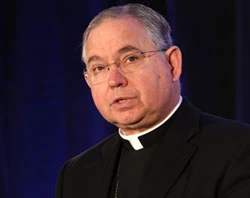
Washington D.C., Mar 23, 2011 / 10:07 am (CNA).- At a conference on U.S.-Mexico relations on March 21, Archbishop Jose H. Gomez of Los Angeles explained that the Catholic Church's social teaching can provide essential guidance on the question of immigration, and other dilemmas presented by a globalized economy.
The Mexican-born archbishop, who is also a U.S. citizen, addressed participants gathered at the Catholic University of America in Washington, D.C. for a conference on the Church's role in the immigration debate.
He encouraged audience members – including Mexico's ambassador to the U.S., Arturo Sarukhan, and the U.S. Assistant Secretary of State Eric Schwartz – to consider both the large-scale economic factors driving immigration, and the rights and needs of individuals caught up in these economic changes.
“Globalization has expanded opportunities for businesses and for workers,” Archbishop Gomez acknowledged. “But it has also created new problems in the relationships between our nations.”
“The biggest problem is that while we have developed laws and policies to govern the flow of capital and money, we have no standards for the movement of laborers.”
“Money, capital, and other resources now flow more freely between our nations,” he noted. “But human beings — the men and women who do the work — cannot.”
Archbishop Gomez also spoke frankly about the need to deal realistically and humanely with the reality of unauthorized immigration.
He emphasized that he was interested in the immigration question not primarily as a matter of politics or diplomacy, but as a spiritual and moral issue affecting millions of people.
“I am not a politician or a diplomat or an expert in the global economy,” said the archbishop. “My concern is to be faithful to the Gospel of Jesus Christ, and to defend and promote the dignity of the human person who is made in the image of God.”
He spoke eloquently of the spiritual toll that immigration often takes on those who lack opportunities in their homeland but are exploited or even hated in their new country.
“It gets harder every day to hold onto your cultural identity, your moral compass, your religion, your dignity,” he observed. “You start to believe what people say about you — that you are no good.”
Archbishop Gomez went on to propose a series of measures to address the root causes of immigration, while respecting the human needs and rights of those who have entered the U.S. illegally.
Many aspects of the problem, the archbishop said, arose from underdevelopment within Mexico – a problem that has no instantaneous solution, but demands urgent action.
“We need to find ways to target economic development,” he said, “so that far fewer Mexicans will feel compelled to leave their homes to seek jobs and money in other countries.”
Archbishop Gomez also indicated that the prosperity of nations and transnational corporations must not be placed above the good of the individuals who make such prosperity possible. He strongly urged his fellow U.S. Catholics to consider the human dignity of immigrants, even as they seek to ensure the rule of law.
“Our current policies of enforcement — detentions, and deportations — are a humanitarian tragedy,” he stated. “We are destroying families in the name of enforcing our laws.”
He pointed out that a nation's immigration laws, however important, could not be given absolute priority over the bonds of family – which precede the state itself, according to the natural law.
“Practically speaking,” he stated, “I would like to see a moratorium on new state and local immigration legislation. And, as the U.S. bishops have called for, I would like to see an end to the severe deportation policies.”
Archbishop Gomez also noted that children and women are the “most vulnerable migrants,” who “often fall prey to unscrupulous traffickers” and others seeking to exploit or harm them. He urged policymakers to consider the safety of these populations, and also to remember the needs of all immigrants who are seeking to be reunited with family members by attaining a U.S. visa.
“All of these measures,” said the archbishop, “would make a real difference in the lives of millions of people.
“But they are only temporary,” he noted. “We need to muster the political will to fix our broken immigration system.”
Saturday, February 5, 2011
US Bishops Notify Congress of Policy Goals
This article comes from the National Catholic Reporter.
The bishops want equal access to the Internet for all!
-----------------------------------------------
Letters outline US bishops’ policy priorities
Feb. 03, 2011
By Michael Sean Winters
The U.S. bishops released two letters to members of Congress late last month that outline “principles and priorities that guide the public policy efforts” of the U.S. Conference of Catholic Bishops.
The first letter, signed by the newly installed conference president, Archbishop Timothy Dolan of New York, exhorts the lawmakers to protect human life from conception to natural death. “Our prayers and hopes [are] that this newly elected Congress will advance the common good and defend the life and dignity of all, especially vulnerable and poor persons whose needs are critical in this time of difficult economic and policy choices.”
The letters were dated Jan. 14 and released to the public Jan. 18.
Dolan pledges to “seek ways to work constructively with the administration and the new Congress and others of goodwill to pursue policies which respect the dignity of all human life and bring greater justice to our nation and peace to our world.”
The second letter – signed by Cardinal Daniel DiNardo of Galveston-Houston, head of the pro-life committee; Bishop Stephen E. Blaire of Stockton, Calif., chairman of the justice and human development committee; and Archbishop José H. Gomez of Los Angeles, chairman of the migration committee – dealt specifically with the issue of health care legislation.
Dolan wrote that the bishops approach public policy “not as politicians but as pastors and teachers … [of] the largest community of faith in the United States, one that serves every part of our nation and is present in almost every place on earth.”
The bishops “will work to retain essential, widely supported policies which show respect for unborn life, protect the conscience rights of health care providers and other Americans, and prevent government funding and promotion of abortion,” Dolan wrote. He asked that the Hyde Amendment, which prevents the use of federal funds for all elective abortion, be enacted as a permanent provision.
Dolan then articulated the bishops’ concern to defend traditional marriage, calling for vigorous enforcement of the Defense of Marriage Act, which limits the degree to which the federal government can recognize same-sex partnerships.
The letter next addressed a variety of concerns about social justice and the poor that range the bishops more on the political left than the political right.
It said that the bishops support economic policies that protect the poor, and call for aid to Catholic schools and continued funding for faith-based organizations that cooperate with the government in providing social services.
Dolan also addressed a novel issue: equal access to the Internet, the first time this issue has received such prominent attention from the bishops’ conference.
He called for comprehensive immigration reform, “recognizing that human dignity comes from God and does not depend on where people were born or how they came to our nation.” Among those items the bishops seek are “a path to earned citizenship, with attention to the fact that international trade and development policies influence economic opportunities in the countries from which immigrants come,” and some effort to prioritize family reunification.
Turning to international affairs, the letter calls for a “responsible” end to the wars in Iraq and Afghanistan, and voices special concern for the religious freedom of Christians and others, noting recent attacks on Christians in Egypt, Iraq and Nigeria, as well as the assassination of a Pakistani official who had spoken against that country’s blasphemy law.
Dolan also urged “continued and persistent leadership” to secure a lasting peace in the Holy Land, support for peaceful change in Sudan, and continued efforts to alleviate the sufferings of the people of Haiti.
Dolan’s letter follows the pattern set by Pope Benedict XVI in his encyclical letter Caritas in Veritate, albeit with far less explicit theological arguments. Dolan’s letter articulates a variety of concerns, all of which flow from the church’s teaching on human dignity, even though some of those concerns are shared mostly with Republicans and others mostly with Democrats.
Dolan’s letter appears to be a far cry from the position held by some conservative Catholics, such as Princeton University Professor Robert George, who argue that the church’s focus should be narrower, restricted to so-called “nonnegotiable” issues like opposition to abortion and support for traditional marriage and religious freedom.
Some might be disappointed to find that immigration comes near the very end, as if it were not a real priority for the bishops and a pressing issue for the country.
The second letter from the three bishops whose committees were most engaged in last year’s health care debate is primarily interesting because it didn’t support efforts to repeal the health care reform law.
“Throughout the last Congress the Catholic bishops of the United States affirmed our strong support for universal access to health care,” the bishops write. “Basic health care for all is a moral imperative, not yet completely achieved.”
They call for Congress to address the health care needs of immigrants, a need unaddressed in last year’s health care law.
The letter from the three bishops enumerates the bishops’ reservations concerning federal funding of abortion and conscience protections for health care workers and Catholics hospitals. They note that these last concerns can all be achieved by enacting other bills that amend the law without repealing it. One such effort, previously introduced in the last Congress, would put the original Stupak-Pitts language back in the law, codifying the Hyde Amendment by law rather than executive order, as President Obama did last year. The Stupak-Pitts Amendment failed last year when no Senate Republican promised to vote for the health care law if the amendment was attached to it.
Another prospective bill would shore up conscience protections for Catholic health care workers, a growing concern of the bishops.
No one seeking to repeal the health care law will likely find solace in this letter.
Both letters exemplify a lack of sharp elbows. The respectful tone, the lack of any demonization or mischaracterization of the views of others, the ideological balance and measured analysis, these all distinguish the bishops’ voices from so many others in the public square.
If the next three years of Dolan’s leadership follow the form and content of this letter, the church’s relationship with the political realm might be less volatile and more constructive then we’ve seen in recent years.
[Based in the nation’s capital, Michael Sean Winters writes the Distinctly Catholic blog.]
Thursday, January 20, 2011
US Ambassador to Vatican Seeks Common Ground
This article comes from the Catholic News Agency.
-----------------------------------
Profile: US ambassador seeks to 'build bridges' with Vatican
By Alan Holdren
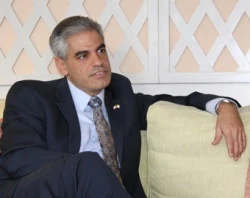
Rome, Italy, Jan 20, 2011 / 04:37 pm (CNA/EWTN News).- America’s ambassador to the Holy See says the two sides are working to rebuild trust following the leak of embarrassing diplomatic cables late last year.
“What brings us together is far, far, far more than what sets us apart, and I want to focus on that," Ambassador Miguel H. Diaz told CNA in a wide-ranging interview at his hilltop residence in Rome Jan. 19.
Ambassador Diaz said that during his 16 months in Rome he has seen “significant signs that show the ongoing commitment of this President, the White House, and our government in general to fostering and deepening this relationship.”
He said the scandal of the U.S. diplomatic cables, released on the website WikiLeaks has not effected the Vatican-U.S. working relationship.
According to an analysis by CNA, more than 700 cables from the U.S. embassy to the Vatican were among the 250,000 State Department cables obtained by WikiLeaks.
To date, only a handful of them has been released. But some of those have proven embarrassing, including one in which a U.S. embassy staffer poked fun at the “poor communications culture” in the Vatican and another in which Vatican Secretary of State Tarcisio Bertone was described as “yes man.”
The WikiLeaks affair has been a bump in the road in an otherwise easy and low-key relationship between the Vatican and the administration of U.S. President Barack Obama, during his first two years in office.
Ambassador Diaz is credited with running a smooth diplomatic operation — especially considering that prior to this he has had no previous diplomatic experience.
The 45-year old Cuban-American was a professor of theology at the College of Saint Benedict and Saint John's University in Minnesota when the call came from the White House in May 2009, five months after President Obama was inaugurated.
Reportedly, he was not first on the list for the position. However, the president’s top choices had to be rejected because they favored abortion or embryonic stem cell research — positions that would have made their appointment appear to be a snub to the Vatican.
The U.S. Senate confirmed Ambassador Diaz in August 2009, and since then he and his wife, also a theology professor, have been living with their four children in the ambassador's residence atop Rome’s Janiculum Hill.
When Pope Benedict XVI received Ambassador Diaz for the first time to accept his credentials, he did so warmly. But he made a point of emphasizing the Church’s differences with the U.S. administration.
“I think particularly of the need for a clear discernment with regard to issues touching the protection of human dignity and respect for the inalienable right to life from the moment of conception to natural death, as well as the protection of the right to conscientious objection on the part of health care workers, and indeed all citizens,” the Pope told the new ambassador.
Despite broad disagreements on basic policies, Ambassador Diaz said he is focusing on the values and the interests the two sides share.
"I think it's important to recognize that there are differences,” he said. “But I think it's important not to be paralyzed by those differences. The things that we have in common far exceed the things that divide us," said Ambassador Diaz.
As the ninth U.S. ambassador, Diaz said he is really "standing on the shoulders" of the "giants" that have gone before him.
Unofficial relations between the two states go back to the birth of America, when President George Washington assured Pope Pius VI that the Pope would have full freedom to appoint bishops in the new land.
It would take until President Ronald Reagan in 1984 for the U.S. to establish its first official embassy here. At that time, it was widely perceived that the U.S. president saw the Vatican and then-Pope John Paul II as an important ally in the fight against communism.
The embassy recently celebrated its 27th anniversary. Ambassador Diaz has as a staff of 19 — a formidable presence for promoting U.S. foreign policy at the world's smallest state.
"The size is really inversely proportional to the scope of influence," said Ambassador Diaz. “You can't just think of the Holy See as boxed with the Vatican City walls. We have to think of it as this vast network."
Since his Senate confirmation hearings, Ambassador Diaz has spoken of his vision for the embassy as one of “building bridges.”
And he has pursued that strategy during his 16-month tenure. He has worked diligently to build relationships not only with Vatican officials, but also with the wider institutions of the universal Church — pontifical universities, religious communities, even hospitals, non-profits and humanitarian agencies.
The embassy has sponsored several high-profile meetings to highlight areas of mutual interest.
An embassy-sponsored conference in 2009 brought professionals to the city to raise awareness of the need to stop mother-child transmission of AIDS. The embassy co-sponsored a concert with the Church aid agency Caritas to raise money for Haitian earthquake victims.
An embassy-sponsored conference at the Pontifical Gregorian University last October encouraged members of different faith traditions to come together in "building bridges." At the event, the director of the White House's Office of Faith-Based and Neighborhood Partnerships, Joshua DuBois, gave the keynote address.
But Ambassador Diaz said much of his diplomatic work is done in one-on-one conversations — what he called "diplomacy at the table" during luncheons and dinners, and "targeted diplomacy" with Vatican contacts through more formal channels.
The issues of concern to the U.S. and the Vatican are broad and far-reaching.
"One of the greatest challenges,” he said, was how the “human family” is going to “reconcile” its “incredible diversity” of religions and cultures. This diversity, he said, “increasingly threatens to tear us apart.”
On that note, Ambassador Diaz called Pope Benedict’s annual speech to diplomats Jan. 10 “ambitious.”
The Pope used strong language to condemn religious discrimination and persecution around globe, especially in the Middle East, North Africa and China.
"The task of building bridges is essential if we are to bring about reconciliation and peace, and if we are going to tackle ongoing problems such as the trafficking of persons and basic violations of human dignity — including violations for persons to exercise a right to religious freedom," Ambassador Diaz said.
He sees a "bridge-building" opportunity in Pope Benedict's call for world religious leaders to gather in Assisi next October to pray for peace. It is fitting that such an encounter should take place in the birthplace of St. Francis, whose name is associated with peace and reconciliation.
In an "interconnected" world, St. Francis’ message that all things are tied together is important, Ambassador Diaz said. The day of prayer called by the Pope has the potential to "do what religion is intended to do — bring people together and not drive them apart."
"In this interdependent world, civic leaders cannot act alone, no nation can act alone, and the contribution of religious leaders is essential in the building of peace, the defending of human dignity, the fight against any type of abuse. And certainly the religious leaders have a central role to play in that outgoing, noble task," Ambassador Diaz said.
He identified ending human trafficking and promoting education and migration issues as the embassy's top priorities.
"There are so many different areas that wherever the dignity of the human person is violated, that persons … and organizations associated with the Church can help," he explained.
"I think that's where the effective work of building those bridges and defending that dignity would come in, the day-to-day exercise of this relationship."
He does not downplay the continued differences between the U.S. and the Holy See on issues such as abortion, embryonic stem cell research, the homosexual lifestyle, and the promotion of condoms for AIDS prevention.
No diplomatic relationship finds both sides seeing eye-to-eye on every issue, Ambassador Diaz noted. "That's the ideal, the ideal will never be there."
He prefers to concentrate on his responsibility as President Obama's personal representative to the Holy See.
"As a person of integrity, I would not be sitting here if I did not believe that there was a significant convergence in my ability to carry out this duty here at the Holy See,” he said. “I'm defending the dignity of human persons in different ways. I am building bridges. And these are fundamental tenets of this administration and fundamental tenets of who I am as a person.”
He would like his time as ambassador to be remembered as one in which U.S. foreign policy and the common interests of the Holy See were united "to advance the common good of the human family."
"If I can do that, even if it's just in little ways, during my tenure here, then I'll call it a success,” he said. “I'll be happy that I did my job, which is to answer the call — certainly of President Obama and of my country, to serve it — and also the call of the human family and the Church to advance the common good."
Wednesday, January 19, 2011
US Catholic Bishops Name Legislative Agenda
This article comes from Catholic Culture.
-----------------------------
US bishops outline 9 legislative priorities
Archbishop Timothy Dolan of New York, president of the United States Conference of Catholic Bishops (USCCB), outlined the conference’s nine legislative priorities for the coming year. The top priority, he said in a letter to members of Congress, is the protection of innocent human life from abortion and euthanasia.
Most fundamentally, we will work to protect the lives of the most vulnerable and voiceless members of the human family, especially unborn children and those who are disabled or terminally ill [emphasis in text]. We will consistently defend the fundamental right to life from conception to natural death. Opposed to abortion as the direct killing of innocent human life, we will encourage one and all to seek common ground, reducing the number of abortions by providing compassionate and morally sound care for pregnant women and their unborn children. We will oppose legislative and other measures to expand abortion. We will work to retain essential, widely supported policies which show respect for unborn life, protect the conscience rights of health care providers and other Americans, and prevent government funding and promotion of abortion. The Hyde amendment and other provisions which for many years have prevented federal funding of abortion have a proven record of reducing abortions, and should be codified in permanent law. Efforts to force Americans to fund abortions with their tax dollars pose a serious moral challenge, and Congress should act to ensure that health care reform does not become a vehicle for such funding.
“In close connection with our defense of all human life and particularly the most vulnerable among us, we stand firm in our support for marriage which is and can only be a faithful, exclusive, lifelong union of one man and one woman,” he continued.
There is good reason why the law has always recognized this, and why it should continue to do so. In a manner unlike any other relationship, marriage makes a unique and irreplaceable contribution to the common good of society, especially through the procreation and education of children. Children need, deserve and yearn for a mother and a father. All human societies in every era of history, differing greatly among themselves in many other ways, have understood this simple wisdom. No other kinds of personal relationships can be justly made equivalent or analogous to the commitment of a husband and a wife in marriage, because no other relationship can connect children to the two people who brought them into the world. For this reason, we will continue to vigorously support the Defense of Marriage Act (DOMA) and strongly oppose legislative or executive measures that seek to redefine or erode the meaning of marriage. We suggest Congressional oversight of executive actions that have the effect of undermining DOMA, such as the expansion of spousal benefits to two persons of the same sex, and the weak defense of DOMA in court against constitutional challenge. We will seek to reflect respect for the family in every policy and program, to protect the rights of children, and to uphold the rights and responsibilities of mothers and fathers to care for their children. We will also continue to monitor legislation and federal regulations that protect our children and families from the destructive repercussions of pornography, which degrades human sexuality and marital commitment.The conference’s next four concern economic challenges, equity in educational funding for private schools, assisting faith-based groups in ways that do not require them “to abandon their identity or mission,” and “equal access to the Internet for all, including religious and non-profit agencies.” Archbishop Dolan then touched upon universal health care:
The Catholic Bishops of the United States have worked for nearly a century to assure health care for all, insisting that access to health care is a basic human right and a requirement of human dignity. Basic health care for all is a moral imperative, not yet completely achieved. We remain committed to our three moral criteria: 1) Ensure access to quality, affordable, life-giving health care for all; 2) Retain longstanding requirements that federal funds not be used for elective abortions or plans that include them, and effectively protect conscience rights; and 3) Protect the access to health care that immigrants currently have and remove current barriers to access. We will continue to devote our efforts to improving and correcting serious moral problems in the current law, so health care reform can truly be universal and life-affirming.The conference’s final two legislative priorities concern comprehensive immigration reform and international affairs, with an emphasis on “responsible transitions to end the wars in Iraq and Afghanistan” and promoting “religious freedom for all, acting against religious repression of our fellow Christians and others.”
Tuesday, January 18, 2011
Catholic Figures Played Major Role in START Treaty
The Vatican has worked hard to spread the ideas of nuclear non-proliferation.
And why is that?
Because the Vatican doesn't have nuclear weapons -- it wants to level the political playing field.
This article comes from the National Catholic Reporter.
------------------------------
Catholics had a major role in passing nuclear treaty
By Dennis Sadowski
WASHINGTON -- As Democratic and Republican senators pressed their divergent views on the New START agreement with Russia outlining the next phase of nuclear disarmament during final debate in December, a wide array of Catholics played a major role in getting the pact ratified.
From political insiders to people in the pews, Catholics provided a moral perspective on the need for the treaty, helping build the final 71-26 margin for ratification, several people working on the issue told Catholic News Service.
The effort by Catholics also helped keep the vote on schedule, preventing it from being pushed into 2011 when the likelihood of ratification would have been dimmer because of the loss of six Democratic seats in the Senate.
Both houses of the Russian parliament are reviewing the treaty and are expected to ratify it in the coming weeks.
No one contacted by CNS said that without the Catholic effort the treaty would have failed. But they acknowledged that the involvement of such a broad array of Catholic voices -- from Archbishop Edwin F. O'Brien of Baltimore, who formerly headed the U.S. Archdiocese for the Military Services, to Dave Robinson, executive director of Pax Christi USA -- ratification became much easier to accomplish in an era where bipartisan cooperation in Congress is almost nonexistent.
David Culp, legislative representative for the Quaker Friends Committee on National Legislation, heaped high praise on Catholics. He pointed to the efforts by the U.S. Conference of Catholic Bishops as well as key Catholic members of Congress and the Obama administration for leading the way.
"(Catholics) definitely have been the most active and most important faith-based group working on this," Culp said. "This has been an amazing effort (by Catholics) from top to bottom."
Pax Christi's Robinson described the Catholic effort as one that has naturally evolved given the church's increasingly stronger stance against nuclear weapons.
"This is an example of people both on the inside and the outside able to apply their values and faith traditions on a really important public policy matter that is going to enhance security and move us down to the road to a nuclear weapons-free world," he said.
The new treaty calls for both countries to reduce their strategic arsenals -- weapons deployed on long-range missiles, bombers and submarines -- to 1,550 each. Under the previous START pact, which expired in December 2009, both countries reduced their strategic arsenals to 2,200 weapons each.
Key Catholic insiders working for the treaty's ratification included the likes of Vice President Joe Biden and aide Brian McKeon; Sen. John Kerry, D-Mass., chairman of the Committee on Foreign Relations; Denis McDonough, deputy national security adviser; and Rose E. Gottemoeller, assistant secretary in the Department of State's Bureau of Verification, Compliance and Implementation, who was the lead U.S. negotiator of the agreement.
Gottemoeller, who holds a degree in Russian from Georgetown University, told CNS she welcomed the "high level of interest" in nuclear disarmament among people of faith, especially Catholics and evangelicals.
"It was important to engage people's interest and to have the Catholic bishops of the United States and Catholic organizations to step forward and speak about the importance of the issue and engage the public," she said.
At the White House, two staffers speaking on background, said their work was motivated by the president's desire to get the treaty ratified as opposed to adhering to the teaching of any particular faith. Both welcomed the comments of people of faith, saying those views were "taken into account" as strategies for approaching senators sitting on the fence were formed.
Stephen Colecchi, director of the USCCB's Office of International Justice and Peace, explained that the bishops staked out their position on the treaty soon after Obama announced April 8 in Prague that he and Russian President Dmitry Medvedev signed the arms reduction pact.
"The fact that Catholics were leading the effort is not a surprise to me," Colecchi said.
He said 30 bishops -- a much larger number than on most legislative issues other than same-sex marriage, abortion and health care -- contacted senators at various times in 2010.
Leading the way was Bishop Howard J. Hubbard of Albany, N.Y., chairman of the bishops' Committee on International Justice and Peace. He regularly joined teleconferences and sent letters to the Senate on behalf of the conference.
The bishops were backed by hundreds of letters from religious orders as well as average Catholics who responded to a series of legislative alerts issued by Colecchi's office.
"The church's teaching on this is very clear and it's very clear on the issue of protecting human life and human dignity," Colecchi said, explaining why large numbers of people responded to the arms control issue.
Outside of the conference, as expected, organizations such as the Maryknoll Office of Global Concerns and Network, a Catholic social justice lobbying organization, also made their voices heard.
This time though, they were joined by the National Association of Evangelicals and organizations such as the Two Futures Project, headed by the Rev. Tyler Wigg-Stevenson, whose influence on social issues is gaining favor rapidly among more traditionally conservative Christians.
"This is an example of where the church's teaching formed and motivated people," Colecchi said. "I think we can be very proud of our church and very proud of our bishops."
Wednesday, January 12, 2011
Venezuelan Bishops Defy Chavez
This article comes from the Washington Post.
----------------------------------
Catholic leaders warn of 'totalitarian' Venezuela
CARACAS, Venezuela -- Roman Catholic leaders in Venezuela are calling for President Hugo Chavez to give up special lawmaking powers granted to him by his congressional allies.
The Venezuelan Bishops' Conference condemned a package of laws approved last month by the National Assembly, including one that grants Chavez power to enact laws by decree for the next 18 months. Chavez gained those powers shortly before a new congress took office with more opposition lawmakers.
A statement from the bishops released Tuesday accuses Chavez of trying to impose a totalitarian system in Venezuela.
Chavez and the bishops have feuded for years. Chavez has accused the Catholic leadership of neglecting the poor and of siding with his opponents and the rich.
----------------------------------
Catholic leaders warn of 'totalitarian' Venezuela
CARACAS, Venezuela -- Roman Catholic leaders in Venezuela are calling for President Hugo Chavez to give up special lawmaking powers granted to him by his congressional allies.
The Venezuelan Bishops' Conference condemned a package of laws approved last month by the National Assembly, including one that grants Chavez power to enact laws by decree for the next 18 months. Chavez gained those powers shortly before a new congress took office with more opposition lawmakers.
A statement from the bishops released Tuesday accuses Chavez of trying to impose a totalitarian system in Venezuela.
Chavez and the bishops have feuded for years. Chavez has accused the Catholic leadership of neglecting the poor and of siding with his opponents and the rich.
Honduran Cardinal Receives Death Threats After Coup
See this post and others in the LATIN AMERICA category for background on this story.
This article comes from the Catholic News Agency.
----------------------------
Honduran cardinal denounces death threats
Tegucigalpa, Jan 11, 2011 / 11:58 am (CNA).- Cardinal Oscar Rodriguez Maradiaga of Tegucigalpa, Honduras recently stated he has been the target of death threats since 2009. He believes the threats are from supporters of the country's deposed President Manuel Zelaya.
President Zelaya was removed from office in June 2009 and was replaced by an interim leader until elections were held. Current Honduran President Porfirio Lobo Sosa was then voted into office.
Zelaya's opponents assert he was impeached by order of the Supreme Court of Honduras for serious crimes, including treason. His supporters argue he was illegally expelled by the military and the high court.
Cardinal Rodriguez Maradiaga stated on Jan. 6 that he has been receiving death threats from individuals who have labeled him a “supporter of the coup.” The cardinal then told Honduras' Channel 10 that soon after the Honduran bishops’ conference issued a statement about the intentions of then-President Zelaya to hold a referendum to draft a new constitution, he “had already become the target of death threats.”
He added that the threats “have been continuous” since June 2009.
“We had all of the pertinent information,” Cardinal Maradiaga said, “and we issued a statement which I read as president on Saturday,” the day before Zelaya was removed from office.
Tuesday, January 11, 2011
Venezuelan Bishop Criticizes Gov't Land Takings
Thus continues the Vatican's confrontational policy with President Hugo Chavez. It is almost certain that the United States is supporting this policy behind the scenes.
This article comes from Catholic News Agency.
---------------------------
Venezuelan cardinal: Government land seizure become serious issue
Caracas, Venezuela, Jan 11, 2011 / 03:09 pm (CNA).- Cardinal Jorge Urosa Savino of Caracas, Venezuela warned that some of the government's recent land seizures have not followed procedures outlined in the country's Constitution.
“While it is true that the government has the power to confiscate, it must do so by following the procedures established in the Constitution,” the cardinal said after Mass for the World Day of Peace on Jan. 9. He noted that “this is not happening in some cases.”
Cardinal Urosa acknowledged that there is a great demand for more housing in the country, but that the need – which sharply increased due to the recent flooding – “is not going to be resolved in six months.”
“The interests and rights of all people must be reconciled, and the government should do so justly,” the cardinal asserted.
New excuse?
In the past week, the Venezuelan government has confiscated numerous buildings and plots claiming they will be used for the construction of homes for those affected by the flooding. However, Rafael Alfonzo, a leading financial analyst, called the move a “new excuse” by Hugo Chavez to take over private lands. Chavez alleged that the measures are necessary to protect the food supply, to “rescue” lands from plantation owners, and to prevent monopolies and market speculation.
The Observatory of Property Rights in Venezuela reported that between 2005 and 2010, some 1,729 violations of private property by the government took place, and that during the last year there were 535 cases of confiscation. The most controversial one involved 2.2 acres of land belonging to the Antimano child nutrition center. Chavez said the center would now be known as the “Amatina Socialist Community.”
On his television program “Alo Presidente” on Jan. 9, Chavez ordered the confiscation of land to “accelerate all over the country, especially south of Maracaibo Lake,” where land belonging to the El Delirio and Dinamarca ranches was recently confiscated.
Sunday, January 9, 2011
Ten Percent of US Congress Educated by Jesuits
A sobering statistic indeed.
Does this mean that 10% of our elected representatives are working for the Vatican? No. However, it does suggest that 10% of our elected representatives perform their political work with a mindset uniquely influenced by Jesuit ideology and remain more open to Vatican influence than other members of Congress.
This post comes from National Jesuit News.
------------------------------
Graduates of Jesuit Institutions Well Represented in the 112th U.S. Congress
8 January 2011Ten percent of the 112th U.S. Congress are Jesuit college and university alumni/ae. Among the 535 Members of this Congress, 53 of them are alumni/ae of Jesuit institutions. At least 30 alums also serve in appointed positions in the Obama Administration.
“With the many challenges facing our nation, we are happy that our Jesuit college and university alumni/ae continue to play important roles in Congress and the Administration,” said AJCU President Fr. Charles Currie, S.J. “Their commitment to lead and to serve is in the best Jesuit tradition.”
There are 12 Jesuit alumni/ae in the Senate and 41 in the House of Representatives. Among the top leadership, Congressmen John Boehner (R-OH) is the first Jesuit alumnus to serve as the Speaker of the House of Representatives. Congressman Steny Hoyer (D-MD) serves as the House Minority Whip. In the Senate, Senator Richard Durbin (D-IL) continues as the Assistant Majority Leader.
Of these 53 alumni/ae, 35 received graduate or professional degrees from Jesuit universities. There are 18 Jesuit institutions represented by alumni/ae in the U.S. Congress. Georgetown University has the most alumni/ae with a total of 18; followed by Boston College with seven; the College of the Holy Cross with four; while Creighton University, Fordham University, Marquette University, and the University of Detroit Mercy each have three.
For a full listing of Jesuit alumni/ae, click here.
Saturday, January 8, 2011
Lorenzo Valla: Part III
Lorenzo Valla was a 15th century Italian priest and humanist who took it upon himself to challenge the Roman popes on their alleged "inheritance" from the Emperor Constantine. The following is the third part of Valla's Discourse on the Forgery of the Donation of Constantine.
Here, Valla discusses several more reasons why Constantine's "donation" could not possibly be genuine.
See the History tag on the sidebar to find the previous two posts, as well as the original post on the Donation of Constantine.
The text comes from the Hanover Historical Texts Project.
---------------------------------
[CONTINUED]
Proceed to the next point; to make us believe in this "donation" which your document recites, something ought still to be extant concerning Sylvester's acceptance of it. There is nothing concerning it extant. But it is believable, you say, that he recognized this "donation." I believe so, too; that [if it was given] he not only recognized it, but sought it, asked for it, extorted it with his prayers; that is believable. But why do you reverse the natural conjecture and then say it is believable? For the fact that there is mention of the donation in the document of the deed is no reason for inferring that it was accepted; but on the contrary, the fact that there is no mention [anywhere] of an acceptance is reason for saying that there was no donation. So you have stronger proof that Sylvester refused the gift than that Constantine wished to give it, and a benefaction is not conferred upon a man against his will. Indeed, we must suspect not so much that Sylvester refused the grants as that he tacitly disclosed that neither could Constantine legally make them nor could he himself legally accept.
O avarice, ever blind and ill-advised! Let us suppose that you may be able to adduce even genuine documents for the assent of Sylvester, not tampered with, authentic: even so, were the grants actually made which are found in such documents? Where is any taking possession, any delivery? For if Constantine gave a charter only, he did not want to befriend Sylvester, but to mock him. It is likely, you say, that any one who makes a grant, gives possession of it, also. See what you are saying; for it is certain that possession was not given, and the question is whether the title was given! It is likely that one who did not give possession did not want to give the title either.
Or is it not certain that possession was never given? To deny it is the sheerest impudence. Did Constantine ever lead Sylvester in state to the Capitol amid the shouts of the assembled Quirites, heathen as they were? Did he place him on a golden throne in the presence of the whole Senate? Did he command the magistrates, each in the order of his rank, to salute their king and prostrate themselves before him? This, rather than the giving of some palace such as the Lateran, is customary in the creation of new rulers. Did he afterwards escort him through all Italy? Did he go with him to the Gauls? Did he go to the Spains? Did he go to the Germans, and the rest of the West? Or if they both thought it too onerous to traverse so many lands, to whom did they delegate such an important function, to represent Caesar in transferring possession and Sylvester in receiving it? Distinguished men, and men of eminent authority, they must have been: and nevertheless we do not know who they were. And how much weight there is here in these two words, give and receive! To pass by ancient instances, I do not remember to have seen any other procedure when any one was made lord of a city, a country, or a province; for we do not count possession as given until the old magistrates are removed and the new ones substituted. If then Sylvester had not demanded that this be done, nevertheless the dignity of Constantine required that he show that he gave possession not in words but in fact, that he ordered his officers to retire and others to be substituted by Sylvester. Possession is not transferred when it remains in the hands of those who had it before, and the new master dares not remove them.
But grant that this also does not stand in the way, that, notwithstanding, we assume Sylvester to have been in possession, and let us say that the whole transaction took place though not in the customary and natural way. After Constantine went away, what governors did Sylvester place over his provinces and cities, what wars did he wage, what nations that took up arms did he subdue, through whom did he carry on this government? We know none of these circumstances, you answer. So! I think all this was done in the nighttime, and no one saw it at all!
Come now! Was Sylvester ever in possession? Who dispossessed him? For he did not have possession permanently, nor did any of his successors, at least till Gregory the Great, and even he did not have possession. One who is not in possession and cannot prove that he has been disseized certainly never did have possession, and if he says he did, he is crazy. You see, I even prove that you are crazy! Otherwise, tell who dislodged the Pope? Did Constantine himself, or his sons, or Julian, or some other Caesar? Give the name of the expeller, give the date, from what place was the Pope expelled first, where next, and so in order. Was it by sedition and murder, or without these? Did the nations conspire together against him, or which first? What! Did not one of them give him aid, not one of those who had been put over cities or provinces by Sylvester or another Pope? Did he lose everything in a single day, or gradually and by districts? Did he and his magistrates offer resistance, or did they abdicate at the first disturbance? What! Did not the victors use the sword on those dregs of humanity, whom they thought unworthy of the Empire, to revenge their outrage, to make sure of the newly won mastery, to show contempt for our religion, not even to make an example for posterity? Did not one of those who were conquered take to flight at all? Did no one hide? Was no one afraid? 0 marvellous event! The Roman Empire, acquired by so many labors, so much bloodshed, was so calmly, so quietly both won and lost by Christian priests that no bloodshed, no war, no uproar took place; and not less marvellous, it is not known at all by whom this was done, nor when, nor how, nor how long it lasted! You would think that Sylvester reigned in sylvan shades, among the trees, not at Rome nor among men, and that he was driven out by winter rains and cold, not by men!
Who that is at all widely read, does not know what Roman kings, what consuls, what dictators, what tribunes of the people, what censors, what aediles were chosen? Of such a large number of men in times so long past, none escapes us. We know also what Athenian commanders there were, and Theban, and Lacedemonian; we know all their battles on land and sea. Nor are the kings of the Persians unknown to us; of the Medes; of the Chaldeans; of the Hebrews; and of very many others; nor how each of these received his kingdom, or held it, or lost it, or recovered it. But how the Roman Empire, or rather the Sylvestrian, began, how it ended, when, through whom, is not known even in the city of Rome itself. I ask whether you can adduce any witnesses of these events, any writers. None, you answer. And are you not ashamed to say that it is likely that Sylvester possessed-even cattle, to say nothing of men!
But since you cannot [prove anything], I for my part will show that Constantine, to the very last day of his life, and thereafter all the Caesars in turn, did have possession [of the Roman Empire], so that you will have nothing left even to mutter. But it is a very difficult, and, I suppose, a very laborious task, forsooth, to do this! Let all the Latin and the Greek histories be unrolled, let the other authors who mention those times be brought in, and you will not find a single discrepancy among them on this point. Of a thousand witnesses, one may suffice; Eutropius, who saw Constantine, who saw the three sons of Constantine who were left masters of the world by their father, and who wrote thus in connection with Julian, the son of Constantine's brother: "This Julian, who was subdeacon in the Roman church and when he became Emperor returned to the worship of the gods, seized the government, and after elaborate preparations made war against the Parthians; in which expedition I also took part." He would not have kept silent about the donation of the Western Empire [had it been made], nor would he have spoken as he did a little later about Jovian, who succeeded Julian: "He made with Sapor a peace which was necessary, indeed, but dishonorable, the boundaries being changed and a part of the Roman Empire being given up, a thing which had never before happened since the Roman state was founded; no, not even though our legions, at the Caudine [Forks] by Pontius Telesinus, and in Spain at Numantia, and in Numidia, were sent under the yoke, were any of the frontiers given up."
Here I would like to interrogate I you, most recent, though deceased, Popes, and you, Eugenius, who live, thanks only to Felix. Why do you parade the Donation of Constantine with a great noise; and all the time, as though avengers of a stolen Empire, threaten certain kings and princes; and extort some servile confession or other from the Emperor when he is crowned, and from some other princes, such as the king of Naples and Sicily? None of the early Roman pontiffs ever did this, Damasus in the case of Theodosius, nor Syricius in the case of Arcadius, nor Anastasius in the case of Honorius, nor John in the case of Justinian, nor the other most holy Popes respectively in the case of the other most excellent Emperors: rather they always regarded Rome and Italy and the provinces I have named as belonging to the Emperors. And so, to say nothing of other monuments and temples in the city of Rome, there are extant gold coins of Constantine's after he became a Christian, with inscriptions, not in Greek, but in Latin letters, and of almost all the Emperors in succession. There are many of them in my possession with this inscription for the most part, under the image of the cross, "Concordia orbis [The Peace of the World]." What an infinite number of coins of the supreme pontiffs would be found if you ever had ruled Rome! But none such are found, neither gold nor silver, nor are any mentioned as having been seen by any one. And yet whoever held the government at Rome at that time had to have his own coinage: doubtless the Pope's would have borne the image of the Savior or of Peter.
Alas for man's ignorance! You do not see that if the Donation of Constantine is authentic nothing is left to the Emperor, the Latin Emperor, I mean. Ah, what an Emperor, what a Roman king, he would be, when if any one had his kingdom and had no other, he would have nothing at all! But if it is thus manifest that Sylvester did not have possession, that is, that Constantine did not give over possession, then there will be no doubt that he [Constantine], as I have said, did not give even the right to possess. That is, unless you say that the right was given, but that for some reason possession was not transferred. In that case he manifestly gave what he knew would never in the least exist; he gave what he could not transfer; he gave what could not come into the possession of the recipient until after it was nonexistent; be gave a gift which would not be valid for five hundred years, or never would be valid. But to say or to think this is insanity.
But it is high time, if I am not to be too prolix, to give the adversaries' cause, already struck down and mangled, the mortal blow and to cut its throat with a single stroke. Almost every history worthy of the name speaks of Constantine as a Christian from boyhood, with his father Constantius, long before the pontificate of Sylvester; as, for instance, Eusebius, author of the Church History, which Rufinus, himself a great scholar, translated into Latin, adding two books on his own times. Both of these men were nearly contemporary with Constantine. Add to this also the testimony of the Roman pontiff who not only took part, but the leading part in these events, who was not merely a witness but the prime mover, who narrates, not another's doings, but his own. I refer to Pope Melchiades, Sylvester's immediate predecessor. He says: "The church reached the point where not only the nations, but even the Roman rulers who held sway over the whole world, came together into the faith of Christ and the sacraments of the faith. One of their number, a most devout man, Constantine, the first openly to come to belief in the Truth, gave permission to those living under his government, throughout the whole world, not only to become Christians, but even to build churches, and he decreed that landed estates be distributed among these. Finally also the said ruler bestowed immense offerings, and began the building of the temple which was the first seat of the blessed Peter, going so far as to leave his imperial residence and give it over for the use of the blessed Peter and his successors." You see, incidentally, that Melchiades does not say that anything was given by Constantine except the Lateran palace, and landed estates, which Gregory mentions very frequently in his register. Where are those who do not permit us to call into question whether the Donation of Constantine is valid, when the "donation" both antedated Svlvester and conferred private possessions alone?
But though it is all obvious and clear, yet the deed of gift itself, which those fools always put forward, must be discussed.
[TO BE CONTINUED]
Friday, January 7, 2011
Cardinal: Church-State Cooperation Makes Everyone Happy
Most people do not realize that the Vatican is fiercely opposed to separation of church and state. Although it will generally toe the line when operating in a secular nation, the Catholic hierarchy constantly advocates for breaking down the barrier.
This article comes from Zenit.
------------------------------------------------
Envoy: Church, State Teamwork Makes for Happy Citizens
Cardinal Dias Leads Conclusion of Vietnam Jubilee
HUE, Vietnam, JAN. 7, 2011 (Zenit.org).- Cardinal Ivan Dias, prefect of the Congregation for the Evangelization of Peoples, represented Benedict XVI on Thursday at the closing of a jubilee year marking the 350th anniversary of the establishment of Vietnam's first two apostolic vicariates at Dang Trong and Dang Ngoai.
The Tuesday through Thursday celebrations, which also marked the 50th anniversary of the establishment of the Catholic hierarchy, brought to a close a year-long jubilee. The events were held at the Marian shrine of LaVang.
Benedict XVI's Latin-language letter in which he named Cardinal Dias as his envoy was made public Dec. 28.
During Wednesday's events, Cardinal Dias compared Church-state cooperation to the parents of a family, according to UCANews. When the parents live in harmony, he said, then the children are happy.
“I hope God allows that between the local Church and State in this country,” the cardinal said in French, with translation to Vietnamese provided by Monsignor Barnabew Nguyen Van Phuong.
Church-state relations in Vietnam are troubled; though Catholics make up the second-largest religious group in the country according to a 1999 census, they are still only about 7% of the population. Almost 10% of Vietnam's near 90 million citizens are Buddhist, and the vast majority (80%) claim no religion.
According to the U.S. State Department's report on religious freedom, in the past year there were instances of local government officials occasionally harassing and using force against religious groups. Other problems included delays in approving registrations of Protestant congregations, and the continuing lack of approval by the government to translate the Bible into H'mong, after five years of waiting for permission.
The report also noted that there were accounts of harsh treatment of detainees who were accused of initiating violence during a protest over the closure of a cemetery in the Catholic Con Dau parish.
Nevertheless, there are some signs of improvement for religious freedom in the nation and after a meeting in June, the Holy See and Vietnam reported "positive developments" with regard to the advancement of diplomatic relations between the two entities.
At Wednesday's celebration -- attended by some 60 cardinals and bishops and 1,000 priests, as well as government officials -- Cardinal Dias noted that the presence of Vietnamese politicians was a "good sign for the future," UCANews reported.
He emphasized that the Church in Vietnam does not request special favors for itself, but only asks for freedom to fulfill its mission, seeking human dignity and the common good.
According to statistics provided by AsiaNews, the Church in Vietnam today counts almost 8 million members divided in 26 dioceses and 2,228 parishes. They are served by some 2,900 priests, 1,500 men religious, 10,000 women religious, 1,500 seminarians and 40,000 catechists.
Wednesday, January 5, 2011
Australian Cardinal Threatens Disobedient Catholic Politicians
This article comes from the Catholic News Agency.
------------------------------------------
Cardinal Pell corrects politicians who claim to be Catholic but vote differently
Sydney, Australia, Jan 5, 2011 / 05:31 am (CNA).- As the country faces intense legislative debate this upcoming year over same-sex “marriage” and euthanasia, Cardinal George Pell of Sydney blasted politicians who claim a Catholic identity, yet consistently defy Church teachings on major issues.
In a Jan. 4 interview with the Sunday Herald Sun, Cardinal Pell gave a sharp rebuke to Australian members of parliament who "fly under the Christian or Captain Catholic flag" but "blithely disregard Christian perspectives" in their actions.
"If a person says, 'Look, I'm not a Christian, I've a different set of perspectives,' I disagree but I understand," he said. "If a person says to me, 'Look, I'm nominally a Christian but it sits lightly with me,' I understand that.”
"But it's incongruous for somebody to be a Captain Catholic one minute, saying they're as good a Catholic as the Pope, then regularly voting against the established Christian traditions."
Cardinal Pell called out politicians who endorse secular stances on issues while insisting that they're Catholics, saying, “if you're espousing something that's not a Christian position, don't claim Christian backing for that."
The Catholic Church “doesn't teach the primacy of conscience,” he said, explaining that a person's conscience doesn't trump Church teaching. “You know if somebody said apartheid was all right, nobody would say, 'Yes you can say that because of the primacy of conscience.'"
"To the extent that on a significant number of issues you depart from Christian teachings you know it's incongruous to be billing yourself as a champion of Christian rights,” he said.
"I'm not telling people how to vote," he underscored during the interview. "I'm telling people how I think they should vote. I'm an Australian citizen and I have as much right to do that as any other citizen."
Tuesday, January 4, 2011
Cuban Economic Reforms Get Vatican Nod
This article comes from SAPA.
-----------------------------------------------
Cuba's economic reforms get Catholic nod
After decades of roller-coaster relations between communist Cuba's government and the Roman Catholic church, Havana on Sunday won the Catholic hierarchy's warm approval of its limited economic reform plans.
Cardinal Jaime Ortega said in a New Year's mass at Havana cathedral that the government reforms “involve all of us” and require “understanding from the people” whom he called on to size up the changes critically.
The local church is arguably the most influential non-state actor in Cuba. But its influence is more with the government than the people.
In a Caribbean country of more than 11 million, most Cubans do not identify themselves as believers or go to church.
Ortega offered up a prayer “for the successful implementation of this process of renewal for the good of all the people.”
The cardinal's encouraging tone reflected a growing rapprochement between church and state in Cuba since a landmark 1998 visit by pope John Paul II and his call for Cuba to “open itself to the world.”
President Raul Castro, 79, argues that Cuba's economic model, which has survived two decades since the Soviet Union dissolved, must be “updated” urgently without copying other countries, and without what he sees as “capitalism.”
His proposed reforms are up for debate in April at the Cuban Communist Party Congress, the first since 1997.
The reforms, which include eventually cutting more than a million government jobs, represent a major management shakeup for the communist island.
They encourage some new foreign investment, call for more private self-employment and a reduced government role in the market.
The proposals make efficiency a vital part of economic management, aim to do away with state subsidies, including food rations, and foresee starting a tax system.
But the government still would control the lion's share of the economy. Cubans only earn 17 dollars a month on average, most are state employees and most spend hours a day trying to figure out how to put food on the table.
Ortega also has acted as a de facto mediator in the government's release of some of its political prisoners.
The government, officially atheist until 1992, finds itself under mounting pressure to meet its promises to free more.
In early December, female relatives of jailed political dissidents held an unprecedented protest outside Cuban jails, angry that the government has not met its pledge to do so.
Dissident sources say around 100 political prisoners remain in Cuban prisons. - Sapa-AFP
In Sudanese Referendum, Church Providing "Vision"
If this vote goes through and southern Sudan does gain its independence, it will be interesting to see how the Catholic Church goes about establishing its political power under the new regime.
This article comes from the Catholic News Agency.
---------------------------------
Church's role is critical in run-up to Sudan independence vote
Baltimore, Md., Jan 4, 2011 / 05:53 am (CNA).- Sudan's Catholic bishops say their country “will never be the same again,” once a January 2011 referendum that could split Africa's largest country in two takes place. Leading up to the vote, the Sudanese Catholic Church is playing a central role in preparing the country for the vote and its possible consequences.
“This is a real case of the Church providing the vision,” said Dan Griffin, Catholic Relief Services' Sudan adviser. Griffin is the agency's main contact between its U.S. headquarters and agents on the ground in Sudan. In the run up to the referendum, he said, “the Church is leading the way, talking about a Sudan that doesn't exist yet – calling people to participate, and engage, in building a nation.”
Most southern Sudanese are said to support full independence from the northern half of Africa's largest country. The ethnically- and religiously-divided nation fought two civil wars –from 1955 to 1972, and again between 1983 and 2005– that left an estimated 2.5 million people dead, and failed to resolve political disputes dating back more than a century.
Sudanese northerners, who are mostly Arab and Muslim, have long attempted to control the resource-rich south, particularly after Sudan gained independence from joint British and Egyptian rule in 1956.
These aspirations have often led to armed conflict with the south, where a myriad of non-Arabic tribes typically practice either Christianity or traditional native religions.
“Currently, the government in Khartoum (the capital) describes Sudan as a Muslim, Arabic country,” Griffin said. “The reality is, Sudan's far more diverse.” While some southern Sudanese factions have historically fought for the goal of a unified Sudan without Islamist rule, others have focused recently on achieving independence from the north, which they see as intractably committed to Sharia law.
Although religious differences have frequently fueled the conflict, Griffin pointed out that there were “multiple reasons” other than religion, for the historic division between the north and the south. The deeper conflict, he said, is “about power and powerlessness.” Currently, power is being retained and defined in Khartoum, but the other regions, “the peripheries of Sudan, (are) being excluded.”
While southern Sudan achieved a measure of political autonomy in a 2005 peace treaty, the region has not made comparable progress on many of its own internal problems. These include a serious lack of infrastructure, extreme poverty and illiteracy, and corruption –or even absence– of government at the local level. These conditions, Griffin said, have forced the Church into a leadership role.
“In many parts of southern Sudan,” he noted, “because of a long history of un-development and underdevelopment, the Church … is the last real vestige of civil society.” In parts of the south, the Church can communicate and work across ethnic and geographical boundaries more readily than southern Sudan's own autonomous government.
In such areas, it falls to the Church to “provide accurate, timely information about the referendum,” and also to build connections and trust between different elements of southern Sudanese society. In these areas, Griffin said, “the Church plays an immensely important role, because it's trusted by the people.”
Sudan's Catholic bishops have not taken a position on the question of full independence for the south. Rather, their priorities are to help voters understand the implications of their decision, and to ensure that the referendum takes place peacefully, fairly, and on schedule. The larger goal, Griffin said, was to make sure the vote and its results would not re-ignite historic conflicts.
At worst, the referendum's results could prompt a third Sudanese civil war– “far more lethal” than the first two, in Griffin's estimation, and “just as targeted against civilians.” Such a war, he predicted, would involve not only Sudan's north and south, but the nine neighboring countries, in what “could be the largest conventional war on the African continent.”
That result, in turn, could de-stabilize large portions of East Africa, immersing other countries in “proxy wars that are ignited and played out across Sudan.” This “worst-case scenario,” according to Griffin, “would make Somalia and Yemen look manageable by comparison.”
Church leaders, he said, have been “very mindful that this could happen,” and consider it their moral obligation to prevent a third civil war. “We've been able to get out and make a lot of interventions, in terms of emergency preparation, conflict mitigation, and peace training. We've been doing this now for more than a year, through the Church networks.”
“Unlike a natural disaster, we know exactly when this referendum is scheduled to take place. So we have to prepare the people for this. We can't stand by and let another humanitarian catastrophe of this size unfold– anywhere in the world, particularly in Africa.”
Griffin recalled that throughout Advent of 2010, Church leaders had continually sought to “appeal to people for calm and patience, not for a return to violence.” He described these messages as “extremely important in giving people an alternate vision (other) than an automatic return to war,” to build confidence that the southern Sudanese “can pursue their rights and self-determination non-violently.”
While a return to civil war is the worst-case scenario, it is not the only possibility that Sudanese leaders and international observers fear. The government in Khartoum has recently indicated it will seek to solidify its Muslim identity, through an increased use of Sharia law, in the event of a southern secession. Popular outrage could also turn against ethnic and religious “southerners” in the north.
Through direct diplomacy and international advocacy, the Sudanese bishops have sought “guarantees of security, not only to the rights of people in the north, but their physical security,” Griffin noted. Such guarantees are urgently necessary, because there are “currently no protection forces whatsoever for the one-and-a-half to two-million ethnically-identified southerners, living in the north.”
In the absence of such protection, huge numbers of people –around 2,000 a day, Griffin estimated– are migrating from the north to the south, which may be severely unprepared to handle the influx of refugees.
Again, the local Church –in collaboration with agencies such as Catholic Relief Services and Caritas– will have to provide whatever accommodation it can, stepping in where the government cannot.
“Until there's a strong civil society, I think much of that falls on the Church,” Griffin said. He reflected that the southern Sudanese administration has faced tremendous challenges in “moving from a rebel guerrilla movement, to a centralized democracy” in only five years.
Some observers believe the south has not handled such transitions well enough to take the more radical step of independence. But Church leaders, who know the southern administration's deficiencies from experience, have judged that the independence vote must nevertheless take place.
The referendum is, among other things, a central condition in the 2005 peace agreement between the north and south– such that it must take place for that treaty's peace process to continue. “There are no guarantees that the people of southern Sudan will be able to move forward peacefully and successfully,” Griffin acknowledged. But under the peace treaty, “they have every right to try.”
“People feel that they have exhausted any meaningful efforts at unity,” he said. “The people of southern Sudan have, in their hearts and minds, turned that corner. They see themselves as a free and independent people, and they're waiting to assert that freedom and that independence.”
Assuming the week-long referendum's results are clear and legitimate, they will not actually take full effect until July of 2011. Whatever the outcome, Griffin said, “we do know that Sudan will be dramatically different” after Jan. 9.
“Not knowing what's going to happen obligates us to prepare for the worst,” he said, “and that's exactly what the Sudanese Church and (international) Church leadership have been doing now for quite some time.”
Saturday, January 1, 2011
Lorenzo Valla: Part II
Lorenzo Valla was a 15th century Italian priest and humanist who took it upon himself to challenge the Roman popes on their alleged political inheritance from the Emperor Constantine. The following is the second part of Valla's Discourse on the Forgery of the Donation of Constantine.
Here, he discusses why it is impossible to believe that the emperor would have given half his empire to a bishop based on a) the inevitable opposition of the Roman people and the b) probable opposition of Pope Sylvester himself.
For Part I of the discourse, see this post. For more information on the Donation of Constantine, see this page.
The text itself comes from the Hanover Historical Texts Project.
-------------------------------------------------
[CONTINUED]
Would not Constantine, unless we would have him totally devoid of humanity, if he were not moved of his own accord, have been moved by this speech? But if he had not been willing to listen to these men, would there not have been those who would oppose this act with both word and deed? Or would the Senate and the Roman people have thought that they had no obligation to do anything in a matter of such importance? Would it not have put forward some orator "distinguished in character and service," as Virgil says, who would hold forth to Constantine as follows:
"Your Majesty, if you are heedless of your subjects and yourself, nor care to give you sons an inheritance, nor your kindred riches, nor your friends honors, nor to keep you empire intact, the Senate and the Roman people at least cannot be heedless of its rights and its dignity. How come you to take such liberties with the Roman Empire, which has been built up, not from your blood, but from ours! Will you cut one body into two parts, and out of one kingdom make two kingdoms, two heads, two wills, and, as it were, reach out to two brothers swords with which to fight over their inheritance! We give to states which have deserved well of this city the rights of citizenship, so that they may be Roman citizens; you take away from us the half of the empire,, so that they will not know this city as their mother. In beehives, if two kings are born, we kill the weaker one; but in the hive of the Roman Empire, where there is one prince, and that the best, you think that another must be introduced, and that the weakest one, not a bee, but a drone.
"We see a sore lack of prudence on your part, your Majesty. For what will happen, if either during your life or after your death, war should be waged by barbarian tribes against the part of the empire which you are alienating, or against the other, which you leave for yourself? With what military force, with what resources can we go to meet them? Even now with the troops of the whole empire we have scarcely enough power; shall we have enough then? Or will this part be forever at peace with that? In my opinion it cannot be, for Rome will want to rule and the other part will not want to be subject. Nay, even in your lifetime, shortly, when the old officials are removed and new ones put in their places, when you withdraw to your kingdom and fare far forth and another is ruling here, will not all interests be different, that is, diverse and contrary? Usually when a kingdom is divided between two brothers, at once the hearts of the people also are divided, and war arises from within sooner than from foreign enemies. That that will happen in this empire, who does not see it? Or do you not know that it was chiefly on this ground that the patricians once said that they would rather die before the eyes of the Roman people than allow the motion to be carried that part of the Senate and part of the plebeians should be sent to live at Veii and that the Roman people should have two cities in common; for if in one city there were so many dissensions, how would it be in two cities? So in our time, if there are so many disorders in one empire, your own knowledge and your labors are a witness, how will it be in two empires!
"Come now, do you think that when you are engaged in wars, there will be men here willing or able to bear you aid? Those who will be in command of our soldiers and cities will always shrink from arms and warfare, as will he who appoints them. Indeed, will not either the Roman legions or the provinces themselves try to despoil this man, so inexperienced in ruling and so inviting to violence, hoping that he will neither fight back nor seek revenge? By Hercules! I believe they will not remain in allegiance a single month, but immediately, at the first news of your departure they will rebel. What will you do? What plan will you follow when you are pressed with a twofold and even a manifold war? The nations which we have conquered we can scarcely hold; how can we withstand them if in addition we have war with free peoples?
"As for your interests, your Majesty, that is for you to see to. But this ought to concern us no less than you. You are mortal; the Empire of the Roman people ought to be immortal, and so far as in us lies, it will be, and not the Empire alone but respect for it as well. Shall we, forsooth, accept the government of those whose religion we despise; shall we, rulers of the world, serve this altogether contemptible being! When the city was captured by the Gauls the aged Romans did not suffer their beards to be stroked by the victors. Will all these men senatorial, praetorian, tribunician, consular and triumphal rank now suffer those to rule them, upon whom as upon guilty slaves they themselves have heaped every kind of contumely and punishment! Will those men create magistrates, govern provinces, wage war, pass sentences of death upon us? will the Roman nobility take wages under them, hope for honors and receive rewards at their hands? What greater, what deeper wound can we receive? Do not think, your Majesty, that the Roman blood has so degenerated as to endure this with equanimity and not deem it a thing to be avoided by fair means or foul. By my faith, not even our women would suffer it, but they would rather burn themselves with their dear children and their household gods, for Carthaginian women should not be braver than Roman.
"To be sure, your Majesty, if we had chosen you king, you would have a great measure of control over the Roman Empire indeed, yet not such that you could in the least diminish its greatness, for then we who should have made you king, by that same token would order you to abdicate your kingdom. How much less then could you divide the kingdom, alienate so many provinces, and deliver even the capital of the kingdom over to a man who is a stranger and altogether base. We put a watch-dog over the sheepfold, but if he tries rather to act like a wolf, we either drive him out or kill him. Now will you, who have long been the watch-dog of the Roman fold and defended it, at the last in the unprecedented manner turn into a wolf?
"But you must know, since you compel us to speak harshly in defense or our rights, that you have no right over the Empire of the Roman people, for Caesar seized the supreme power by force; Augustus was the heir of his wrongdoing and made himself master by the ruin of the opposing factions; Tiberius, Gaius, Claudius, Nero, Galba, Otho, Vitellius, Vespasian, and the rest, in the same way or nearly so, made spoil of our liberty; and you also became ruler by expelling or killing others. I say nothing of your being born out of wedlock.
"Wherefore, to speak our mind, your Majesty; if you do not care to keep the government of Rome, you have sons, and by the law of nature, with our permission, also, and on our motion, you may substitute one of them in your place. If not, it is our purpose to defend the public honor and our personal dignity. For this is no less an act of violence against the Quirites than was once the rape of Lucretia, nor will there fail us a Brutus to offer himself to this people as a leader against Tarquinius for the recovery of liberty. We will draw our swords first upon those whom you are putting over us, and then upon you, as we have done against many emperors, and for lighter reasons."
This would surely have prevailed on Constantine, unless we deem him made of stone or wood. And if the people would not have said this, it could be believed that they spoke among themselves and vented their rage in about these words. Let me go on a step and say that Constantine wished to benefit Sylvester, the one whom he would subject to the hatred and the swords of so many men that he, Sylvester, would scarcely have survived, I think, a single day. For it seemed that when he and a few others had been removed all trace of such a cruel outrage and insult would have been obliterated from the breasts of the Romans.
Let us suppose, however, if possible, that neither prayers, nor threats, nor any argument availed aught, and that still Constantine persisted and was not willing to yield through persuasion the position he had taken. Who would not acknowledge himself moved by the speech of Sylvester, that is, if the event had ever actually occurred? It would doubtless have been something like this:
"Most worthy prince and son, Caesar, though I cannot but like and embrace your piety, so abject and effusive, nevertheless you have fallen somewhat into error in offering gifts to God and immolating victims, and I am not at all surprised at it, for you are still a novice in the Christian service. As once it was not right for the priest to sacrifice every sort of beast and animal and fowl, so now he is not to accept every sort of gift. I am a priest and pontiff, and I ought to look carefully at what I permit to be offered on the altar, lest perchance there be offered, I do not say an unclean animal, but a viper or a serpent. And this is what you would do. But if it were your right to give a part of the Empire including Rome, queen of the world, to another than your sons, a thing I do not at all approve; if this people, if Italy, if the other nations, should suffer themselves to be willing to submit to the government of those whom they hate and whose religion, snared by the enticements of this world, they have hitherto spit upon,-an impossible supposition; if you nevertheless think I am to be given anything, my most loving son, I could not by any argument be brought to give you my assent, unless I were to be false to myself, to forget my station, and well-nigh deny my Lord Jesus. For your gifts, or if you wish, your payments, would tarnish and utterly ruin my honor and purity and holiness and that of all my successors, and would close the way to those who are about to come to the knowledge of the truth.
"Elisha was not willing, was he, to accept a reward when Naaman the Syrian was cured of the leprosy? Should I accept one when you are cured? He rejected presents; should I allow kingdoms to be given to me? He was unwilling to obscure the prophetic office; could I obscure the office of Christ, which I bear in me? But why did he think that the prophetic office would be obscured by his receiving gifts? Doubtless because he might seem to sell sacred things, to put the gift of God out at usury, to want the patronage of men, to lower and lessen the worth of his benefaction. He preferred, therefore, to make princes and kings his beneficiaries rather than to be himself their beneficiary, or even to allow mutual benefactions. For, as says the Lord, 'It is more blessed to give than to receive." I am in the same case, only more so, whom the Lord taught, saying, 'Heal the sick, cleanse the lepers, raise the dead, cast out devils: freely ye have received, freely give." Shall I commit such a disgrace, your Majesty, as not to follow the precepts of God; as to tarnish my glory? 'It were better,' says Paul, 'for me to die than that any man should make my glorying void." Our glory is to honor our ministry in the sight of God, as Paul also said; 'I speak to you Gentiles, inasmuch as I am the apostle of the Gentiles, I magnify mine office."
"Your Majesty, should even I be both an example and a cause for the apostasy of others, I, a Christian, a priest of God, pontiff of Rome, vicar of Christ! For how, indeed, will the blamelessness of priests remain untouched amid riches, magistracies, and the management of secular business? Do we renounce earthly possessions in order to attain them more richly, and have we given up our own property in order to possess another's and the public's? Shall we have cities, tributes, tolls? How then can you call us 'clergy' if we do this? Our portion, or our lot, which in Greek is called kleros, is not earthly, but celestial. The Levites, also clergy, were not allotted a portion with their brethren, and do you command us to take even our brothers' portion!
"What are riches and dominions to me who am commanded by the voice of the Lord not to be anxious for the morrow, and to whom he said; 'Lay not up for yourselves treasures upon earth, possess not gold nor silver nor money in your purses," and 'It is harder for a rich man to enter into the kingdom of heaven, than for a camel to go through the eye of a needle.' Therefore he chose poor men as his ministers, and those who left all to follow him, and was himself an example of poverty. Even so is the handling of riches and of money, not merely their possession and ownership, the enemy of uprightness. Judas alone, he that had the purses and carried the alms, was a liar, and for the love of money, to which he had become accustomed, chided and betrayed his Master, his Lord, his God. So I fear your Majesty, lest you change me from a Peter into a Judas.
"Hear also what Paul says: 'We brought nothing into this world, and it is certain we can carry nothing out. And having food and raiment, let us be therewith content. But they that will be rich fall into temptation and a snare of the devil, and into many foolish and hurtful lusts, which drown men in destruction and perdition. For the love of money is the root of all evil, which while some coveted after, they erred from the faith, and pierced themselves through with many sorrows. But thou, 0 man of God, flee these things." And you command me, your Majesty, to accept what I ought to shun as poison!
"And consider besides, for prudence' sake, your Majesty, what chance would there be in all this for divine service? To certain who complained that their destitute were neglected in the daily distribution, the apostles answered that it was not reason that they should leave the word of God, and serve tables. Yet to feed widows, how different is that from exacting tolls, running the treasury, hiring soldiers, and engaging in a thousand other cares of this sort! 'No man that warreth for God entangleth himself with the affairs of this life," says Paul. Did Aaron and others of the tribe of Levi take care of anything except the tabernacle of the Lord? And his sons, because they had put strange fire in their censers, were consumed by fire from heaven. And you order us to put the fire of worldly riches, forbidden and profane, in our sacred censers, that is, our priestly duties! Did Eleazar, did Phinehas, did the other priests and ministers, either of the tabernacle or of the temple, administer anything except what pertained to the divine service? I say did they administer, nay, could they have administered anything, if they wished to fulfil their own duty? And if they did not wish to, they would hear the curse of the Lord, saying, 'Cursed be they that do the work of the Lord deceitfully.' And this curse, though it impends over all, yet most of all it impends over the pontiffs.
"Oh what a responsibility is the pontifical office! What a responsibility it is to be head of the church! What a responsibility to be appointed over such a great flock as a shepherd at whose hand is required the blood of every single lamb and sheep lost; to whom it is said, 'If thou lovest me more than these, as thou sayest, feed my lambs.' Again, 'If thou lovest me, as thou sayest, feed my sheep.' And a third time, 'If thou lovest me, as thou sayest, feed my sheep.' And you order me, your Majesty, to shepherd also goats and swine, which cannot be herded by the same shepherd!
"What! you want to make me king, or rather Caesar, that is ruler of kings! When the Lord Jesus Christ, God and man, king and priest, affirmed himself king, hear of what kingdom he spoke: 'My kingdom,' he said, 'is not of this world; if my kingdom were of this world, then would my servants fight.' And what was his first utterance and the oft-repeated burden of his preaching, but this: 'Repent, for the kingdom of heaven is at hand.' The kingdom of God is at hand for him for whom the kingdom of heaven is prepared.' When he said this, did he not make clear that he had nothing to do with secular sovereignty? And not only did he not seek a kingdom of this sort, but when it was offered him, he would not accept it. For once when he learned that the people planned to take him and make him king, he fled to the solitude of the mountains. He not only gave this to us who occupy his place as an example to be imitated, but he taught us by precept: 'The princes of the Gentiles exercise dominion over them, and they that are great exercise authority upon them. But it shall not be so among you; but whosoever will be great among you, let him be your minister; and whosoever will be chief among you, let him be your servant; even as the Son of man came not to be ministered unto, but to minister, and to give his life a ransom for many.'
"Know this, your Majesty; God formerly established judges over Israel, not kings; and he hated the people for demanding a king for themselves. And he gave them a king on account of the hardness of their hearts, but only because he permitted their rejection, which he revoked in the new law. And should I accept a kingdom, who am scarcely permitted to be a judge? 'Or do ye not know,' says Paul, 'that the saints shall judge the world? and if the world shall be judged by you, you are not the ones to judge the smallest matters. Know ye not that we shall judge angels? How much more things that pertain to this life! If then ye have judgments of things pertaining to this life, set them to judge who are least in the church.' But judges merely gave judgment concerning matters in controversy, they did not levy tribute also. Should I do it, with the knowledge that when Peter was asked by the Lord, 'Of whom do the kings of the earth take custom or tribute? of their own children or of strangers? and answered 'Of strangers,' the Lord said, 'Then are the children free.' But if all men are my children, your Majesty, as they certainly are, then will all be free; nobody will pay anything. Therefore your Donation will be no good to me, and I shall get nothing out of it but labor which I am least able to do, as also I am least justified in doing it.
"Nay more, I should have to use my authority to shed blood in punishing offenders, in waging wars, in sacking cities, in devastating countries with fire and sword. Otherwise I could not possibly keep what you have given me. And if I do this am I a priest, a pontiff, a vicar of Christ? Rather I should hear him thunder out against me, saying, 'My house shall be called of all nations the house of prayer, but ye have made it a den of thieves.' 'I am not come into the world, said the Lord, 'to judge the world, but to save it.' And shall I who have succeeded him be the cause of men's death, I to whom in the person of Peter it was said, 'Put up again thy sword into his place, for all they that take the sword shall perish with the sword'? It is not permitted us even to defend ourselves with the sword, for Peter wished only to defend his Lord, when he cut off the servant's ear. And do you command us to use the sword for the sake of either getting or keeping riches?
"Our authority is the authority of the keys, as the Lord said, 'I will give unto thee the keys of the kingdom of heaven: and whatsoever thou shalt bind on earth shall be bound in heaven: and whatsoever thou shalt loose on earth shall be loosed in heaven' 'And the gates of hell shall not prevail against it.' Nothing can be added to this authority, not to this dignity, not to this kingdom. He who is not contented therewith, seeks something more from the devil, who dared even to say to the Lord, 'I will give thee all the kingdoms of the world, if thou wil fall to the earth and worship me.' Wherefore, your Majesty, by your leave let me say it, do not play the part of the devil to me by ordering Christ, that is, me, to accept the kingdoms of the world at your hand. For I prefer rather to scorn than to possess them.
"And to speak of the unbelievers, future believers though, I hope, do not transform me for them from an angel of light into an angel of darkness. I want to win their hearts to piety, not impose a yoke upon their necks; to subject them to me with the sword of the word of God, not with a sword of iron, that they should not be made worse than they are, nor kick, nor gore me, nor, angered by my mistake, blaspheme the name of God. I want to make them my most beloved sons, not my slaves; to adopt them, not cast them out; to have them born again, not to seize them out of hand; to offer their souls a sacrigice to God, not their bodies a sacrifice to the devil. 'Come unto me,' says the Lord, 'for I am meek and lowly in heart. Take my yoke upon you, and ye shall find rest for your souls. For my yoke is easy and my burden is light.'
"Finally, to come to an end at last, in this matter accept that sentence of his, which he spoke as though to me and to you; 'Render unto Caesar the things which are Caesar's; and unto God, the things that are God's.' Accordingly, therefore, your Majesty, you must not surrender the things that are yours, and I must not accept the things that are Caesar's; nor will I ever accept them, though you offer them a thousand times."
To this speech of Sylvester's, worthy of an apostolic hero, what could there be further for Constantine to bring out in opposition? Since the case stands thus, do not they who say that the Donation took place do violence to Constantine when they would have him rob his own family and tear the Roman Empire asunder? Do they not do violence to the Senate and the Roman people, to Italy, and to the whole West, which according to them allowed the government to be changed contrary to law and justice? Do they not do violence to Sylvester, who according to them accepted a gift not befitting a holy man? violence to the supreme pontificate, when they think that it would take charge of earthly kingdoms and rule over the Roman Empire? Verily, all this tends to show plainly that Constantine, in the face of so many obstacles, would never have thought of giving practically the whole Roman state to Sylvester, as they say he did.
[TO BE CONTINUED]
Subscribe to:
Posts (Atom)