Showing posts with label Latin America. Show all posts

Friday, March 25, 2011

'Courtyard of the Gentiles' Seeks Only to Answer Questions


This article comes from Catholic Culture.
-------------------------------


'Courtyard of Gentiles' aims to address ultimate questions, not prompt conversion

A new Vatican initiative to open dialogue with the secular world, the “Courtyard of the Gentiles,” should not be seen as an effort to convert unbelievers, according to the Vatican official responsible for the venture.

Cardinal Gianfranco Ravasi, the president of the Pontifical Council for Culture, told the French daily La Croix: “Our task is to conduct a discourse on “ultimate realities.” The dialogue, he said, would involve “not only God, the Word, and transcendence, but also—and this is the program for the Courtyard—the great existential questions: life, love, death…”

The Italian prelate said that even thoroughly secularized societies are finding these questions unavoidable. The interest in New Age ideas, magic, and supernatural claims all testify to the abiding importance of these questions, he said. He observed that important writers like Dostoievski, Pascal, Dante, and Nietzsche all ponder the same ultimate questions.

Asked whether the Courtyard of the Gentiles should be seen as a place for evangelization, however, Cardinal Ravasi answered unequivocally: “Certainly not.” He explains:

We are like Paul at the Areopagua in Athens. We say what we believe, before those who do not believe, and those who will listen to us.

Thursday, March 24, 2011

L.A. Archbishop: Immigration Laws Should Conform to Catholic Social Teaching


Catholic social teaching must inform immigration debate, says LA archbishop
 
By Benjamin Mann

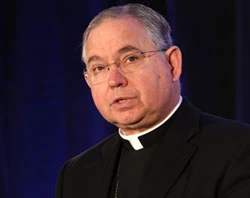
.- At a conference on U.S.-Mexico relations on March 21, Archbishop Jose H. Gomez of Los Angeles explained that the Catholic Church's social teaching can provide essential guidance on the question of immigration, and other dilemmas presented by a globalized economy.

The Mexican-born archbishop, who is also a U.S. citizen, addressed participants gathered at the Catholic University of America in Washington, D.C. for a conference on the Church's role in the immigration debate.

He encouraged audience members – including Mexico's ambassador to the U.S., Arturo Sarukhan, and the U.S. Assistant Secretary of State Eric Schwartz – to consider both the large-scale economic factors driving immigration, and the rights and needs of individuals caught up in these economic changes.

“Globalization has expanded opportunities for businesses and for workers,” Archbishop Gomez acknowledged. “But it has also created new problems in the relationships between our nations.”

“The biggest problem is that while we have developed laws and policies to govern the flow of capital and money, we have no standards for the movement of laborers.”

“Money, capital, and other resources now flow more freely between our nations,” he noted. “But human beings — the men and women who do the work — cannot.”

Archbishop Gomez also spoke frankly about the need to deal realistically and humanely with the reality of unauthorized immigration.

He emphasized that he was interested in the immigration question not primarily as a matter of politics or diplomacy, but as a spiritual and moral issue affecting millions of people.

“I am not a politician or a diplomat or an expert in the global economy,” said the archbishop. “My concern is to be faithful to the Gospel of Jesus Christ, and to defend and promote the dignity of the human person who is made in the image of God.”

He spoke eloquently of the spiritual toll that immigration often takes on those who lack opportunities in their homeland but are exploited or even hated in their new country.

“It gets harder every day to hold onto your cultural identity, your moral compass, your religion, your dignity,” he observed. “You start to believe what people say about you — that you are no good.”

Archbishop Gomez went on to propose a series of measures to address the root causes of immigration, while respecting the human needs and rights of those who have entered the U.S. illegally.

Many aspects of the problem, the archbishop said, arose from underdevelopment within Mexico – a problem that has no instantaneous solution, but demands urgent action.

“We need to find ways to target economic development,” he said, “so that far fewer Mexicans will feel compelled to leave their homes to seek jobs and money in other countries.”

Archbishop Gomez also indicated that the prosperity of nations and transnational corporations must not be placed above the good of the individuals who make such prosperity possible. He strongly urged his fellow U.S. Catholics to consider the human dignity of immigrants, even as they seek to ensure the rule of law.

“Our current policies of enforcement — detentions, and deportations — are a humanitarian tragedy,” he stated. “We are destroying families in the name of enforcing our laws.”

He pointed out that a nation's immigration laws, however important, could not be given absolute priority over the bonds of family – which precede the state itself, according to the natural law.

“Practically speaking,” he stated, “I would like to see a moratorium on new state and local immigration legislation. And, as the U.S. bishops have called for, I would like to see an end to the severe deportation policies.”

Archbishop Gomez also noted that children and women are the “most vulnerable migrants,” who “often fall prey to unscrupulous traffickers” and others seeking to exploit or harm them. He urged policymakers to consider the safety of these populations, and also to remember the needs of all immigrants who are seeking to be reunited with family members by attaining a U.S. visa.

“All of these measures,” said the archbishop, “would make a real difference in the lives of millions of people.

“But they are only temporary,” he noted. “We need to muster the political will to fix our broken immigration system.”

Wednesday, January 12, 2011

Venezuelan Bishops Defy Chavez

This article comes from the Washington Post.
----------------------------------

Catholic leaders warn of 'totalitarian' Venezuela

CARACAS, Venezuela -- Roman Catholic leaders in Venezuela are calling for President Hugo Chavez to give up special lawmaking powers granted to him by his congressional allies.

The Venezuelan Bishops' Conference condemned a package of laws approved last month by the National Assembly, including one that grants Chavez power to enact laws by decree for the next 18 months. Chavez gained those powers shortly before a new congress took office with more opposition lawmakers.

A statement from the bishops released Tuesday accuses Chavez of trying to impose a totalitarian system in Venezuela.

Chavez and the bishops have feuded for years. Chavez has accused the Catholic leadership of neglecting the poor and of siding with his opponents and the rich.

Honduran Cardinal Receives Death Threats After Coup


See this post and others in the LATIN AMERICA category for background on this story.

This article comes from the Catholic News Agency.
----------------------------


.- Cardinal Oscar Rodriguez Maradiaga of Tegucigalpa, Honduras recently stated he has been the target of death threats since 2009. He believes the threats are from supporters of the country's deposed President Manuel Zelaya.

President Zelaya was removed from office in June 2009 and was replaced by an interim leader until elections were held. Current Honduran President Porfirio Lobo Sosa was then voted into office.

Zelaya's opponents assert he was impeached by order of the Supreme Court of Honduras for serious crimes, including treason. His supporters argue he was illegally expelled by the military and the high court.

Cardinal Rodriguez Maradiaga stated on Jan. 6 that he has been receiving death threats from individuals who have labeled him a “supporter of the coup.” The cardinal then told Honduras' Channel 10 that soon after the Honduran bishops’ conference issued a statement about the intentions of then-President Zelaya to hold a referendum to draft a new constitution, he “had already become the target of death threats.”

He added that the threats “have been continuous” since June 2009.

“We had all of the pertinent information,” Cardinal Maradiaga said, “and we issued a statement which I read as president on Saturday,” the day before Zelaya was removed from office.

Tuesday, January 11, 2011

Venezuelan Bishop Criticizes Gov't Land Takings


Thus continues the Vatican's confrontational policy with President Hugo Chavez.  It is almost certain that the United States is supporting this policy behind the scenes.

This article comes from Catholic News Agency.
---------------------------

Venezuelan cardinal: Government land seizure become serious issue

.- Cardinal Jorge Urosa Savino of Caracas, Venezuela warned that some of the government's recent land seizures have not followed procedures outlined in the country's Constitution.

“While it is true that the government has the power to confiscate, it must do so by following the procedures established in the Constitution,” the cardinal said after Mass for the World Day of Peace on Jan. 9. He noted that “this is not happening in some cases.”

Cardinal Urosa acknowledged that there is a great demand for more housing in the country, but that the need – which sharply increased due to the recent flooding – “is not going to be resolved in six months.” 

“The interests and rights of all people must be reconciled, and the government should do so justly,” the cardinal asserted.

New excuse?

In the past week, the Venezuelan government has confiscated numerous buildings and plots claiming they will be used for the construction of homes for those affected by the flooding. However, Rafael Alfonzo, a leading financial analyst, called the move a “new excuse” by Hugo Chavez to take over private lands. Chavez alleged that the measures are necessary to protect the food supply, to “rescue” lands from plantation owners, and to prevent monopolies and market speculation.

The Observatory of Property Rights in Venezuela reported that between 2005 and 2010, some 1,729 violations of private property by the government took place, and that during the last year there were 535 cases of confiscation.  The most controversial one involved 2.2 acres of land belonging to the Antimano child nutrition center.  Chavez said the center would now be known as the “Amatina Socialist Community.” 

On his television program “Alo Presidente” on Jan. 9, Chavez ordered the confiscation of land to “accelerate all over the country, especially south of Maracaibo Lake,” where land belonging to the El Delirio and Dinamarca ranches was recently confiscated.

Tuesday, January 4, 2011

Cuban Economic Reforms Get Vatican Nod


This article comes from SAPA.
-----------------------------------------------

Cuba's economic reforms get Catholic nod

After decades of roller-coaster relations between communist Cuba's government and the Roman Catholic church, Havana on Sunday won the Catholic hierarchy's warm approval of its limited economic reform plans. 

Cardinal Jaime Ortega said in a New Year's mass at Havana cathedral that the government reforms “involve all of us” and require “understanding from the people” whom he called on to size up the changes critically. 

The local church is arguably the most influential non-state actor in Cuba. But its influence is more with the government than the people.

In a Caribbean country of more than 11 million, most Cubans do not identify themselves as believers or go to church.

Ortega offered up a prayer “for the successful implementation of this process of renewal for the good of all the people.”

The cardinal's encouraging tone reflected a growing rapprochement between church and state in Cuba since a landmark 1998 visit by pope John Paul II and his call for Cuba to “open itself to the world.”

President Raul Castro, 79, argues that Cuba's economic model, which has survived two decades since the Soviet Union dissolved, must be “updated” urgently without copying other countries, and without what he sees as “capitalism.”

His proposed reforms are up for debate in April at the Cuban Communist Party Congress, the first since 1997.

The reforms, which include eventually cutting more than a million government jobs, represent a major management shakeup for the communist island.

They encourage some new foreign investment, call for more private self-employment and a reduced government role in the market.

The proposals make efficiency a vital part of economic management, aim to do away with state subsidies, including food rations, and foresee starting a tax system.

But the government still would control the lion's share of the economy. Cubans only earn 17 dollars a month on average, most are state employees and most spend hours a day trying to figure out how to put food on the table.

Ortega also has acted as a de facto mediator in the government's release of some of its political prisoners.

The government, officially atheist until 1992, finds itself under mounting pressure to meet its promises to free more.

In early December, female relatives of jailed political dissidents held an unprecedented protest outside Cuban jails, angry that the government has not met its pledge to do so.

Dissident sources say around 100 political prisoners remain in Cuban prisons. - Sapa-AFP

Sunday, December 12, 2010

Analyst Dissects Vatican WikiLeaks Fallout


This article comes from the National Catholic Reporter.
----------------------------------------------------

Sex abuse crisis, Vatican PR woes figure in WikiLeaks scoops

By John L. Allen, Jr.

Secret diplomatic cables revealed this morning as part of the WikiLeaks releases confirm that while the Vatican was appalled by revelations of clerical sexual abuse in Ireland in 2009 and 2010, it was also offended by demands that the papal ambassador participate in a government-sponsored probe, seeing it as an insult to the Vatican’s sovereign immunity under international law.
 
That stance, according to the cable, came off in Ireland as “pettily procedural” while failing to confront the reality of clerical abuse, and thereby made the crisis worse.

The cables also contain critical diplomatic assessments of Pope Benedict XVI’s recent decision to create new structures to welcome disgruntled Anglicans, as well as the perceived technological illiteracy and communications ineptitude of some senior Vatican officials.

PR woes in the Vatican, according to one cable, have lowered the volume on the pope’s “moral megaphone.”

Newly disclosed cables also indicate that:

• The Vatican has expressed desire to resist the influence of Venezuelan Socialist strongman Hugo Chavez across Latin America;

• It agreed to quietly encourage countries to support the Copenhagen accord on climate change, even though the Holy See does not officially take positions on draft agreements;

• It hoped that Poland would act as a bulwark against radical secularism within the European Union, especially by “holding the line” on life and family issues;

• Then-Cardinal Joseph Ratzinger opposed Turkey’s entry into the European Union, but as pope, Benedict XVI has taken an official neutral stance, while continuing to emphasize the importance of Europe’s Christian roots.

While the cables unveiled this morning don’t really contain any surprises about the Vatican itself, they do lift the veil on how American diplomats and their colleagues have viewed various moves by Rome in recent years.

The revelations come mostly in cables from the U.S. Embassy to the Holy See back to the State Department in Washington, often expressing information gleaned from conversations either with church sources or with other diplomats in Rome.

The cables were unveiled in the Dec. 11 issue of the U.K.-based Guardian newspaper.

One 2009 cable, titled “Sex abuse scandal strains Irish-Vatican relations, shakes up Irish church, and poses challenges for the Holy See,” reports on a conversation between Julieta Valls Noyes, the number two official at the U.S. embassy to the Vatican, and her counterparts in the Irish embassy to the Holy See.

Noyes writes that while the Vatican’s first concern was for the victims of abuse, it also felt that requests for its ambassador in Ireland to cooperate with the “Murphy Commission” probe threatened its sovereignty under international law.

The cable reports that the Vatican’s Secretary of State, Cardinal Tarcisio Bertone, ultimately wrote to the Irish Embassy to the Holy See to insist that any requests for information should come through proper diplomatic channels.

That stance, Noyes wrote, produced backlash in Ireland: “Much of the Irish public views the Vatican protests as pettily procedural and failing to confront the real issue of horrific abuse and cover-up by Church officials,” she wrote.

As the Irish situation developed in late 2009 and early 2010, Noyes went on to say, “the normally cautious Vatican moved with uncharacteristic speed to address the internal church crisis,” pointing to a meeting between Pope Benedict and Irish bishops in February 2010, but she also says that contacts both in Ireland and the Vatican expect the crisis “to be protracted over several years.”

In another 2009 cable, Noyes describes a conversation with Francis Campbell, the ambassador of the United Kingdom to the Holy See, about the pope’s decision to create new structures, called “personal ordinariates,” to welcome traditionalist Anglicans upset with liberalizing moves such as the ordination of women and openly gay bishops, and the blessing of same-sex unions.

The move put the Archbishop of Canterbury, Rowan Williams, in an “impossible situation,” according to Campbell, and potentially constituted “the worst crisis in 150 years” in Anglican-Catholic relations.

According to Noyes’ description of the conversation, Campbell warned that the move could unleash latent anti-Catholicism in the United Kingdom, and even provoke acts of violence in isolated cases.

The cable from the U.S. diplomats expressed doubt about “whether the damage to inter-Christian relations was worth it,” especially, it said, “since the number of disaffected Anglicans that will convert is likely to be a trickle rather than a wave.”

Another cable from January 2009 from Noyes, written in the wake of a global controversy provoked by Pope Benedict’s decision to lift the excommunications of four traditionalist Catholic bishops, including one who is a Holocaust denier, said the case revealed a serious “communications gap” in the Vatican.

That gap, according to the cable, leads to “muddled, reactive messaging that reduces the volume of the moral megaphone the Vatican uses to advance its objectives.”

The Vatican spokesperson, Jesuit Fr. Federico Lombardi, is the only senior papal aide to use a Blackberry, according to the cable, and most senior Vatican officials don’t even use e-mail accounts.

Because senior Vatican officials typically do not understand the nature of modern communications, the cable asserted, they often speak in “coded” language impossible for the outside world to decipher. Noyes cited an example from the Israeli ambassador to the Holy See, who said he had been given a letter from the Vatican which supposedly contained a positive message for his country, but it was “so veiled he missed it, even when told it was there.”

Part of the communications problem, the cable asserted, is structural: Lombardi is not part of the pope’s inner circle, so he “is the deliverer, rather than a shaper, of the message,” and he is “terribly overworked.”

In the wider Catholic world, the cable added, there are communications success stories – pointing in particular to the way the Catholic group Opus Dei responded to the frenzy created by the novel and movie “The Da Vinci Code.”

In general, the cable reported there's ferment in the Vatican about the need for better communications strategies, but little concrete sense of what to do about it.

“Our Vatican contacts seem to be talking about nothing but the need for better internal coordination on decisions and planned public messages,” it said. “But if or when change will come remains an open question.”

For the moment, it doesn't seem that today's disclosures are likely to create a diplomatic crisis, especially given that the Vatican announced preemptively that it did not want the WikiLeaks revelations to disrupt U.S./Vatican ties.

For one thing, Vatican officials realize that at least some of the critical assessments expressed in the leaked cables, especially on the PR front, are widely shared inside the Vatican itself. In addition, the Obama White House has tried to send reassuring signals to Rome, including the recent appointment of a presidential delegation to attend the Nov. 20 consistory for the creation of 24 new cardinals. It was the first time a U.S. president sent an official delegation to a consistory, and it was seen in the Vatican as a diplomatic way of expressing respect.

At mid-morning, Lombardi, the Vatican spokesperson, released a statement in both Italian and English on the WikiLeaks disclosures.

"Without venturing to evaluate the extreme seriousness of publishing such a large amount of secret and confidential material, and its possible consequences" the statement read, "the Holy See Press Office observes that part of the documents published recently by Wikileaks concerns reports sent to the U.S. State Department by the U.S. Embassy to the Holy See."

"Naturally these reports reflect the perceptions and opinions of the people who wrote them," the statement said, "and cannot be considered as expressions of the Holy See itself, nor as exact quotations of the words of its officials. Their reliability must, then, be evaluated carefully and with great prudence, bearing this circumstance in mind."

U.S. Ambassador to the Holy See Miguel Diaz likewise issued a statement, condemning the leaks "in the strongest possible terms" while declining to comment on their authenticity.

The United States and the Holy See are working together on multiple fronts, Diaz said, from fixing the global economy to human rights, climate change and interfaith dialogue, and those partnerships "will withstand this challenge."

Saturday, December 4, 2010

US Bishops Pressure Congress on DREAM Act


This press release comes from the USCCB website.
-------------------------------------------------------

U.S. Catholic Bishops to Congress:  The Dream Act is the ‘Right Thing to Do’

WASHINGTON (December 3, 2010)—In a letter to Congress December 2, Coadjutor Archbishop Jose Gomez of Los Angeles, chairman of the United States Conference of Catholic Bishops’ (USCCB) Committee on Migration, called on Congress to pass the Development, Relief, and Education for Alien Minors Act (DREAM), calling it “the right thing to do.”

“With the passage of the DREAM Act, we can welcome a new generation of Americans who will one day become leaders of our nation,” wrote Archbishop Gomez.

The DREAM Act would provide a path to citizenship for thousands of young persons without legal status who were brought to the United States as children by their parents. Under the legislation, young people who complete two years of higher education or two years of military service would be eligible for legal permanent residence and eventual citizenship.

“It is important to note that these young persons entered the United States with their parents at a young age, and therefore did not enter without inspection on their own volition. We would all do the same thing in a similar situation,” Archbishop Gomez said. “They have incredible talent and energy and are awaiting a chance to fully contribute their talents to our nation. We would be foolhardy to deny them that chance.”

The USCCB has long supported the DREAM Act, as well as comprehensive reform of the nation’s immigration system.

“There are times when a proposal should be enacted because, simply put, it is the right thing to do.  This is one of them,” the Archbishop said.  “The DREAM Act represents a practical, fair, and compassionate solution for thousands of young persons who simply want to reach their God-given potential and contribute to the well-being of our nation.”

Full text of the letter follows.

---------------------------------------
December 2, 2010
U.S. House of Representatives
Washington, D.C. 20515
Dear Representative:

On behalf of the United States Conference of Catholic Bishops (USCCB), I write to express our support for the Development, Relief, and Education for Alien Minors Act (DREAM Act).  This legislation would make a difference in the lives of undocumented youth who were brought to the United States by their parents and now, because of their lack of legal status, face obstacles to their future.  By removing such barriers, the DREAM Act permits immigrant students to pursue a promising future through college education or military service.

Those who would benefit from the DREAM Act are talented, intelligent, and dedicated young persons who know only the United States as their home.   They can become some of the future leaders of our country, provided we are wise enough to provide them the opportunity to pursue their dreams. 

Under the DREAM Act, deserving immigrant youth can adjust to permanent resident status provided that they entered the United States before age sixteen, have been physically present in the United States for not less than five years, demonstrated good moral character, have no criminal record and do not threaten national security, and have earned their high school diploma.  This bill also offers students a fair opportunity to earn U.S. citizenship if they commit to and complete at least two years of college or two years of honorable service in the military. 

Importantly, this legislation will apply to students in both public and private education, including those attending Catholic schools.

It is important to note that these young persons entered the United States with their parents at a young age, and therefore did not enter without inspection on their own volition. We would all do the same thing in a similar situation. The United States is the only country that they know.  They have incredible talent and energy and are awaiting a chance to fully contribute their talents to our nation. We would be foolhardy to deny them that chance.
With the passage of the DREAM Act, we can welcome a new generation of Americans who one day will become the leaders of our nation. There are times when a proposal should be enacted because, simply put, it is the right thing to do. This is one of them.

The DREAM Act represents a practical, fair, and compassionate solution for thousands of young persons in our nation who simply want to reach their God-given potential and contribute to the well-being of our nation. I urge you to support this measure and call for its immediate enactment.

Sincerely,
                                                           
Most Reverend Jose H. Gomez
Coadjutor Archbishop of Los Angeles
Chairman, USCCB Committee on Migration

Friday, October 8, 2010

Pope Pushes for Church-State Collaboration

This article comes from Zenit.

----------------------------------------------------

Pope Urges Church-State Collaboration

Says Good of Society Is Only Interest

VATICAN CITY, OCT. 7, 2010 (Zenit.org).- There should be "loyal and respectful collaboration" between the Church and state, Benedict XVI affirmed today in speaking with Chile's new ambassador to the Holy See.

Fernando Zegers Santa Cruz presented his letters of credence to the Pope in the Vatican today, giving the Holy Father an opportunity to speak about the spiritual and human richness of Chile.

The Pontiff also emphasized an appropriate relationship for Church and state, "independent and autonomous each in its own field," but both called "to develop a loyal and respectful collaboration to serve the personal and social vocation of persons themselves."

"In fulfilling her specific mission of proclaiming the Good News of Jesus Christ, the Church seeks to respond to the expectations and questions of men, leaning also on the ethical and anthropological values and principles that are inscribed in human nature," the Holy Father explained.

He continued: "When the Church raises her voice in face of today's great challenges and problems, such as wars, hunger, the extreme poverty of so many, the defense of human life from its conception until its natural end, or the promotion of the family founded on marriage between a man and a woman and the first [entity] responsible for the education of children, it does not act out of individual interests or for principles that can only be perceived by those who profess a specific religious faith.

"Respecting the rules of democratic coexistence, it does so for the good of the whole society and in the name of values that every person can share with his right reasoning."

Closeness to Chile

The Pope expressed his own affection for Chile, saying that despite the geographical distance, he carries the nation "very deep in my heart, and very especially after the terrible earthquake it suffered recently."

"I also do not forget the miners of the Atacama region and their loved ones, for whom I pray fervently," he said.

In this light, the Pontiff lauded the "unity of the Chilean people in face of tragedies, and their very generous and solidary response when suffering intensifies."

He also stressed "the immense effort of the Catholic Church in Chile -- many of whose communities have also been sorely tested by the quake -- which it is carrying out to try to help those most in need."

Fruitful Church

Noting that Zegers Santa Cruz begins his mission to the Holy See in the year in which Chile celebrates the bicentenary of its independence, Benedict XVI also emphasized the role of the Church in the most important events of the country, "as well as in the consolidation of its own national identity, profoundly marked by the Catholic sentiment."

The Gospel, he observed, has produced in the country "abundant fruits of sanctity, of charity, of human promotion, of constant search for peace and coexistence."

In this connection, he also recalled last year's celebration of the 25th anniversary of the signing "of the Treaty of Peace and Friendship with the sister nation Argentina that, with papal mediation, put an end to the southern disagreement."

This "historic agreement" will remain "for future generations as a luminous example of the immense good that peace brings with it, as well as the importance of preserving and nourishing those moral and religious values that constitute the most intimate fabric of the soul of a people."

Above all in the present circumstances, in which "so many challenges must be faced that threaten cultural identity itself," it is important "to favor especially among the youngest a healthy pride, a renewed appreciation and new valuing of their faith, of their history, their culture, their traditions and their artistic wealth, and of that which constitutes the best and richest spiritual and human patrimony of Chile," said the Pope.

"The Chilean people well know," he concluded, "that the Church in that nation collaborates sincerely and effectively, and wishes to continue doing so, in all that contributes to the promotion of the common good, of just progress, and of the peaceful and harmonious coexistence of all those who live in that beautiful land."

Friday, September 10, 2010

Pope to Brazilian Bishops: Fight Protestant Influence


This article comes from Catholic Culture.
-----------------------------------------

Evangelization needed to combat sects in Brazil, Pope tells bishops

Meeting on September 10 with a group of bishops from Brazil, Pope Benedict XVI said that the Catholic Church has always been a crucial part of the Brazilian identity. But that identity is now challenged, he said, by the rapid rise of Evangelical sects. 

The Pope remarked to the Brazilian bishops, who were finishing their ad limina visits to Rome, that Brazil has always been marked by “harmonious coexistence among people from different regions and cultures.” What is remarkable about recent changes in that country, he said, is the growth of influences that were “practically unknown just a few decades ago.” 

The rise of Protestant sects, the Pope continued, testifies to “a widespread thirst for God.” But at the same time, the fact that so many people who were raised as Catholics now seek religious support elsewhere suggests that the evangelization efforts of their Catholic pastors has been “sometimes superficial.” “In this context it is necessary, first and foremost, for the Catholic Church in Brazil to commit to a new evangelisation which spares no efforts in seeking out lapsed Catholics and people who know little or nothing of the evangelical message, bringing them to a personal encounter with the living person of Jesus Christ Who is active in His Church,” the Pope said. 

The Pontiff went on to say that Catholics must recognize the new influence of other Christian groups, and establish an ecumenical dialogue with them. Otherwise, he said, “the lack of unity is a cause of scandal” that inhibits evangelization. He cautioned, too, that true ecumenism should be characterized not by “doctrinal indifference” but by mutual respect and a shared commitment to serve Christ.

Friday, August 20, 2010

Guatemalan Bishop "Unafraid" to Meddle in Politics


This article comes from Spero News.
---------------------------------------------------------------

Cardinal Quezada of Guatemala "unafraid" in the face of economic and political powers

Cardinal Rodolfo Quezada Toruño, who serves as archbishop of Guatemala City and head of the Central American country’s prelates, said during a homily on August 15 “I will continue to be a voice for the voiceless.” This came on the feast of the Assumption of the Blessed Virgin Mary, the patroness of Guatemala. Cardinal Quezada also spoke of the legacy left by his predecessor, Bishop Francisco Marroquín, who defended the “voiceless” aboriginal Mayan Guatemalans who suffered the depredations of the Spanish conquistadores as of the mid-1500s.

The outspoken Quezada was recently criticized on the PorMiFamiliayPorGuate.org (For My Family and Guatemala) website, which said he is “imprudent” for criticizing government dealings that would favor companies such as Canada’s Goldcorp – a mining concern whose operations met with opposition fromn the Interamerican Commission on Human Rights out of concern for possible environmental degradation that would come from further mining of gold and silver. While PorMiFamiliayPorGuate.org argues that exploiting natural resources would improve the lot of all Guatemalans, the archbishop has remained critical. Among the collaborators of the website is Rodolfo “Fito” Paiz Andrade, a Harvard-educated businessman who led a commission on economic development during the administration of President Oscar Berger.

Guatemala is still emerging from the results of a 30 year civil war and comes to grips with what has been described as the greatest gap between rich and poor in Latin America. The Guatemalan military fought against both Marxist inspired guerrillas and democratically-minded reformers from the mid-1950s until 1996. Guatemala’s military became one of the most notorious in the world for its program of scorched earth destruction, especially in the largely Mayan highland region, as well as targeted assassinations of opponents such as Catholic clergy, labor leaders, and politicians. One of the most notorious murders was the assassination of Bishop Juan Jose Gerardi Conedera, an outspoken advocate of human rights, who was murdered in his home in 1998. While there were arrests made, those ultimately responsible remain unknown.

Guatemala remains one of the most violent countries in the world. Murders occur on a daily basis that pit rival criminal organizations against each other and the apparently hapless police forces. In June, a special investigator appointed by the United Nations left the country in disgust having found that there appears to be a lack of political will and organizational ability in the Central American republic to address the wave of murders and kidnappings. Quezada said he was pleased to be the object of such criticism since it confirms that he is accomplishing his work with his flock as did Bishop Marroquín – “a defender of the Indians.”

Cardinal Quezada, known for his sharp sense of humor, noted that if his predecessor Marroquín would have been called “imprudent” by the Spanish conquistadores if newspapers had existed then. It has been five hundred years since the Conquest, said Quezada, but the majority of Guatemalans still lack adequate education and health or worthy employment. He noted that since he is “independent of political, economic, or military powers” he can afford to do as his conscience dictates and denounce injustices, especially those committed against Guatemala’s native peoples. “As long as I have life, I will continue to be ‘imprudent’, as Marroquín was and other archbishops and bishops of Guatemala, four of whom were expelled because they choose to be a ‘voice for the voiceless.” Continuing in the same vein, the outspoken prelate said “I am afraid of no one,” to the applause of the hundreds of people congregated at the Metropolitan Cathedral in Guatemala City.

At the end of his homily, Quezada told those present to share solidarity with the families of those who have fallen victim to violence. He called upon the government of President Alvaro Colom, the scion of a wealthy family, to “stop being useless and take the measures necessary which they are obliged to do to provide us peace, the peace to which we all have a right.”

Martin Barillas is a former US diplomat, who also worked as a democracy advocate and election observer in Latin America.

Friday, August 6, 2010

Cuban Cardinal: All Political Prisoners to be Released


.- Cardinal Jaime Ortega y Alamino, Archbishop of Havana, Cuba, announced at the Knights of Columbus' annual States Dinner that thanks to the mediation of the Catholic Conference of Cuban Bishops, fifty-two prisoners of conscience will be released within three to four months.

Upon receiving the Gaudium et Spes award on the evening of August 3, Cardinal Ortega said that “regardless of the distance, and the differences in our social or political systems, you have been brothers to the Cuban Catholics and have shown us your solidarity.”

The Cuban cardinal especially mentioned the Knights of Columbus' support in the construction of the new San Carlos y San Ambrosio National Seminary in Havana. The seminary is scheduled to open in November and will be able to house 100 seminarians.

Cardinal Ortega also highlighted that lay people have played a significant role in Cuba, “especially in the last 40 years, not only by the work they have carried out in some ministries due to the shortage of priests, but also by the social role they have played within families, at work places, schools and society in general; sometimes they have had to face hardships given the constrains and limitations suffered by believers in past decades.” 

“The laity's role in Cuba is very well-known by the Knights of Columbus, who were present  in my country since the beginning of the Republic in 1902, carrying out  a  fruitful work that has left its imprint on us,” he added.

The cardinal also revealed that “nowadays the situation is more favorable for the action of charity services characteristic of the Knights of Columbus in the Cuban Church,” since “plenty of social works” have become real possibilities and have enabled the Church in Cuba to have a social presence.

The Archbishop of Havana also described a growing phenomenon: “the Mission Houses that gather communities of 60, 70 or even 100 people in family homes. Many times, these communities are looked after by catechist laymen who prepare the faithful to evolve from evangelized communities to Eucharistic communities. In my archdiocese, several of these communities have turned into parishes. Now we must build parish churches.”

“The Church,” Cardinal Ortega explained, “has always been duly interested—in a discreet, direct and non-violent way—in everything related to justice and the common good.”

“Lately,” he informed the Knights, “the Cuban government, responding to our request, has asked us to mediate between the political prisoners' relatives and the government authorities in order to know their proposals. In this way a process began, which has led to the recent announcement  that fifty-two convicts, considered prisoners of conscience by Amnesty International, will be released in a period of three to four months.”

More than 20 of these prisoners have already traveled to Spain.

According to the Cuban cardinal, these discussions with the government “have been unprecedented, and they bring about a  new situation of  social appreciation for our Catholics.  We hope that this process of dialogue, in which we are immerged (sic) now, ends successfully.” 

The Knights of Columbus has previously conferred the Gaudium et Spes award on Catholic leaders such as Blessed Mother Teresa of Calcutta, Cardinal Tarcisio Bertone and the late Cardinal John O'Connor.

Tuesday, August 3, 2010

Venezuelan Prelate Wins Points for Civility


.- After Venezuela's President Hugo Chavez called Cardinal Jorge Urosa of Caracas a "neanderthal" and said that the Pope is not the ambassador of Christ on earth, Cardinal Urosa spoke before the country's National Assembly in a civil and measured way, confounding some lawmakers who predicted he would use aggressive and arrogant language.

The undersecretary of the Venezuelan Bishops’ Conference, Father Jose Gregorio Salazar, stated that “With Cardinal Urosa we have given a great lesson for the National Assembly. They thought he would address them with arrogant and aggressive language. They thought he would be insulted but nothing of the sort happened. We were prepared to speak before country or to do so in private, as happened,” he said.

The undersecretary noted the cardinal reminded lawmakers that “as a Venezuelan, he has to right to voice an opinion, and he made it clear, as St. Augustine said in his time, that with us he is Venezuelan but as pastor of the Church he is a cardinal. We cannot forget that his investiture (as a cardinal) corresponds to the dignity of a prince. And as such he spoke in a spirit of dialogue, with profound civility and absolute respect,” Father Salazar said.

“He reiterated his position with solid arguments and made it clear that he fears God and not men,” the priest continued. “When you pick on a cardinal, you are picking on the Church. The best part of his message was that once more he made it clear that we must treat each equally, whether we support Chavez or the opposition, because in the end we are all Venezuelans,” he added.

Father Salazar also referred to the accords between the Vatican and Venezuela, saying that if President Hugo Chavez wants to do away with funding for the Church’s works, he would be doing her a favor, as “what would happened is what happened recently in Spain, where the citizens are the ones who decide how much they want to voluntarily donate, and the Church’s income has increased every since.”

“Venezuela would have a Church like that of Germany, totally autonomous and strengthened because the faithful would become more aware of their duties as citizens,” the undersecretary said. “More than 90 percent of the country professes to be Catholic, let us support the Church. I am sure we would end up benefiting greatly,” he reasoned, underscoring that it was “the State that assumed the commitment of subsidizing the works, it was not from a request by the Church.”

Father Salazar concluded by reiterating the right of the bishops to voice their opinions on politics in the search for the common good, noting that recent polls show the Church enjoys a 67 percent credibility rating.  “This gives an idea of what the country believes in,” he said.

Mexican Bishops: Arizona Law "Selfish and Irresponsible"


This article comes from the Fides News Service.

Selfish?  I suppose it's too much to ask that a nation safeguard its own well-being.
-----------------------------------------------------------

Arizona immigration law SB 1070: "selfish and irresponsible" say the Bishops of Mexico

Texcoco (Agenzia Fides) – A statement presented by Bishop Víctor René Rodríguez Gómez, Bishop of Texcoco and secretary general of the Catholic Bishops' Conference of Mexico, a copy of the statement was sent to Fides, expresses deep disappointment with regard to the SB 1070 immigration law adopted by the state of Arizona in the south of the United States.
 
The statement expresses solidarity with Mexican citizens who have resided for years in Arizona, gratitude for the noble generosity of the people of the United States who have welcomed immigrants from Mexico and from all over the world for years, and precisely because of this, the Mexican Bishops write “we are disappointed to see, and we firmly condemn, the selfish and irresponsible attitude of certain powerful groups which aim to separate countless families, leaving them to drown in deepest misery and poverty after having made enormous sacrifices and risked their lives in the search for a better life and a future of wellbeing and justice for their children”.
 
The statement continues: “We join our voices with those of all men and women of goodwill calling on Mexican authorities, and Mexican families and parishes to warmly welcome with specific pastoral care, our brothers and sisters forced to retrace their steps.”
 
"We intend to continue our activity to render our people of Mexico, "A Home and a School of Communion", enabling them to be present in faith and prayer. We give them our blessing as Bishops and we commend them to the Heart of God, to His Son Jesus Christ and to Santa Maria de Guadalupe.” Besides the Bishops of Mexico, Catholic Bishops in many other countries of America have harshly criticised the new law in Arizona, including the Bishops of El Salvador (see Fides 26/07/2010), Guatemala (see Fides 18/05/2010), Peru (see Fides 7/05/2010) and also the Bishops of the United States (see Fides 27/04/2010) (CE) (Agenzia Fides, 30/07/2010)

Tuesday, July 27, 2010

Catholic Bishops and the Arizona Immigration Law


This article comes from the National Catholic Register.
-----------------------------------------------------------

Not Preaching to the Choir?

Bishops Struggle to Air Their Views on Immigration

By Joan Frawley Desmond

WASHINGTON — Arizona’s controversial immigration law takes effect July 29 — unless the Obama administration succeeds in blocking it. 

The law is expected to complicate efforts on Capitol Hill to pass comprehensive immigration reform this year — a longtime legislative goal of the U.S. Conference of Catholic Bishops.

But even if the president’s legal challenge is successful, the nation’s Catholic bishops hope Arizona’s plight will be a wake-up call for legislators in Washington, D.C.

“The Arizona law is the result of growing levels of frustration and fear that have developed within the state,” acknowledged Bishop Gerald Kicanas of Tucson, who also serves as the U.S. bishops’ conference’s vice president. “But the bishops of Arizona do not believe this bill is the answer. The real answer is comprehensive immigration policy at the federal level.”

Last week in a Phoenix federal district courthouse, Judge Susan Bolton reviewed sharply opposing arguments by the Justice Department and the state of Arizona. But she has yet to issue a ruling, which could come at any time.

Attorney General Eric Holder hopes to secure a preliminary injunction against Arizona’s S.B. 1070, which he criticizes as both an untenable challenge to the federal government’s traditional role in setting immigration policy and a problem for U.S. foreign policy. If Holder obtains the preliminary injunction, legal experts predict the judge will ultimately strike down the state law.

Arizona’s Republican governor, Jan Brewer, however, contends that the state has been forced to act because federal immigration laws have not been effectively enforced. If the measure stands, it will be a violation of state law to be in the country illegally; police engaged in routine law enforcement will be permitted to investigate the immigration status of anyone they suspect to be in the country illegally.

Whatever the law’s fate, polls confirm its broad popularity, not only in Arizona, but across the country. Support for the law reflects mounting public frustration with the real and perceived issues linked to illegal immigration during a time of economic crisis.

During testimony this month before the House Subcommittee on Immigration, Citizenship, Refugees, Border Security and International Law, Bishop Kicanas argued that voters want real solutions to a “broken” system and that the Arizona law should revitalize the push for immigration reform in the nation’s capital.

“The message is to break the partisan paralysis and act now,” Bishop Kicanas stated in his testimony. “Without congressional action on immigration reform — sooner rather than later — other states will pass similar laws, to the detriment of our nation.”

He added that he witnesses “the human consequences of our broken immigration system in my diocese’s social service programs, hospitals, schools and parishes.”

Political Will?

President Obama signaled his interest in addressing immigration reform in a July 1 speech, but even immigrant-rights groups agree that Capitol Hill isn’t prepared to work out a compromise during an already contentious election year.

“The situation in Arizona has brought national attention to the crisis in the immigration system. But it will be difficult for Congress to act before the election,” said Clarissa Martinez, director of immigration and national campaigns for the National Council of La Raza, an advocacy group for Hispanics in America.

“The administration seems not to be anxious to advance legislation unless there were some assurance that 60 senators would support it,” noted Archbishop Thomas Wenski of Miami, a longtime Catholic leader on immigrant issues. “Unless there would be some action during a ‘lame duck’ session of Congress after the November elections, it seems that we are far away indeed.”

Republican senators say border security must be stepped up before they address divisive issues like legalization for illegal immigrants. But the USCCB’s director of migration policy and public affairs, Kevin Appleby, questions the logic of narrowly focusing on enforcement issues.

“Since 2000, the U.S. government has spent more than $100 billion on immigration enforcement,” Appleby wrote in the July 4 edition of the Register. “During the same period, the number of undocumented persons has grown from 6 million to 12 million, and border communities continue to see drug-related violence. Since 1998, nearly 5,000 migrants have died attempting to cross the American desert.”

“Comprehensive immigration reform, as supported by the U.S. bishops, would help achieve the seemingly incompatible principles of a secure border and a generous immigration policy,” Appleby continued.

The USCCB seeks passage of a number of measures, including an expansion of a path to citizenship for the 12 million undocumented persons in the country and the creation of a new worker program, which would permit unskilled migrant laborers to obtain visas to come to the United States legally and work under certain conditions.

A recent USCCB-sponsored poll concluded that “69% of Catholics supported a path to citizenship for the undocumented, provided they register with the government.”

Prudential Judgments

But the bishops’ support for immigration reform has also sparked considerable debate and a measure of antagonism. Bishops who have used their own Internet blogs to criticize the Arizona law have received a flood of overwhelmingly negative comments.

“Some Catholics, on hearing Catholic bishops speak on social doctrine and social issues, can’t help thinking that the bishops embrace pious visions but avoid real messiness and costs and low probabilities of success,” said Michael Novak, the prominent Catholic thinker and an occasional critic of USCCB policy positions.

“Regarding immigration, there are probably hundreds of legitimate prudential judgments among Catholics about which are the most moral and realistic policies to support,” Novak observed. “Some of these judgments seem a lot less naive than others.”

Asked for his response, Archbishop Wenski acknowledged some “legitimate concerns regarding the rule of law — and so sometimes an immigrant’s ‘illegal status’ does not win him sympathy.”

But the archbishop also suggested that believing Catholics should take the Church’s social teaching to heart. Catholics in America “should not be divided on this issue. And the bishops, in our pastoral letter, ‘Strangers No Longer: Together on the Journey of Hope: A Pastoral Letter Concerning Migration from the Catholic Bishops of Mexico and the United States,’ give clear teaching that good Catholics should be open to receiving.”

The archbishop vowed that Florida’s Catholic bishops would be “vigorously opposed to any attempt to pass a Florida-specific law, as was done in Arizona. Such an attempt would prove, I fear, divisive and counterproductive.”

In Arizona — the “epicenter” of an increasingly volatile immigration debate — Bishop Kicanas has echoed the Church’s consistent concern for the social needs and human rights of migrants.

But the bishop also has looked for opportunities to clarify the USCCB position, disputing common mischaracterizations of the bishops’ stance, and he has initiated public forums where all points of view are aired.

“Some people believe the Church is supporting open borders, but the Church does not support open borders, and it doesn’t support amnesty,” said Bishop Kicanas. “What the bishops are asking and pressing for is an earned pathway to citizenship. Illegal immigrants could come out of the shadows and wait their turn.”

“But we have legitimate policy concerns, like family reunification,” he added. “The Arizona law could force mothers or fathers or young people, who never lived outside this country but do not have proper papers, to leave the United States.”

Earlier this year, Bishop Kicanas presided at the funeral of Rob Krentz, the Arizona rancher whose still unsolved murder fueled support for the Arizona law.

Initial reports suggested that Krentz had been killed by an illegal immigrant, but state law enforcement officials have yet to confirm the identity of the rancher’s assailant.

“Krentz’s murder cries out for justice,” said the bishop, noting that the Church’s stake in the immigration policy debate was not limited to the plight of migrants, but also the plundering of Arizona ranches and the safety of border patrol officials.

“The Church has been criticized for getting involved in politics,” he said. “But it’s actually concerned with public policy — how we live together in a community.”

Joan Frawley Desmond writes from Chevy Chase, Maryland.

Monday, July 12, 2010

Vatican Spokesman on Developments in Cuba


This article comes from Zenit.
-----------------------------------------------------------

Aide: Church Plays Key Role in Dialogue in Cube

Father Lombardi Reflects on Release of 50 Prisoners

VATICAN CITY, JULY 11, 2010 (Zenit.org).- The announcement of the upcoming release of political dissidents in Cuba, an event in which the Church played a vital role, is a significant step for the Caribbean nation, says a Vatican spokesman.

Jesuit Father Federico Lombardi, the director of the Vatican press office, said this in the most recent edition of the weekly Vatican Television program "Octava Dies."

On Wednesday, the Archdiocese of Havana announced the forthcoming release of 52 political prisoners -- five immediately and 47 more in the coming three or four months. Their release is another fruit of mediation by the Church, which already brought the freedom of a paraplegic prisoner and the relocation of 12 others.

The Vatican spokesman said the release of the prisoners, and the end of the hunger strike of journalist Guillermo Fariñas, "is good news from the Caribbean island, which we were expecting for several weeks."

"They are significant signs," he stressed, "that we hope indicate stable progress toward that climate of renewed social and political coexistence that we all hope for the Cuban nation."

"The crucial role in the process of dialogue assumed by Cardinal Ortega Alamino and by Archbishop Dionisio García, president of the bishops' conference, was made possible by the evident fact that the Catholic Church is deeply rooted among the people and is a reliable interpreter of it spirit and expectations."

The Church, he observed, "is not an extrinsic reality, she does not flee in difficult times. She bears sufferings and hopes with dignity and with patience, without servility but also without trying to increase tensions and excite souls. On the other hand, she does so with the continuous effort to open roads to understanding and to dialogue."

"For its part," the Jesuit continued, "the Holy See accompanies and supports the local Church with its spiritual solidarity and with its international authority."

"From John Paul II's trip [to Cuba] to the recent visits of Secretary of State Cardinal Tarcisio Bertone and Archbishop Dominique Mamberti, to the diplomatic contacts in the Vatican on the Cuban situation, the Holy See has always been against the embargo, and therefore solidary with the sufferings of the people, and ready to support every prospect of positive dialogue."

"'May Cuba open to the world and the world to Cuba!' John Paul II exclaimed on his unforgettable trip in 1998," Father Lombardi recalled. "With patience, important progress has been made in this direction. We all hope that the journey will continue."