Showing posts with label Roman Culture. Show all posts

Friday, March 25, 2011

'Courtyard of the Gentiles' Seeks Only to Answer Questions


This article comes from Catholic Culture.
-------------------------------


'Courtyard of Gentiles' aims to address ultimate questions, not prompt conversion

A new Vatican initiative to open dialogue with the secular world, the “Courtyard of the Gentiles,” should not be seen as an effort to convert unbelievers, according to the Vatican official responsible for the venture.

Cardinal Gianfranco Ravasi, the president of the Pontifical Council for Culture, told the French daily La Croix: “Our task is to conduct a discourse on “ultimate realities.” The dialogue, he said, would involve “not only God, the Word, and transcendence, but also—and this is the program for the Courtyard—the great existential questions: life, love, death…”

The Italian prelate said that even thoroughly secularized societies are finding these questions unavoidable. The interest in New Age ideas, magic, and supernatural claims all testify to the abiding importance of these questions, he said. He observed that important writers like Dostoievski, Pascal, Dante, and Nietzsche all ponder the same ultimate questions.

Asked whether the Courtyard of the Gentiles should be seen as a place for evangelization, however, Cardinal Ravasi answered unequivocally: “Certainly not.” He explains:

We are like Paul at the Areopagua in Athens. We say what we believe, before those who do not believe, and those who will listen to us.

Thursday, March 24, 2011

L.A. Archbishop: Immigration Laws Should Conform to Catholic Social Teaching


Catholic social teaching must inform immigration debate, says LA archbishop
 
By Benjamin Mann

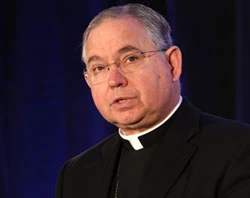
.- At a conference on U.S.-Mexico relations on March 21, Archbishop Jose H. Gomez of Los Angeles explained that the Catholic Church's social teaching can provide essential guidance on the question of immigration, and other dilemmas presented by a globalized economy.

The Mexican-born archbishop, who is also a U.S. citizen, addressed participants gathered at the Catholic University of America in Washington, D.C. for a conference on the Church's role in the immigration debate.

He encouraged audience members – including Mexico's ambassador to the U.S., Arturo Sarukhan, and the U.S. Assistant Secretary of State Eric Schwartz – to consider both the large-scale economic factors driving immigration, and the rights and needs of individuals caught up in these economic changes.

“Globalization has expanded opportunities for businesses and for workers,” Archbishop Gomez acknowledged. “But it has also created new problems in the relationships between our nations.”

“The biggest problem is that while we have developed laws and policies to govern the flow of capital and money, we have no standards for the movement of laborers.”

“Money, capital, and other resources now flow more freely between our nations,” he noted. “But human beings — the men and women who do the work — cannot.”

Archbishop Gomez also spoke frankly about the need to deal realistically and humanely with the reality of unauthorized immigration.

He emphasized that he was interested in the immigration question not primarily as a matter of politics or diplomacy, but as a spiritual and moral issue affecting millions of people.

“I am not a politician or a diplomat or an expert in the global economy,” said the archbishop. “My concern is to be faithful to the Gospel of Jesus Christ, and to defend and promote the dignity of the human person who is made in the image of God.”

He spoke eloquently of the spiritual toll that immigration often takes on those who lack opportunities in their homeland but are exploited or even hated in their new country.

“It gets harder every day to hold onto your cultural identity, your moral compass, your religion, your dignity,” he observed. “You start to believe what people say about you — that you are no good.”

Archbishop Gomez went on to propose a series of measures to address the root causes of immigration, while respecting the human needs and rights of those who have entered the U.S. illegally.

Many aspects of the problem, the archbishop said, arose from underdevelopment within Mexico – a problem that has no instantaneous solution, but demands urgent action.

“We need to find ways to target economic development,” he said, “so that far fewer Mexicans will feel compelled to leave their homes to seek jobs and money in other countries.”

Archbishop Gomez also indicated that the prosperity of nations and transnational corporations must not be placed above the good of the individuals who make such prosperity possible. He strongly urged his fellow U.S. Catholics to consider the human dignity of immigrants, even as they seek to ensure the rule of law.

“Our current policies of enforcement — detentions, and deportations — are a humanitarian tragedy,” he stated. “We are destroying families in the name of enforcing our laws.”

He pointed out that a nation's immigration laws, however important, could not be given absolute priority over the bonds of family – which precede the state itself, according to the natural law.

“Practically speaking,” he stated, “I would like to see a moratorium on new state and local immigration legislation. And, as the U.S. bishops have called for, I would like to see an end to the severe deportation policies.”

Archbishop Gomez also noted that children and women are the “most vulnerable migrants,” who “often fall prey to unscrupulous traffickers” and others seeking to exploit or harm them. He urged policymakers to consider the safety of these populations, and also to remember the needs of all immigrants who are seeking to be reunited with family members by attaining a U.S. visa.

“All of these measures,” said the archbishop, “would make a real difference in the lives of millions of people.

“But they are only temporary,” he noted. “We need to muster the political will to fix our broken immigration system.”

Monday, January 3, 2011

Pope: Europe Must Strengthen Christian (Catholic) Roots


This article comes from the Vatican Information Service blog.
-----------------------------------

Europe Must Strengthen Its Christian Roots

VATICAN CITY, 31 DEC 2010 (VIS) - The Holy Father has sent a Letter to Archbishop Julian Barrio Barrio of Santiago de Compostela, Spain, to marks today's closing of the Compostela Holy Year.

  The people who have made the pilgrimage to Santiago de Compostela during the course of this year "must return to their homes as the disciples of Emmaus returned to Jerusalem", the Pope writes. "We cannot be credible witnesses of God if we fail to collaborate with men and women and to serve them. This service to profound understanding and to the courageous defence of man is an evangelical requirement and an essential contribution that we, as Christians, can make to society".

  Addressing himself in particular to the young, "whom I will have the joy to meet next year in Madrid for World Youth Day", the Pope invites them to let themselves "be attracted by Christ, establishing a frank and serene dialogue with Him and asking themselves: Will the Lord be able to rely on me to be His apostle in the world, to be His messenger of love? May your response not be lacking in generosity, nor in the enthusiasm which led St. James to follow his Master with no concern for the sacrifices involved".

  The Holy Father then goes on to encourage seminarians "to identify themselves increasingly with Jesus, Who calls them to work in His vineyard. The priestly vocation is an admirable gift of which we should be proud, because the world needs people completely dedicated to making Jesus Christ present, shaping their lives and their activities around Him, daily repeating His words and gestures with humility, so as to be His image in the flock entrusted to their care".

  "As I conserve in my heart the recollection of my happy stay in Santiago de Compostela, I ask the Lord that the forgiveness and the aspiration to sanctity which have developed during this Compostela Holy Year may, under the guidance of St. James, help to make the redeeming Word of Jesus Christ present in that particular Church and in all of Spain. May this light", he concludes, "also be perceptible in Europe, as an incessant call to strengthen its Christian roots and thus increase its commitment to solidarity and the defence of man's dignity".

Sunday, December 19, 2010

Benedict Calls for a "New Class of Intellectuals"


This article comes from Zenit.
-----------------------------------------------------


Benedict XVI Calls for New Class of Intellectuals

Delivers Christmas Greeting to Rome's University Students

VATICAN CITY, DEC. 19, 2010 (Zenit.org).- Italy needs "a new class of intellectuals," according to Benedict XVI.

The Pope said this Thursday in his annual pre-Christmas gathering with Rome's university students, held in St. Peter's Basilica. Some 5,000 students and professors from the universities of Rome attended the event, which was begun by John Paul II in 1979. Also present was the Holy Father's vicar for Rome, Cardinal Agostino Cardinal Vallini.

In his homily, Benedict XVI underscored the necessity of profound educational action and a continual discernment, which "must involve the whole academic community, promoting that synthesis between intellectual formation, moral discipline and religious commitment."

"In our times," he stressed, "one sees the need for a new class of intellectuals who are able to interpret social and cultural dynamics and offer solutions that are not abstract but concrete and realistic. The university is called to play this irreplaceable role and the Church is its convinced and active supporter."

At the beginning of the celebration, Renato Lauro, rector of the University of Rome "Tor Vergata," addressed a brief word of greeting to the Pontiff, emphasizing that "believing is not opposed to thinking and intellectual commitment, but it demands it and employs it in a new way with other motivations, as the past 2,000 years of the history of the West have demonstrated through philosophers, theologians, artists and men of science who were profound believers."

In his homily, Benedict XVI invited those presence to fix their gaze upon the stable of Bethlehem and to set out on that path to the Lord who was born to free "the heart from every ferment of intolerance and false expectation," which can always develop if one forgets "that God has already come, he is already at work in our history" and "he asks to be heard."

"Returning there, to that humble and august place, is not a merely ideal journey," he warned, "it is the journey that we are called to take experiencing today God’s nearness and his action that renews and sustains our existence."

"We too must travel to Bethlehem," he encouraged them, "with our gaze turned to God who is patient and faithful, who knows how to wait, who knows how to pause, who knows how to respect the seasons of our existence. That child who we will meet is the full manifestation of the mystery of the love of God, who loves, giving his life, who loves in a disinterested way, who teaches us to love and only asks to be loved."

At the conclusion of the prayer event, a delegation of African university students handed over the icon of Mary Sedes Sapientiae to a group of Spanish students, symbolically initiating the pilgrimage of the icon through all of Spain’s universities ahead of the 26th World Youth Day that will take place in Madrid in August 2011.

Thursday, December 16, 2010

Pope: Religious Freedom the Key to World Peace


This transcript of Pope Benedict XVI's World Day of Peace Message (Jan. 1, 2011) comes from Zenit. It is in Italian, but I will post the English version when I get it.

------------------------------------------------------------------ 

Messaggio di Benedetto XVI per la Giornata Mondiale della Pace 2011

"Libertà religiosa, via per la pace"

CITTA' DEL VATICANO, giovedì, 16 dicembre 2010 (ZENIT.org).- Pubblichiamo di seguito il testo del messaggio del Santo Padre per la 44a Giornata Mondiale della Pace, che si celebrerà il 1° gennaio 2011 sul tema: "Libertà religiosa, via per la pace".

* * *
1. All’inizio di un Nuovo Anno il mio augurio vuole giungere a tutti e a ciascuno; è un augurio di serenità e di prosperità, ma è soprattutto un augurio di pace. Anche l’anno che chiude le porte è stato segnato, purtroppo, dalla persecuzione, dalla discriminazione, da terribili atti di violenza e di intolleranza religiosa.

Il mio pensiero si rivolge in particolare alla cara terra dell'Iraq, che nel suo cammino verso l’auspicata stabilità e riconciliazione continua ad essere scenario di violenze e attentati. Vengono alla memoria le recenti sofferenze della comunità cristiana, e, in modo speciale, il vile attacco contro la Cattedrale siro-cattolica "Nostra Signora del Perpetuo Soccorso" a Baghdad, dove, il 31 ottobre scorso, sono stati uccisi due sacerdoti e più di cinquanta fedeli, mentre erano riuniti per la celebrazione della Santa Messa. Ad esso hanno fatto seguito, nei giorni successivi, altri attacchi, anche a case private, suscitando paura nella comunità cristiana ed il desiderio, da parte di molti dei suoi membri, di emigrare alla ricerca di migliori condizioni di vita. A loro manifesto la mia vicinanza e quella di tutta la Chiesa, sentimento che ha visto una concreta espressione nella recente Assemblea Speciale per il Medio Oriente del Sinodo dei Vescovi. Da tale Assise è giunto un incoraggiamento alle comunità cattoliche in Iraq e in tutto il Medio Oriente a vivere la comunione e a continuare ad offrire una coraggiosa testimonianza di fede in quelle terre.

Ringrazio vivamente i Governi che si adoperano per alleviare le sofferenze di questi fratelli in umanità e invito i Cattolici a pregare per i loro fratelli nella fede che soffrono violenze e intolleranze e ad essere solidali con loro. In tale contesto, ho sentito particolarmente viva l’opportunità di condividere con tutti voi alcune riflessioni sulla libertà religiosa, via per la pace. Infatti, risulta doloroso constatare che in alcune regioni del mondo non è possibile professare ed esprimere liberamente la propria religione, se non a rischio della vita e della libertà personale. In altre regioni vi sono forme più silenziose e sofisticate di pregiudizio e di opposizione verso i credenti e i simboli religiosi. I cristiani sono attualmente il gruppo religioso che soffre il maggior numero di persecuzioni a motivo della propria fede. Tanti subiscono quotidianamente offese e vivono spesso nella paura a causa della loro ricerca della verità, della loro fede in Gesù Cristo e del loro sincero appello perché sia riconosciuta la libertà religiosa. Tutto ciò non può essere accettato, perché costituisce un’offesa a Dio e alla dignità umana; inoltre, è una minaccia alla sicurezza e alla pace e impedisce la realizzazione di un autentico sviluppo umano integrale.1

Nella libertà religiosa, infatti, trova espressione la specificità della persona umana, che per essa può ordinare la propria vita personale e sociale a Dio, alla cui luce si comprendono pienamente l’identità, il senso e il fine della persona. Negare o limitare in maniera arbitraria tale libertà significa coltivare una visione riduttiva della persona umana; oscurare il ruolo pubblico della religione significa generare una società ingiusta, poiché non proporzionata alla vera natura della persona umana; ciò significa rendere impossibile l’affermazione di una pace autentica e duratura di tutta la famiglia umana.

Esorto, dunque, gli uomini e le donne di buona volontà a rinnovare l’impegno per la costruzione di un mondo dove tutti siano liberi di professare la propria religione o la propria fede, e di vivere il proprio amore per Dio con tutto il cuore, con tutta l’anima e con tutta la mente (cfr Mt 22,37). Questo è il sentimento che ispira e guida il Messaggio per la XLIV Giornata Mondiale della Pace, dedicato al tema: Libertà religiosa, via per la pace.

Sacro diritto alla vita e ad una vita spirituale

2. Il diritto alla libertà religiosa è radicato nella stessa dignità della persona umana,2 la cui natura trascendente non deve essere ignorata o trascurata. Dio ha creato l’uomo e la donna a sua immagine e somiglianza (cfr Gen 1,27). Per questo ogni persona è titolare del sacro diritto ad una vita integra anche dal punto di vista spirituale. Senza il riconoscimento del proprio essere spirituale, senza l’apertura al trascendente, la persona umana si ripiega su se stessa, non riesce a trovare risposte agli interrogativi del suo cuore circa il senso della vita e a conquistare valori e principi etici duraturi, e non riesce nemmeno a sperimentare un’autentica libertà e a sviluppare una società giusta.3

La Sacra Scrittura, in sintonia con la nostra stessa esperienza, rivela il valore profondo della dignità umana: "Quando vedo i tuoi cieli, opera delle tue dita, la luna e le stelle che tu hai fissato, che cosa è mai l’uomo perché di lui ti ricordi, il figlio dell’uomo, perché te ne curi? Davvero l’hai fatto poco meno di un dio, di gloria e di onore lo hai coronato. Gli hai dato potere sulle opere delle tue mani, tutto hai posto sotto i suoi piedi" (Sal 8, 4-7).

Dinanzi alla sublime realtà della natura umana, possiamo sperimentare lo stesso stupore espresso dal salmista. Essa si manifesta come apertura al Mistero, come capacità di interrogarsi a fondo su se stessi e sull’origine dell’universo, come intima risonanza dell’Amore supremo di Dio, principio e fine di tutte le cose, di ogni persona e dei popoli.4 La dignità trascendente della persona è un valore essenziale della sapienza giudaico-cristiana, ma, grazie alla ragione, può essere riconosciuta da tutti. Questa dignità, intesa come capacità di trascendere la propria materialità e di ricercare la verità, va riconosciuta come un bene universale, indispensabile per la costruzione di una società orientata alla realizzazione e alla pienezza dell’uomo. Il rispetto di elementi essenziali della dignità dell’uomo, quali il diritto alla vita e il diritto alla libertà religiosa, è una condizione della legittimità morale di ogni norma sociale e giuridica.

Libertà religiosa e rispetto reciproco

3. La libertà religiosa è all’origine della libertà morale. In effetti, l’apertura alla verità e al bene, l’apertura a Dio, radicata nella natura umana, conferisce piena dignità a ciascun uomo ed è garante del pieno rispetto reciproco tra le persone. Pertanto, la libertà religiosa va intesa non solo come immunità dalla coercizione, ma prima ancora come capacità di ordinare le proprie scelte secondo la verità.

Esiste un legame inscindibile tra libertà e rispetto; infatti, "nell’esercitare i propri diritti i singoli esseri umani e i gruppi sociali, in virtù della legge morale, sono tenuti ad avere riguardo tanto ai diritti altrui, quanto ai propri doveri verso gli altri e verso il bene comune".5

Una libertà nemica o indifferente verso Dio finisce col negare se stessa e non garantisce il pieno rispetto dell’altro. Una volontà che si crede radicalmente incapace di ricercare la verità e il bene non ha ragioni oggettive né motivi per agire, se non quelli imposti dai suoi interessi momentanei e contingenti, non ha una "identità" da custodire e costruire attraverso scelte veramente libere e consapevoli. Non può dunque reclamare il rispetto da parte di altre "volontà", anch’esse sganciate dal proprio essere più profondo, che quindi possono far valere altre "ragioni" o addirittura nessuna "ragione". L’illusione di trovare nel relativismo morale la chiave per una pacifica convivenza, è in realtà l’origine della divisione e della negazione della dignità degli esseri umani. Si comprende quindi la necessità di riconoscere una duplice dimensione nell’unità della persona umana: quella religiosa e quella sociale. Al riguardo, è inconcepibile che i credenti "debbano sopprimere una parte di se stessi - la loro fede - per essere cittadini attivi; non dovrebbe mai essere necessario rinnegare Dio per poter godere dei propri diritti".6

La famiglia, scuola di libertà e di pace

4. Se la libertà religiosa è via per la pace, l’educazione religiosa è strada privilegiata per abilitare le nuove generazioni a riconoscere nell’altro il proprio fratello e la propria sorella, con i quali camminare insieme e collaborare perché tutti si sentano membra vive di una stessa famiglia umana, dalla quale nessuno deve essere escluso.

La famiglia fondata sul matrimonio, espressione di unione intima e di complementarietà tra un uomo e una donna, si inserisce in questo contesto come la prima scuola di formazione e di crescita sociale, culturale, morale e spirituale dei figli, che dovrebbero sempre trovare nel padre e nella madre i primi testimoni di una vita orientata alla ricerca della verità e all’amore di Dio. Gli stessi genitori dovrebbero essere sempre liberi di trasmettere senza costrizioni e con responsabilità il proprio patrimonio di fede, di valori e di cultura ai figli. La famiglia, prima cellula della società umana, rimane l’ambito primario di formazione per relazioni armoniose a tutti i livelli di convivenza umana, nazionale e internazionale. Questa è la strada da percorrere sapientemente per la costruzione di un tessuto sociale solido e solidale, per preparare i giovani ad assumere le proprie responsabilità nella vita, in una società libera, in uno spirito di comprensione e di pace.

Un patrimonio comune

5. Si potrebbe dire che, tra i diritti e le libertà fondamentali radicati nella dignità della persona, la libertà religiosa gode di uno statuto speciale. Quando la libertà religiosa è riconosciuta, la dignità della persona umana è rispettata nella sua radice, e si rafforzano l’ethos e le istituzioni dei popoli. Viceversa, quando la libertà religiosa è negata, quando si tenta di impedire di professare la propria religione o la propria fede e di vivere conformemente ad esse, si offende la dignità umana e, insieme, si minacciano la giustizia e la pace, le quali si fondano su quel retto ordine sociale costruito alla luce del Sommo Vero e Sommo Bene.

La libertà religiosa è, in questo senso, anche un’acquisizione di civiltà politica e giuridica. Essa è un bene essenziale: ogni persona deve poter esercitare liberamente il diritto di professare e di manifestare, individualmente o comunitariamente, la propria religione o la propria fede, sia in pubblico che in privato, nell’insegnamento, nelle pratiche, nelle pubblicazioni, nel culto e nell’osservanza dei riti. Non dovrebbe incontrare ostacoli se volesse, eventualmente, aderire ad un’altra religione o non professarne alcuna. In questo ambito, l’ordinamento internazionale risulta emblematico ed è un riferimento essenziale per gli Stati, in quanto non consente alcuna deroga alla libertà religiosa, salvo la legittima esigenza dell’ordine pubblico informato a giustizia.7 L’ordinamento internazionale riconosce così ai diritti di natura religiosa lo stesso status del diritto alla vita e alla libertà personale, a riprova della loro appartenenza al nucleo essenziale dei diritti dell’uomo, a quei diritti universali e naturali che la legge umana non può mai negare.

La libertà religiosa non è patrimonio esclusivo dei credenti, ma dell’intera famiglia dei popoli della terra. È elemento imprescindibile di uno Stato di diritto; non la si può negare senza intaccare nel contempo tutti i diritti e le libertà fondamentali, essendone sintesi e vertice. Essa è "la cartina di tornasole per verificare il rispetto di tutti gli altri diritti umani".8 Mentre favorisce l’esercizio delle facoltà più specificamente umane, crea le premesse necessarie per la realizzazione di uno sviluppo integrale, che riguarda unitariamente la totalità della persona in ogni sua dimensione.9

La dimensione pubblica della religione

6. La libertà religiosa, come ogni libertà, pur muovendo dalla sfera personale, si realizza nella relazione con gli altri. Una libertà senza relazione non è libertà compiuta. Anche la libertà religiosa non si esaurisce nella sola dimensione individuale, ma si attua nella propria comunità e nella società, coerentemente con l’essere relazionale della persona e con la natura pubblica della religione.

La relazionalità è una componente decisiva della libertà religiosa, che spinge le comunità dei credenti a praticare la solidarietà per il bene comune. In questa dimensione comunitaria ciascuna persona resta unica e irripetibile e, al tempo stesso, si completa e si realizza pienamente.

E’ innegabile il contributo che le comunità religiose apportano alla società. Sono numerose le istituzioni caritative e culturali che attestano il ruolo costruttivo dei credenti per la vita sociale. Più importante ancora è il contributo etico della religione nell’ambito politico. Esso non dovrebbe essere marginalizzato o vietato, ma compreso come valido apporto alla promozione del bene comune. In questa prospettiva bisogna menzionare la dimensione religiosa della cultura, tessuta attraverso i secoli grazie ai contributi sociali e soprattutto etici della religione. Tale dimensione non costituisce in nessun modo una discriminazione di coloro che non ne condividono la credenza, ma rafforza, piuttosto, la coesione sociale, l’integrazione e la solidarietà.


Libertà religiosa, forza di libertà e di civiltà:
i pericoli della sua strumentalizzazione

7. La strumentalizzazione della libertà religiosa per mascherare interessi occulti, come ad esempio il sovvertimento dell’ordine costituito, l’accaparramento di risorse o il mantenimento del potere da parte di un gruppo, può provocare danni ingentissimi alle società. Il fanatismo, il fondamentalismo, le pratiche contrarie alla dignità umana, non possono essere mai giustificati e lo possono essere ancora di meno se compiuti in nome della religione. La professione di una religione non può essere strumentalizzata, né imposta con la forza. Bisogna, allora, che gli Stati e le varie comunità umane non dimentichino mai che la libertà religiosa è condizione per la ricerca della verità e la verità non si impone con la violenza ma con "la forza della verità stessa".10 In questo senso, la religione è una forza positiva e propulsiva per la costruzione della società civile e politica.

Come negare il contributo delle grandi religioni del mondo allo sviluppo della civiltà? La sincera ricerca di Dio ha portato ad un maggiore rispetto della dignità dell’uomo. Le comunità cristiane, con il loro patrimonio di valori e principi, hanno fortemente contribuito alla presa di coscienza delle persone e dei popoli circa la propria identità e dignità, nonché alla conquista di istituzioni democratiche e all’affermazione dei diritti dell’uomo e dei suoi corrispettivi doveri.

Anche oggi i cristiani, in una società sempre più globalizzata, sono chiamati, non solo con un responsabile impegno civile, economico e politico, ma anche con la testimonianza della propria carità e fede, ad offrire un contributo prezioso al faticoso ed esaltante impegno per la giustizia, per lo sviluppo umano integrale e per il retto ordinamento delle realtà umane. L’esclusione della religione dalla vita pubblica sottrae a questa uno spazio vitale che apre alla trascendenza. Senza quest’esperienza primaria risulta arduo orientare le società verso principi etici universali e diventa difficile stabilire ordinamenti nazionali e internazionali in cui i diritti e le libertà fondamentali possano essere pienamente riconosciuti e realizzati, come si propongono gli obiettivi - purtroppo ancora disattesi o contraddetti - della Dichiarazione Universale dei diritti dell’uomo del 1948.

Una questione di giustizia e di civiltà:
il fondamentalismo e l’ostilità contro i credenti
pregiudicano la laicità positiva degli Stati


8. La stessa determinazione con la quale sono condannate tutte le forme di fanatismo e di fondamentalismo religioso, deve animare anche l’opposizione a tutte le forme di ostilità contro la religione, che limitano il ruolo pubblico dei credenti nella vita civile e politica.

Non si può dimenticare che il fondamentalismo religioso e il laicismo sono forme speculari ed estreme di rifiuto del legittimo pluralismo e del principio di laicità. Entrambe, infatti, assolutizzano una visione riduttiva e parziale della persona umana, favorendo, nel primo caso, forme di integralismo religioso e, nel secondo, di razionalismo. La società che vuole imporre o, al contrario, negare la religione con la violenza, è ingiusta nei confronti della persona e di Dio, ma anche di se stessa. Dio chiama a sé l’umanità con un disegno di amore che, mentre coinvolge tutta la persona nella sua dimensione naturale e spirituale, richiede di corrispondervi in termini di libertà e di responsabilità, con tutto il cuore e con tutto il proprio essere, individuale e comunitario. Anche la società, dunque, in quanto espressione della persona e dell’insieme delle sue dimensioni costitutive, deve vivere ed organizzarsi in modo da favorirne l’apertura alla trascendenza. Proprio per questo, le leggi e le istituzioni di una società non possono essere configurate ignorando la dimensione religiosa dei cittadini o in modo da prescinderne del tutto. Esse devono commisurarsi - attraverso l’opera democratica di cittadini coscienti della propria alta vocazione - all’essere della persona, per poterlo assecondare nella sua dimensione religiosa. Non essendo questa una creazione dello Stato, non può esserne manipolata, dovendo piuttosto riceverne riconoscimento e rispetto.

L’ordinamento giuridico a tutti i livelli, nazionale e internazionale, quando consente o tollera il fanatismo religioso o antireligioso, viene meno alla sua stessa missione, che consiste nel tutelare e nel promuovere la giustizia e il diritto di ciascuno. Tali realtà non possono essere poste in balia dell’arbitrio del legislatore o della maggioranza, perché, come insegnava già Cicerone, la giustizia consiste in qualcosa di più di un mero atto produttivo della legge e della sua applicazione. Essa implica il riconoscere a ciascuno la sua dignità,11 la quale, senza libertà religiosa, garantita e vissuta nella sua essenza, risulta mutilata e offesa, esposta al rischio di cadere nel predominio degli idoli, di beni relativi trasformati in assoluti. Tutto ciò espone la società al rischio di totalitarismi politici e ideologici, che enfatizzano il potere pubblico, mentre sono mortificate o coartate, quasi fossero concorrenziali, le libertà di coscienza, di pensiero e di religione.

Dialogo tra istituzioni civili e religiose

9. Il patrimonio di principi e di valori espressi da una religiosità autentica è una ricchezza per i popoli e i loro ethos. Esso parla direttamente alla coscienza e alla ragione degli uomini e delle donne, rammenta l’imperativo della conversione morale, motiva a coltivare la pratica delle virtù e ad avvicinarsi l’un l’altro con amore, nel segno della fraternità, come membri della grande famiglia umana.12

Nel rispetto della laicità positiva delle istituzioni statali, la dimensione pubblica della religione deve essere sempre riconosciuta. A tal fine è fondamentale un sano dialogo tra le istituzioni civili e quelle religiose per lo sviluppo integrale della persona umana e dell'armonia della società.

Vivere nell’amore e nella verità

10. Nel mondo globalizzato, caratterizzato da società sempre più multi-etniche e multi-confessionali, le grandi religioni possono costituire un importante fattore di unità e di pace per la famiglia umana. Sulla base delle proprie convinzioni religiose e della ricerca razionale del bene comune, i loro seguaci sono chiamati a vivere con responsabilità il proprio impegno in un contesto di libertà religiosa. Nelle svariate culture religiose, mentre dev’essere rigettato tutto quello che è contro la dignità dell’uomo e della donna, occorre invece fare tesoro di ciò che risulta positivo per la convivenza civile.

Lo spazio pubblico, che la comunità internazionale rende disponibile per le religioni e per la loro proposta di "vita buona", favorisce l’emergere di una misura condivisibile di verità e di bene, come anche un consenso morale, fondamentali per una convivenza giusta e pacifica. I leader delle grandi religioni, per il loro ruolo, la loro influenza e la loro autorità nelle proprie comunità, sono i primi ad essere chiamati al rispetto reciproco e al dialogo.

I cristiani, da parte loro, sono sollecitati dalla stessa fede in Dio, Padre del Signore Gesù Cristo, a vivere come fratelli che si incontrano nella Chiesa e collaborano all’edificazione di un mondo dove le persone e i popoli "non agiranno più iniquamente né saccheggeranno […], perché la conoscenza del Signore riempirà la terra come le acque ricoprono il mare" (Is 11, 9).

Dialogo come ricerca in comune

11. Per la Chiesa il dialogo tra i seguaci di diverse religioni costituisce uno strumento importante per collaborare con tutte le comunità religiose al bene comune. La Chiesa stessa nulla rigetta di quanto è vero e santo nelle varie religioni. "Essa considera con sincero rispetto quei modi di agire e di vivere, quei precetti e quelle dottrine che, quantunque in molti punti differiscano da quanto essa stessa crede e propone, tuttavia non raramente riflettono un raggio di quella verità che illumina tutti gli uomini".13

Quella indicata non è la strada del relativismo, o del sincretismo religioso. La Chiesa, infatti, "annuncia, ed è tenuta ad annunciare, il Cristo che è «via, verità e vita» (Gv 14,6), in cui gli uomini devono trovare la pienezza della vita religiosa e in cui Dio ha riconciliato con se stesso tutte le cose".14 Ciò non esclude tuttavia il dialogo e la ricerca comune della verità in diversi ambiti vitali, poiché, come recita un’espressione usata spesso da san Tommaso d’Aquino, "ogni verità, da chiunque sia detta, proviene dallo Spirito Santo".15

Nel 2011 ricorre il 25° anniversario della Giornata mondiale di preghiera per la pace, convocata ad Assisi nel 1986 dal Venerabile Giovanni Paolo II. In quell’occasione i leader delle grandi religioni del mondo hanno testimoniato come la religione sia un fattore di unione e di pace, e non di divisione e di conflitto. Il ricordo di quell’esperienza è un motivo di speranza per un futuro in cui tutti i credenti si sentano e si rendano autenticamente operatori di giustizia e di pace.

Verità morale nella politica e nella diplomazia

12. La politica e la diplomazia dovrebbero guardare al patrimonio morale e spirituale offerto dalle grandi religioni del mondo per riconoscere e affermare verità, principi e valori universali che non possono essere negati senza negare con essi la dignità della persona umana. Ma che cosa significa, in termini pratici, promuovere la verità morale nel mondo della politica e della diplomazia? Vuol dire agire in maniera responsabile sulla base della conoscenza oggettiva e integrale dei fatti; vuol dire destrutturare ideologie politiche che finiscono per soppiantare la verità e la dignità umana e intendono promuovere pseudo-valori con il pretesto della pace, dello sviluppo e dei diritti umani; vuol dire favorire un impegno costante per fondare la legge positiva sui principi della legge naturale.16 Tutto ciò è necessario e coerente con il rispetto della dignità e del valore della persona umana, sancito dai Popoli della terra nella Carta dell’Organizzazione delle Nazioni Unite del 1945, che presenta valori e principi morali universali di riferimento per le norme, le istituzioni, i sistemi di convivenza a livello nazionale e internazionale.

Oltre l’odio e il pregiudizio

13. Nonostante gli insegnamenti della storia e l’impegno degli Stati, delle Organizzazioni internazionali a livello mondiale e locale, delle Organizzazioni non governative e di tutti gli uomini e le donne di buona volontà che ogni giorno si spendono per la tutela dei diritti e delle libertà fondamentali, nel mondo ancora oggi si registrano persecuzioni, discriminazioni, atti di violenza e di intolleranza basati sulla religione. In particolare, in Asia e in Africa le principali vittime sono i membri delle minoranze religiose, ai quali viene impedito di professare liberamente la propria religione o di cambiarla, attraverso l’intimidazione e la violazione dei diritti, delle libertà fondamentali e dei beni essenziali, giungendo fino alla privazione della libertà personale o della stessa vita.

Vi sono poi - come ho già affermato - forme più sofisticate di ostilità contro la religione, che nei Paesi occidentali si esprimono talvolta col rinnegamento della storia e dei simboli religiosi nei quali si rispecchiano l’identità e la cultura della maggioranza dei cittadini. Esse fomentano spesso l’odio e il pregiudizio e non sono coerenti con una visione serena ed equilibrata del pluralismo e della laicità delle istituzioni, senza contare che le nuove generazioni rischiano di non entrare in contatto con il prezioso patrimonio spirituale dei loro Paesi.

La difesa della religione passa attraverso la difesa dei diritti e delle libertà delle comunità religiose. I leader delle grandi religioni del mondo e i responsabili delle Nazioni rinnovino, allora, l’impegno per la promozione e la tutela della libertà religiosa, in particolare per la difesa delle minoranze religiose, le quali non costituiscono una minaccia contro l’identità della maggioranza, ma sono al contrario un’opportunità per il dialogo e per il reciproco arricchimento culturale. La loro difesa rappresenta la maniera ideale per consolidare lo spirito di benevolenza, di apertura e di reciprocità con cui tutelare i diritti e le libertà fondamentali in tutte le aree e le regioni del mondo.

Libertà religiosa nel mondo

14. Mi rivolgo, infine, alle comunità cristiane che soffrono persecuzioni, discriminazioni, atti di violenza e intolleranza, in particolare in Asia, in Africa, nel Medio Oriente e specialmente nella Terra Santa, luogo prescelto e benedetto da Dio. Mentre rinnovo ad esse il mio affetto paterno e assicuro la mia preghiera, chiedo a tutti i responsabili di agire prontamente per porre fine ad ogni sopruso contro i cristiani, che abitano in quelle regioni. Possano i discepoli di Cristo, dinanzi alle presenti avversità, non perdersi d’animo, perché la testimonianza del Vangelo è e sarà sempre segno di contraddizione.

Meditiamo nel nostro cuore le parole del Signore Gesù: "Beati quelli che sono nel pianto, perché saranno consolati […]. Beati quelli che hanno fame e sete della giustizia, perché saranno saziati [...]. Beati voi quando vi insulteranno, vi perseguiteranno e, mentendo, diranno ogni sorta di male contro di voi per causa mia. Rallegratevi ed esultate, perché grande è la vostra ricompensa nei cieli" (Mt 5,4-12). Rinnoviamo allora "l’impegno da noi assunto all’indulgenza e al perdono, che invochiamo nel Pater noster da Dio, per aver noi stessi posta la condizione e la misura della desiderata misericordia. Infatti, preghiamo così: «Rimetti a noi i nostri debiti, come noi li rimettiamo ai nostri debitori» (Mt 6,12)".17 La violenza non si supera con la violenza. Il nostro grido di dolore sia sempre accompagnato dalla fede, dalla speranza e dalla testimonianza dell’amore di Dio. Esprimo anche il mio auspicio affinché in Occidente, specie in Europa, cessino l’ostilità e i pregiudizi contro i cristiani per il fatto che essi intendono orientare la propria vita in modo coerente ai valori e ai principi espressi nel Vangelo. L’Europa, piuttosto, sappia riconciliarsi con le proprie radici cristiane, che sono fondamentali per comprendere il ruolo che ha avuto, che ha e che intende avere nella storia; saprà, così, sperimentare giustizia, concordia e pace, coltivando un sincero dialogo con tutti i popoli.

Libertà religiosa, via per la pace

15. Il mondo ha bisogno di Dio. Ha bisogno di valori etici e spirituali, universali e condivisi, e la religione può offrire un contributo prezioso nella loro ricerca, per la costruzione di un ordine sociale giusto e pacifico, a livello nazionale e internazionale.

La pace è un dono di Dio e al tempo stesso un progetto da realizzare, mai totalmente compiuto. Una società riconciliata con Dio è più vicina alla pace, che non è semplice assenza di guerra, non è mero frutto del predominio militare o economico, né tantomeno di astuzie ingannatrici o di abili manipolazioni. La pace invece è risultato di un processo di purificazione ed elevazione culturale, morale e spirituale di ogni persona e popolo, nel quale la dignità umana è pienamente rispettata. Invito tutti coloro che desiderano farsi operatori di pace, e soprattutto i giovani, a mettersi in ascolto della propria voce interiore, per trovare in Dio il riferimento stabile per la conquista di un’autentica libertà, la forza inesauribile per orientare il mondo con uno spirito nuovo, capace di non ripetere gli errori del passato. Come insegna il Servo di Dio Paolo VI, alla cui saggezza e lungimiranza si deve l’istituzione della Giornata Mondiale della Pace: "Occorre innanzi tutto dare alla Pace altre armi, che non quelle destinate ad uccidere e a sterminare l'umanità. Occorrono sopra tutto le armi morali, che danno forza e prestigio al diritto internazionale; quelle, per prime, dell’osservanza dei patti".18 La libertà religiosa è un’autentica arma della pace, con una missione storica e profetica. Essa infatti valorizza e mette a frutto le più profonde qualità e potenzialità della persona umana, capaci di cambiare e rendere migliore il mondo. Essa consente di nutrire la speranza verso un futuro di giustizia e di pace, anche dinanzi alle gravi ingiustizie e alle miserie materiali e morali. Che tutti gli uomini e le società ad ogni livello ed in ogni angolo della Terra possano presto sperimentare la libertà religiosa, via per la pace!

Dal Vaticano, 8 dicembre 2010

BENEDICTUS PP XVI
_____________________________
1 Cfr Benedetto XVI, Lett. enc. Caritas in veritate, 29.55-57.
2 Cfr Conc. Ecum. Vat. II, Dichiarazione sulla libertà religiosa Dignitatis humanae, 2.
3 Cfr Benedetto XVI, Lett. enc. Caritas in veritate, 78.
4 Cfr Conc. Ecum. Vat. II, Dichiarazione sulle relazioni della Chiesa con le religioni non cristiane Nostra aetate, 1.
5 Id., Dichiarazione sulla libertà religiosa Dignitatis humanae, 7.
6 Benedetto XVI, Discorso all’Assemblea Generale dell’Organizzazione delle Nazioni Unite (18 aprile 2008): AAS 100 (2008), 337.
7 Cfr Conc. Ecum. Vat. II, Dichiarazione sulla libertà religiosa Dignitatis humanae, 2
8 Giovanni Paolo II, Discorso ai Partecipanti all’Assemblea Parlamentare dell’Organizzazione per la Sicurezza e la Cooperazione in Europa (OSCE) (10 ottobre 2003), 1: AAS 96 (2004), 111.
9 Cfr Benedetto XVI, Lett. enc. Caritas in veritate, 11.
10 Cfr Benedetto XVI, Lett. enc. Caritas in veritate, 11.
11 Cfr Cicerone, De inventione, II, 160.
12 Cfr Benedetto xvi, Discorso ai Rappresentanti di altre Religioni del Regno Unito (17 settembre 2010): L’Osservatore Romano (18 settembre 2010), p. 12.
13 Conc. Ecum. Vat. II, Dichiarazione sulle relazioni della Chiesa con le religioni non cristiane Nostra aetate, 2.
14 Ibidem.
15 Super evangelium Joannis, I, 3.
16 Cfr Benedetto xvi, Discorso alle Autorità civili e al Corpo diplomatico a Cipro (5 giugno 2010): L’Osservatore Romano (6 giugno 2010), p. 8; COMMISSIONE TEOLOGICA INTERNAZIONALE, Alla ricerca di un’etica universale: uno sguardo sulla legge naturale, Città del Vaticano 2009.
17 Paolo VI, Messaggio per la Giornata Mondiale della Pace 1976: AAS 67 (1975), 671.
18 Ibid., p. 668.

Friday, November 19, 2010

Regime Change in the U.S. Bishops' Conference


This article comes from the National Catholic Reporter.
---------------------------------------------------

Shake up in the bishops' conference

The American anti-incumbency mood of 2010 hit the U.S. bishops’ conference this month when the group, for the first time in the history of the modern conference, declined to elect an eligible sitting vice president.

This year’s shakeup, in which New York Archbishop Timothy Dolan defeated Bishop Gerald Kicanas of Tucson, Ariz., is telling in several respects. For starters, the defeat of Kicanas punctuated the end of the “Bernardin era,” a loose designation that honors the approach of the late Cardinal Joseph Bernardin of Chicago. 

Bernardin took a broad and generally progressive outlook on the big cultural issues and employed a conciliatory style within the church. One of the consistent hallmarks of that era was its strong advocacy for those on the margins. At the era’s most robust point during the 1980s and early 1990s, bishops were known to swallow individual disagreements so that the conference could present a unified face, whether toward the wider culture or the Vatican.

The end of the Bernardin era is the fulfillment of the late Pope John Paul II’s wish that the U.S. bishops’ conference’s influence be diminished and that the scope of its concerns be reduced. In recent years, during which a moderate conference has become increasingly conservative, the body has become splintered, often arguing over an agenda dominated by such in-house matters as liturgy and Catholic identity.

Episcopal activity in the public square has been focused almost exclusively on abortion, homosexuality and same-sex marriage.

Just how deeply insular and inward-looking the conference has become was apparent in the fact that the agenda for this year’s meeting, conducted amid the greatest recession since the Great Depression, contained no mention of the poor, the jobless or the state of the economy.
It is impossible to say precisely why the bishops voted as they did, but several explanations emerged in private conversations.

One is that a number of bishops who voted for Kicanas three years ago have since retired, eroding his base of support. Another is that younger bishops resisted the system that automatically elevates the vice president to the top spot. Finally, some said that a number of bishops walked away from Kicanas after victims’ groups accused him of mishandling the case of an abusive seminarian.

If, indeed, some bishops feared getting the new leader tangled up in allegations before he even took over the job, Dolan may provide small consolation. While he did some admirable things when he took over the Milwaukee archdiocese from Archbishop Rembert Weakland, he also faces a bill of particulars on the other side of the equation that groups like Survivors Network of Those Abused by Priests (known as SNAP) and BishopAccountability.org will be only too eager to list for the New York media.

The allegations against Kicanas, hyped just before the election by conservative groups that previously showed little interest in investigating clergy sex abuse, may have provided a convenient shield for those more concerned with ideological purity (Kicanas was viewed as a moderate in the Bernardin tradition) than with accountability.

The “heckler’s veto” against Kicanas, whatever its value in upending him, is one mark of how the conference has been shaped recently by the extremes. Another is the defense the bishops were forced to make of the Catholic Campaign for Human Development, a program that annually gives tangible expression to the heart of the Gospel the church professes. The program has been attacked relentlessly by a tiny, irrational but highly vocal camp of detractors.

In much the same way the Republican Party is paying a price for its courtship of the extremes by now having to deal with the anarchy of the tea party, the bishops are paying a price for their accommodation of some of the most unreasonable elements in the Catholic community. The splash back, they are discovering, can be toxic.

Notable for his absence at this meeting was soon-to-be Cardinal Raymond Burke, who gained distinction for excommunicating people while archbishop in St. Louis. Burke’s appointment to the Vatican’s high court means that he lost his conference vote.

Gone, too, is the mercurial former bishop of Scranton, Pa., Joseph Martino, whose rants against politicians, academics and others alienated a good portion of his diocese. We are left to our own conclusions about why he suddenly “retired” some 12 years ahead of schedule. Some insiders privately claim that the most vociferous and imprudent among the American hierarchy are being isolated and removed from center stage.

If, as Jesuit Fr. Thomas Reese contends, this year’s election was a decision by the bishops to focus on the culture wars, they chose two of the happiest warriors in Dolan, who has a well-earned reputation as a hail-fellow-well-met, and his vice president, Archbishop Joseph Kurtz of Louisville, Ky. Both are amiable men who genuinely like people and are more interested in persuasion than in fighting.

They face two enormous challenges: unifying a conference that has fractured in many ways over the past quarter century and unifying a church that is bleeding members who are deeply suspicious of their leaders.

How Dolan and Kurtz use the relatively small amount of political and public relations capital the conference may yet possess will be important. Being elected leader of the conference at this point in history may be an honor, but it’s no easy path to glory.

Saturday, November 13, 2010

Pope, Curia Discuss Catholicization of Europe/America


This article comes from Catholic Culture.
------------------------------------------------------------

Pope meets with leaders of the Roman Curia

Pope Benedict XVI met on November 12 with the heads of all the major offices of the Roman Curia. Although the Vatican did not announce the purpose of the meeting, informed sources said that the Vatican officials discussed plans for the new Pontifical Council for New Evangelization. 

On October 12, the Pope formally inaugurated the new Pontifical Council, with Archbishop Salvatore (Rino) Fisichella as its president. At that time, Archbishop Fisichella said that concrete plans for the work of the new dicastery were still in a formative stage. 

The creation of the new Pontifical Council, with a broad mandate to promote the faith in Europe and North America, would probably require shifting some lines of responsibility for other offices of the Roman Curia.

Saturday, November 6, 2010

Pope Begins Campaign to Re-Catholicize Europe


This article comes from Zenit.
---------------------------------------------------

Pontiff Tells Europe: God is Not the Enemy

Urges Continent to Meet Christ Without Fear

SANTIAGO DE COMPOSTELA, Spain, NOV. 6, 2010 (Zenit.org).- Benedict XVI is encouraging Europe to let go of the idea that God is an enemy to its freedom, and to open itself to him without fear.

The Pope said this today in the homily he delivered on the occasion of the Compostelian Jubilee Year. The Mass took place in the Plaza del Obradoiro in Santiago de Compostela.

"God exists and he has given us life," the Holy Father affirmed to the thousands present. "He alone is absolute, faithful and unfailing love, that infinite goal that is glimpsed behind the good, the true and the beautiful things of this world, admirable indeed, but insufficient for the human heart. St. Teresa of Jesus understood this when she wrote: 'God alone suffices.'"

The Pontiff lamented that Europe in the 19th century somehow grew convinced that "that God is somehow man's antagonist and an enemy of his freedom," and that there was an "attempt to obscure the true biblical faith."

"God is the origin of our being and the foundation and apex of our freedom, not its opponent," Benedict XVI asserted.

"We need to hear God once again under the skies of Europe," the Pope affirmed. "May this holy word not be spoken in vain, and may it not be put at the service of purposes other than its own. It needs to be spoken in a holy way. And we must hear it in this way in ordinary life, in the silence of work, in brotherly love and in the difficulties that years bring on."

"Europe must open itself to God, must come to meet him without fear," the Pontiff continued, "and work with his grace for that human dignity which was discerned by her best traditions: not only the biblical, at the basis of this order, but also the classical, the medieval and the modern, the matrix from which the great philosophical, literary, cultural and social masterpieces of Europe were born."

Benedict XVI said Europe can look to the cross for guidance. He called it the "supreme sign of love."

"The cross and love, the cross and light," he explained, "have been synonymous in our history because Christ allowed himself to hang there in order to give us the supreme witness of his love, to invite us to forgiveness and reconciliation, to teach us how to overcome evil with good."

The Pontiff urged those present to "learn the lessons of that Christ whom we encounter at the crossroads of our journey and our whole life, in whom God comes forth to meet us as our friend, father and guide."

He added, "Blessed Cross, shine always upon the lands of Europe!"

Dignity

Benedict XVI also spoke of the need to promote the dignity of the person, and warned of "the threats to his dignity resulting from the privation of his essential values and richness, and the marginalization and death visited upon the weakest and the poorest."

"One cannot worship God without taking care of his sons and daughters," he said. "And man cannot be served without asking who his Father is and answering the question about him."

The Pope stated: "The Europe of science and technology, the Europe of civilization and culture, must be at the same time a Europe open to transcendence and fraternity with other continents, and open to the living and true God, starting with the living and true man.

"This is what the Church wishes to contribute to Europe: to be watchful for God and for man, based on the understanding of both which is offered to us in Jesus Christ."

Tuesday, October 5, 2010

Vatican Hosts Conference on Catholic Media


This article comes from the Catholic News Service.
---------------------------------------------------


Vatican meeting looks at mission of Catholic press

By Cindy Wooden

VATICAN CITY (CNS) -- Budget crunches, the availability of free information from the Internet and suspicion about the Catholic Church in the wake of the clerical sex abuse crisis have all combined to present a serious challenge to the future of the Catholic press, said speakers at a Vatican conference.

But the importance of information in Catholics' daily lives and the need for the church to communicate and to help people grow in responsibility and holiness also combine to encourage the Catholic press to find ways to stay afloat, they said.

The "difficult and painful" cases of abuse must lead "the entire believing community to a greater commitment to following the Lord and placing itself at the service of humanity with an even greater witness of life capable of demonstrating what we bear in our hearts," said Archbishop Claudio Maria Celli, president of the Pontifical Council for Social Communications.

Archbishop Celli's office sponsored a Catholic Press Congress Oct. 4-7 to discuss the present and future role and challenges facing Catholic journalism. Representatives from 83 countries gathered at the Vatican for the congress.

The archbishop told the journalists and communications directors that the Catholic press must have a clear idea of its mission and role within the church and society, and must look at how it can help people face their worries and desires in a truly Catholic way.

"Of no less importance," he said, is "the role that the Catholic press has within the church because it can be a privileged instrument in the not easy task of promoting and nourishing an intellectual understanding of the faith."

Greg Erlandson, president of Our Sunday Visitor Publishing in the United States, told the conference that the Catholic press faces the financial pressures all newspapers are facing. But, additionally, he said, the Catholic press suffers because Catholics know less about their faith, there is "a growing distrust of institutions" and, consequently, there is "a resulting decline in Catholic identity."

At the same time, he wrote in remarks prepared for the meeting, the Internet allows Catholic media to reach different audiences in different ways at a relatively low cost.

Erlandson also said the sex abuse crisis is, or should be, forcing the church to change the way it communicates.

"Church leaders have become increasingly aware that most of their flock gets its news about its own church from the secular media and that media is often an unreliable source," he said.

He told the congress he hoped the experience would help church leaders understand the value of the Catholic press and the fact that if they allow Catholic newspapers to be "transparent and honest, they will gain in credibility over the long haul."

Amy Mitchell, vice director of the Pew Research Center's Project for Excellence in Journalism, presented statistics on the decline in U.S. secular newspaper subscriptions and their plummeting advertising revenues, as well as on the fact that people are increasingly "news grazers," getting their news and information from an average of two to five media platforms each day.

In the new media environment, she said, "journalism is not a product, but a service" that gives people verified information.

By serving as a credible eyewitness and pulling together information from reliable sources, she said, journalists help people make sense of the news and empower them to act.

Even as outlets offering free information mushroom, the church -- like society in general -- needs trained journalists able to present accurate news and ask the right questions to help people understand what is going on around them, she told Catholic News Service.

Although the world of journalism has changed enormously over the past 20 years, "the principles of journalism haven't changed. The ideas of verification, authentication, of being transparent with your readers or listeners about the information you know, the information you don't know, about where you're coming from, the influences you have -- all of those remain constant," she said.

"Covering important events from the perspective of a Catholic point of view still involves solid reporting," she said, and Pew surveys have shown that people "really do understand the differences" between the various outlets they access for information. They go to different places for analysis and "sense-making," than for quick takes or entertaining debate, she said.

Michael Pruller, vice director of the Die Presse newspaper company in Austria, was a bit more optimistic about the future of printed news because, he said, "to have something printed in black and white on paper still matters."

While encouraging the Catholic press to look at new opportunities to create revenue with digital products, he said it would be stupid to kill off a Catholic paper "just because you are afraid it's dying."

Although newspapers are making less of a profit than they were 10 years ago, "it's still easier to make money in print than online," he said.

Pruller told the journalists one thing they still have going for them is "the irresistible force of curiosity," which makes people wonder what is in each issue delivered to their home. "Your job is to make your customers curious about what is in each issue," he said.

Friday, October 1, 2010

Pope Pontificates to European Bishops


This article comes from Zenit.
----------------------------------------------------

Pope to European Bishops: Defend Family, Life

Observatory Created on Discrimination Against Christians

ZAGREB, Croatia, SEPT. 30, 2010 (Zenit.org).- Benedict XVI is urging the bishops of Europe to work for the defense of the family and human life, and to fight against intolerance and discrimination of Christians.

The Pope sent a telegram, through his secretary of state, Cardinal Tarcisio Bertone, to participants in a plenary assembly of the Council of European Bishops' Conferences.

The assembly began today in Zagreb, and will focus on the theme, "Demographics and the Family in Europe." It will end Sunday.

In the telegram, the Pontiff encouraged the prelates "to continue the important work undertaken and inspire in the Church communities the necessary commitment so that the faithful might be free from intolerance and discrimination and to promote the family and the defense of human life."

He assured the participants of his prayers "so that the providential meeting may contribute to strengthening the bonds of unity and communion between the European bishops giving a further courageous thrust to the new evangelization of the continent."

The Holy Father imparted "the requested apostolic blessing as a pledge of abundant Divine assistance."

Identity crisis

In his opening speech, Cardinal Peter Erdo, president of the council and archbishop of Esztergom-Budapest, offered an analysis of the situation in Europe.

"Europe, this continent in which many cultures have found the Gospel, and from where so many missionaries have set out to proclaim the Word to the ends of the earth, is today experiencing an identity crisis," he noted.

"Europe needs God," the prelate said, "to recall its own roots and therefore to look to the future with realism and hope."

He noted, however, the challenges faced by Christians who attempt to share their faith with others.

In this light, the cardinal announced the birth of an "Observatory on Intolerance and Discrimination Against Christians in Europe," which aims to "promote greater awareness of the forms of intolerance and discrimination which some Christians in Europe suffer, and in agreement with what was decided in our previous assemblies."

He continued: "This observatory does not aim to be a tool for disputes, but an aid to create a society more respectful of religious freedom, more capable too of understanding and accepting both its own roots and the plural reality through a healthy secularism. 

"In short, it is, on the one hand, a help to modern evangelization, and, on the other, a help to the development of an authentic democracy based on equality in our continent."

Evangelization

Cardinal Erdo underlined "the urgency of the new evangelization," which "has always been [the council's] main aim." He pointed to the Pontifical Council for the Promotion of the New Evangelization, recently established by Benedict XVI, as "a clear sign of the Holy Father's judgement about this urgency."

The prelate noted that "a clear consequence of the unease in our society is also present in the question which we want to tackle in greater depth over these days: demographics and its necessary link to the question of the family."

"The family's state of health is an image of the health of society and vice versa," he added.
The cardinal affirmed that "the family and life are an integral part of God's plan and they are God's way of making us anticipate full communion with him."

He continued, "The beauty of love between a man and a woman, who for the whole of their lives unite and make of their love a gift to also welcome and educate new people, is and will always be the most beautiful image of God."

"The Church calls for policies to be put in place which are appropriate to the real needs of the family and asks that concrete aid measures be always more consistent and effective to the reality of the family," Cardinal Erdo stated.

"However," he added, "perhaps what is missing the most in our society and also in our families, are not solutions for solving immediate problems, even if this can be sometimes necessarily urgent, but above all the enthusiasm is missing, the energy which God gives us if we live in him."

In working for the good of the family, the prelate acknowledged the "great harmony both in the anthropological and in the theological reasons that support the Christian vision of the family and the urgent need to protect it between the Catholic Church and the Orthodox Churches."

He concluded by expressing the hope that this annual meeting of the bishops will be one of "intense reflection" for the good of the family and European society, but also "of prayer and friendship."

Thursday, September 16, 2010

Pope Lands in UK, Meets Queen Elizabeth II


This article comes from Zenit.
------------------------------------------------------

Queen Notes Common Heritage, Concerns of Pope

Stresses Opportunity to Deepen Anglican-Catholic Relations

EDINBURGH, Scotland, SEPT. 16, 2010 (Zenit.org).- Queen Elizabeth II welcomed Benedict XVI to the United Kingdom, affirming the common Christian heritage and global concerns that they share.

The Pope today began his four-day state visit in Edinburgh, with a welcoming ceremony held in the Palace of Holyroodhouse, the summer home of the royal family.

The queen met privately with the Pontiff, after which both ascended to a stage in the palace park to address the 400 political, civil, and church leaders of Scotland gathered there.

In her address, Queen Elizabeth II said to the Holy Father, "Your presence here today reminds us of our common Christian heritage, and of the Christian contribution to the encouragement of world peace, and to the economic and social development of the less prosperous countries of the world."

"In this country," the queen noted, "we deeply appreciate the involvement of the Holy See in the dramatic improvement in the situation in Northern Ireland."

She added that "the Holy See continues to have an important role in international issues, in support of peace and development and in addressing common problems like poverty and climate change."

Queen Elizabeth II acknowledged the Church's "special contribution," particularly "in its ministry to the poorest and most deprived members of society, its care for the homeless and for the education provided by its extensive network of schools."

She underlined "the relationship between the different faiths" as "a fundamental factor in the necessary cooperation within and between nation states."

"I am pleased that your visit will also provide an opportunity to deepen the relationship between the Roman Catholic Church and the established Church of England and the Church of Scotland," the queen said.

She added that it is "vital to encourage a greater mutual and respectful understanding."

International stage

For his part, Benedict XVI also affirmed the role of Britain in this common task of building peace and seeking the common good throughout the world's history.

He spoke about instances such as Britain's intervention "to stop the international slave trade," and the work of women like Florence Nightingale that "set new standards in healthcare."

The Pope pointed out, "Even in our own lifetime, we can recall how Britain and her leaders stood against a Nazi tyranny that wished to eradicate God from society and denied our common humanity to many, especially the Jews, who were thought unfit to live.

He acknowledged the British government's role in Northern Ireland to accomplish "a peaceful resolution of the conflict there."

"Looking abroad, the United Kingdom remains a key figure politically and economically on the international stage," the Pontiff stated.

He noted, "Your forefathers' respect for truth and justice, for mercy and charity come to you from a faith that remains a mighty force for good in your kingdom, to the great benefit of Christians and non-Christians alike."

The Holy Father thanked the authorities and highlighted "the friendly relations existing between the Holy See and the United Kingdom."

This is the first official state visit by a Pope to the United Kingdom, initiated by an invitation of Queen Elizabeth II to Benedict XVI. The last Papal visit took place in 1982, when John Paul II traveled to Britain.

Friday, September 10, 2010

Pope to Brazilian Bishops: Fight Protestant Influence


This article comes from Catholic Culture.
-----------------------------------------

Evangelization needed to combat sects in Brazil, Pope tells bishops

Meeting on September 10 with a group of bishops from Brazil, Pope Benedict XVI said that the Catholic Church has always been a crucial part of the Brazilian identity. But that identity is now challenged, he said, by the rapid rise of Evangelical sects. 

The Pope remarked to the Brazilian bishops, who were finishing their ad limina visits to Rome, that Brazil has always been marked by “harmonious coexistence among people from different regions and cultures.” What is remarkable about recent changes in that country, he said, is the growth of influences that were “practically unknown just a few decades ago.” 

The rise of Protestant sects, the Pope continued, testifies to “a widespread thirst for God.” But at the same time, the fact that so many people who were raised as Catholics now seek religious support elsewhere suggests that the evangelization efforts of their Catholic pastors has been “sometimes superficial.” “In this context it is necessary, first and foremost, for the Catholic Church in Brazil to commit to a new evangelisation which spares no efforts in seeking out lapsed Catholics and people who know little or nothing of the evangelical message, bringing them to a personal encounter with the living person of Jesus Christ Who is active in His Church,” the Pope said. 

The Pontiff went on to say that Catholics must recognize the new influence of other Christian groups, and establish an ecumenical dialogue with them. Otherwise, he said, “the lack of unity is a cause of scandal” that inhibits evangelization. He cautioned, too, that true ecumenism should be characterized not by “doctrinal indifference” but by mutual respect and a shared commitment to serve Christ.

Friday, September 3, 2010

Priest: Muslims Want to Take Over Europe


This article comes from Zenit.
-----------------------------------

Priest: Islam May Fill Europe's Religious Vacuum

ROME, SEPT. 3, 2010 (Zenit.org).- On an official visit to Italy this week, the Libyan chief of state caused a few ripples by stating that Europe should convert to Islam. The general public was perhaps more shocked, however, by his request for a few billion dollars to stop African immigration.

However, a missionary priest did call for taking seriously Muammar al-Qadhafi's statements on religion, saying a European conversion to Islam just might happen if the continent continues denying its Christian roots.

Father Piero Gheddo of the Pontifical Institute for Foreign Missions and founder of the missionary news agency AsiaNews, said that far from being "folklore," al-Qadhafi's summons could become a reality in a few decades.

"The fact is that, as a people, we are becoming ever more pagan and the religious vacuum is inevitably filled by other proposals and religious forces," the priest said.

He observed, "No newspaper -- except Avvenire, the newspaper of the Italian Episcopal Conference -- has seriously taken into consideration how to respond to this challenge of Islam, which sooner or later will conquer the majority in Europe."

Archbishop Robert Sarah, secretary of the Vatican Congregation for the Evangelization of Peoples, classified the Libyan leader's call as a "provocation" and a lack of respect for Italy.

Identity crisis

Father Gheddo stated: "The challenge must be taken seriously. 

"Certainly from a demographic point of view, as it is clear to everyone that Italians are decreasing by 120,000 or 130,000 persons a year because of abortion and broken families; while among the more than 200,000 legal immigrants a year in Italy, more than half are Muslims and Muslim families, which have a much higher level of growth." 

"Newspapers and television programs never speak of this," he added. "However, an answer must be given above all in the religious and cultural fields and in the area of identity."

The priest lamented the "religious vacuum" in the region, observing that "religious practice diminishes in Christian Europe and indifference spreads; Christianity and the Church are attacked." 

Father Gheddo asserted, "If we consider ourselves a Christian country, we should return to the practice of Christian life, which would also solve the problem of empty cradles."